
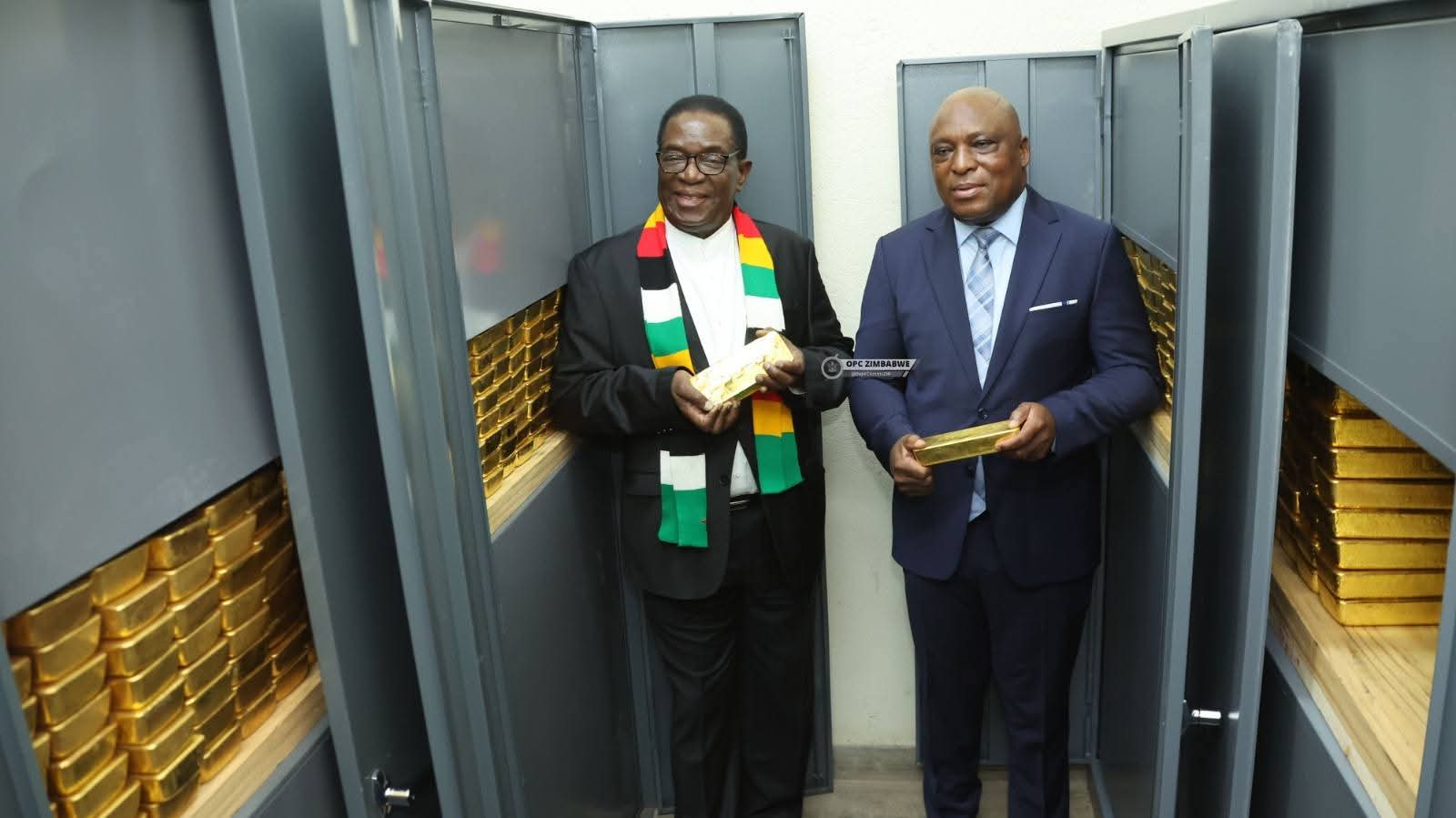
Zimbabwe’s gold reserves have risen beyond four metric tonnes, President Emmerson Mnangagwa said on Monday after personally inspecting bullion and foreign currency holdings stored at the Reserve Bank of Zimbabwe (RBZ), in a move government says strengthens confidence in the gold-backed Zimbabwe Gold (ZiG) currency.
By Advent Shoko
The high-profile visit to the RBZ vaults comes as authorities intensify efforts to stabilise Zimbabwe’s fragile economy, restore trust in the local currency and reduce dependence on the United States dollar, which still dominates most transactions across the country.
“This morning, I inspected the vaults of the Reserve Bank of Zimbabwe to personally verify our national gold and ZiG reserves,” Mnangagwa said.
“I am delighted to report that our strategic initiatives to establish a gold-backed foundation for our economy are producing substantial outcomes.”
Mnangagwa said Zimbabwe now ranks 11th in Africa and third in the Southern African Development Community (SADC) in terms of official gold reserves, describing the stockpile as a key pillar underpinning the country’s monetary sovereignty.
“These reserves are tangible assets that underpin our monetary sovereignty, rather than mere numbers,” he said.
“With over four metric tonnes of gold and foreign currency reserves, our ZiG currency remains fully backed and resilient to global economic shocks.”
ZiG At The Centre Of Zimbabwe’s Economic Reset
The ZiG currency, introduced in April 2024, marked Zimbabwe’s latest attempt to establish a stable domestic currency after years of exchange rate volatility, inflation spikes and repeated currency collapses that eroded public confidence in the financial system.
Unlike previous local currency models, ZiG is backed by physical gold reserves and foreign currency assets held by the central bank, a strategy authorities say is designed to prevent excessive money creation and strengthen market confidence.
The reserve accumulation programme gained momentum after Mnangagwa directed two years ago that mineral royalties, particularly from gold producers, be preserved in physical form rather than immediately converted into cash.
Government believes the policy is now beginning to yield measurable results.
The mining sector has increasingly become the backbone of Zimbabwe’s economy, contributing critical foreign currency inflows at a time when authorities are battling inflationary pressures and liquidity constraints.
Gold remains one of Zimbabwe’s top export earners alongside platinum and lithium, with small-scale miners contributing the majority of annual deliveries.
Analysts say the country’s ability to maintain and expand its reserves could become a defining factor in determining whether ZiG succeeds where previous currencies failed.
Cautious Optimism Amid Long-Standing Currency Challenges
Despite government’s optimism, economists say reserve backing alone may not automatically guarantee long-term currency stability without sustained fiscal discipline, policy consistency and wider public confidence.
Zimbabweans still vividly remember the hyperinflation era and multiple currency transitions that wiped out savings and weakened trust in formal banking systems.
Although authorities have tightened monetary policy and increased efforts to support ZiG in formal markets, the United States dollar continues to dominate the informal sector and major business transactions.
The RBZ has, however, maintained that ZiG’s structure differs fundamentally from previous local currency systems because it is anchored on verifiable reserves rather than speculative value.
Mnangagwa said government is now targeting five metric tonnes of gold reserves by year-end as part of broader efforts to strengthen the economy against global market shocks.
“As we progress toward our goal of five metric tonnes by year-end, we remain committed to fostering a stable, transparent and prosperous economy for all Zimbabweans,” he said.
“Collectively, we are laying the groundwork for a robust future.”
For investors and ordinary citizens alike, the growing reserves may provide a powerful symbol of stability, but the long-term success of ZiG will likely depend on one critical factor, whether Zimbabweans fully regain confidence in holding and transacting in their local currency once again.
Leave a Reply