

After years of complaints from businesses over high licence fees, excessive bureaucracy and costly regulatory hurdles, Zimbabwe has unveiled one of its most aggressive ease-of-doing-business reform packages in recent years, cutting charges and abolishing permits across key sectors of the economy.
By Advent Shoko
The reforms, approved by Cabinet and announced by Finance Minister Mthuli Ncube on Tuesday, target the manufacturing, financial services, property and healthcare sectors in what government says is a broader push to stimulate investment, formalise businesses and accelerate economic growth under Vision 2030.
For many companies struggling with high operating costs, the measures could provide rare relief in an economy where compliance expenses, multiple licences and approval delays have long been blamed for choking productivity and discouraging investment.
“This is the kind of intervention businesses have been asking for over the years,” a Harare-based small-scale manufacturer said after the announcement.
“Sometimes the licences and approvals cost more than the actual business opportunity itself.”
Zimbabwe’s informal sector is estimated to account for a significant share of economic activity, with many small businesses avoiding formal registration due to taxes, fees and administrative burdens. The sector, therefore, constitutes a soft spot for revenue leakage.
Government says the latest reforms are designed to reverse that trend by making regulation more supportive rather than punitive.
In its statement, Treasury said the measures aim to “eliminate administrative bottlenecks, promote business formalisation and ensure that regulatory frameworks are facilitative rather than restrictive.”
Manufacturing Sector Gets Major Relief
Manufacturers emerged among the biggest beneficiaries of the reforms.
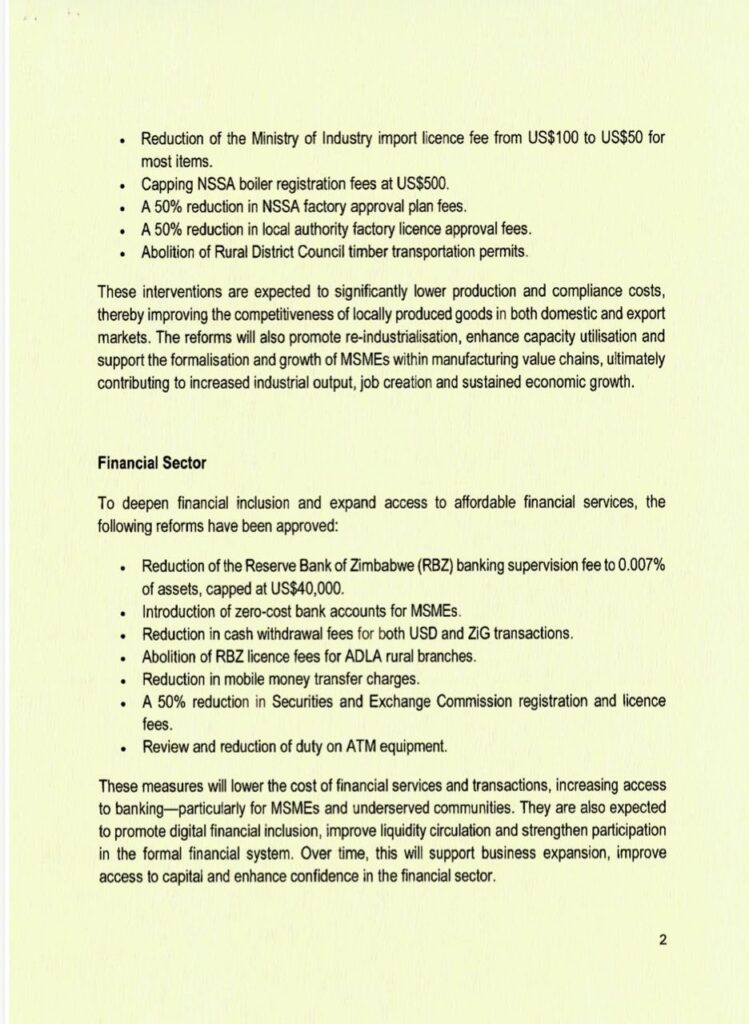
Government reduced the Ministry of Industry import licence fee from US$100 to US$50 for most products, while National Social Security Authority (NSSA) boiler registration fees will now be capped at US$500.
NSSA factory approval plan fees and local authority factory licence approval fees were both cut by 50%.
Authorities also abolished Rural District Council timber transportation permits, a requirement businesses had long criticised as expensive and repetitive.
The reforms could significantly reduce operating costs for manufacturers already battling high electricity tariffs, foreign currency shortages and expensive financing costs.
Industry players have frequently warned that locally produced goods struggle to compete against imports partly because of the cumulative burden of taxes, permits and regulatory charges.
Government believes the measures will improve competitiveness, support re-industrialisation and encourage more small businesses to formalise and expand operations.
The reforms are also expected to strengthen manufacturing value chains, improve capacity utilisation and create jobs.
Banking and Mobile Money Costs Reduced
The financial sector reforms focus heavily on lowering transaction costs and expanding access to affordable banking services.
The Reserve Bank of Zimbabwe’s banking supervision fee was reduced to 0.007% of assets and capped at US$40,000.
Authorities also introduced zero-cost bank accounts for Micro, Small and Medium Enterprises (MSMEs), a move likely to benefit thousands of informal traders and small businesses that have long complained about high bank charges.
Cash withdrawal fees for both US dollar and ZiG transactions are set to decline, while mobile money transfer charges will also be reduced.
Government further abolished Reserve Bank licence fees for ADLA rural branches in a move aimed at improving financial access in underserved communities.
Meanwhile, Securities and Exchange Commission registration and licence fees were cut by 50%, while authorities said duty on ATM equipment would also be reviewed and reduced.
Economists say the measures reflect growing pressure on authorities to address the high cost of transacting in Zimbabwe’s financial system, where businesses and ordinary consumers alike have increasingly shifted toward informal cash dealings to avoid charges.
If implemented effectively, the reforms could improve confidence in the banking sector and encourage broader participation in formal financial systems.
Property Developers Get Regulatory Breakthrough
Zimbabwe’s construction and real estate sector also received significant regulatory relief.
Government announced that local authority building plan approval fees will now be standardised and capped to reduce inconsistencies between councils.
Authorities also abolished certain building permit requirements and removed Environmental Impact Assessment requirements previously imposed by local authorities.
Certificate of occupation fees were cut by 50%, while contractor registration fees charged by councils will now be standardised at US$20 across all categories.
Property developers and contractors have for years complained about lengthy approval processes, unpredictable council charges and overlapping requirements that delayed projects and increased housing costs.
Some developers have previously said project approvals could take months, increasing financing costs and discouraging investment.
Government says the reforms are expected to shorten approval timelines, improve transparency and stimulate growth in construction and related industries.
The measures could also support housing delivery and infrastructure development in rapidly growing urban centres such as Harare and Bulawayo, where demand for accommodation continues to rise.
Healthcare Sector Receives Wide-Ranging Fee Cuts
The healthcare sector saw one of the broadest sets of reforms announced under the package.
Government abolished Health Professions Authority licences for pharmaceutical and manufacturing wholesalers and removed Medicines Control Authority of Zimbabwe pharmacy licence fees.
Licensing fees for hospitals, laboratories and medical service providers were reduced by between 20% and 30%.
Authorities also reduced medicine registration fees and cut pharmaceutical manufacturing licence fees by 25%.
Medical practitioners, nurses, pharmacists and laboratory scientists will benefit from lower registration and practising fees, while Medical and Dental Practitioners Council practising certificate fees for students were abolished completely.
Private hospital approval letter fees were capped at US$100.
Healthcare operators have long argued that rising compliance costs, imported equipment expenses and foreign currency pressures were making it increasingly difficult to run affordable medical services.
Government says the latest reforms are expected to encourage investment in healthcare infrastructure, improve the availability of medicines and support the training and entry of more health professionals into the system.
If successful, the measures could improve access to healthcare services at a time when many Zimbabweans continue to face high treatment costs in both public and private institutions.
Success May Depend on Implementation
Despite the optimism surrounding the reforms, analysts say the real test will be implementation.
Zimbabwe has previously announced investment-friendly reforms that later faced resistance, delays or inconsistent application at local authority and institutional level.
Businesses have often complained that some government agencies continue demanding old fees or creating new administrative requirements even after reforms are announced.
Analysts say authorities will also need to balance deregulation with maintaining standards and oversight, particularly in sensitive sectors such as healthcare, finance and construction.
Still, the scale and breadth of the reforms signal a significant policy shift as government attempts to revive confidence in Zimbabwe’s business environment amid slowing industrial growth, persistent economic pressures and intense competition for regional investment.
Since coming to power in 2017, President Emmerson Mnangagwa has repeatedly declared that ‘Zimbabwe is open for business.’ Critics, however, have long argued that opening the economy without making it easier and cheaper to do business offered little practical value. These latest reforms could now be seen as one of the clearest attempts yet to translate that rhetoric into concrete action.
In his statement, Ncube said government would continue reviewing regulations to ensure they remain responsive to industry needs while promoting innovation and sustainable economic growth.
Whether businesses ultimately experience faster approvals, lower costs and easier operations on the ground may determine if the reforms become a genuine economic turning point, or simply another ambitious policy announcement.
Leave a Reply