
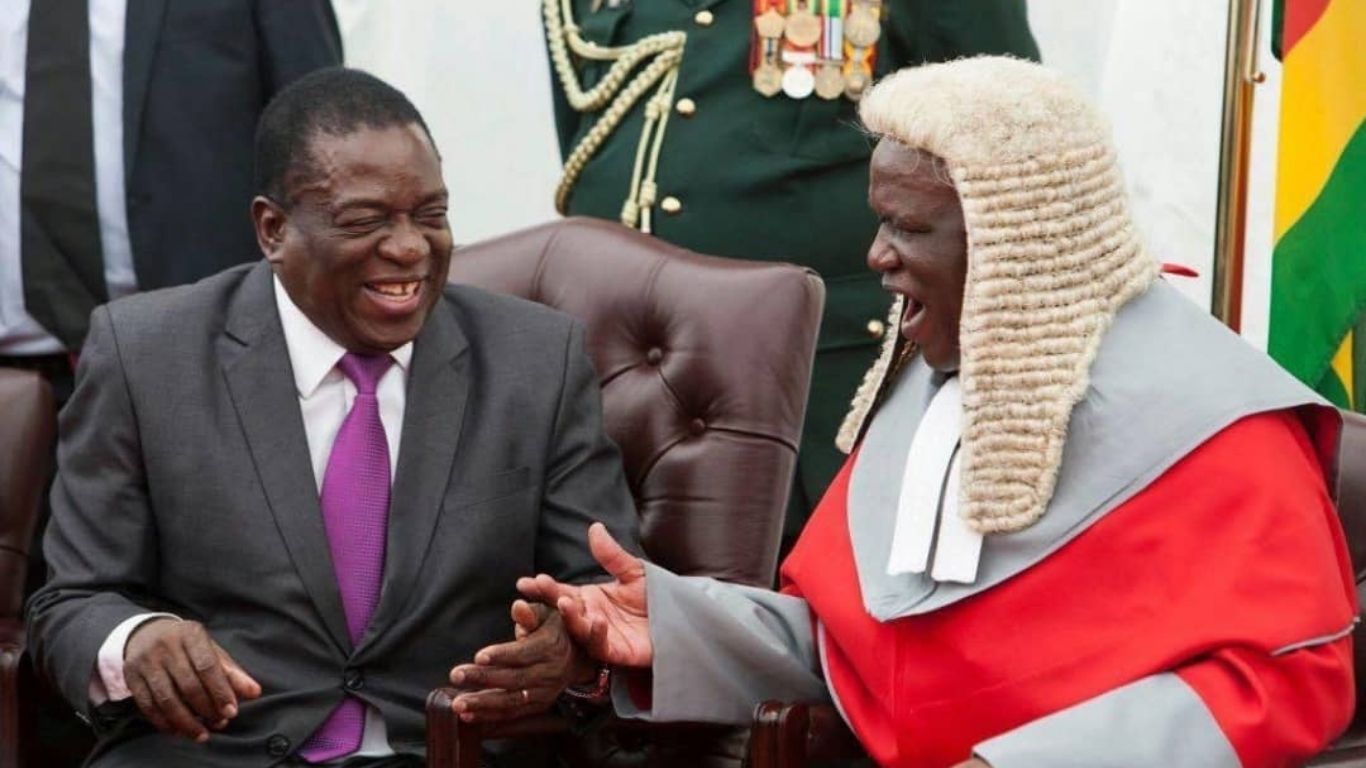
Zimbabwe’s long-serving Chief Justice Luke Malaba has retired leaving behind a deeply divided legacy, with prominent human rights lawyer Beatrice Mtetwa arguing that the public praise surrounding his departure does not reflect private sentiment within the legal profession.
By Advent Shoko
In a detailed analysis of his tenure, Mtetwa says the “gushing and over-effusive praises” that marked Malaba’s retirement contrast sharply with the more critical views held by many legal practitioners, even if those views are not always expressed publicly.
She acknowledges that Malaba is “an above average jurist”, pointing to his earlier judgments before becoming Chief Justice as evidence of strong legal reasoning and constitutional understanding.
- Zimbabwe JSC Confirms Chief Justice Malaba’s Retirement – Why It Matters
- CJ Luke Malaba Steps Down, Leaving A Legacy Of Controversy, Reform And High-Stakes Rulings
- Chamisa: Bad Luck, Poor Strategy Or A Politician Constantly Outmanoeuvred?
Among the most cited is his dissenting opinion in Mawarire v Mugabe N.O & Others (2012), where he delivered a firm and detailed constitutional argument that has often been referenced as an example of his judicial competence.
However, Mtetwa argues that his tenure as Chief Justice did not reflect the same level of constitutional independence displayed in his earlier judicial work.
According to her analysis, expectations that Malaba would usher in a stronger era of constitutionalism following Zimbabwe’s 2013 Constitution were not fully realised. She suggests instead that the judiciary under his leadership became increasingly cautious in politically sensitive matters involving the executive.
Mtetwa further argues that access to constitutional justice became more restrictive during his tenure, citing concerns within the legal profession about procedural controls and internal court practices that, in her view, limited open litigation in constitutional disputes.
She also raises concern over judicial administration practices introduced during his time in office, including what she describes as increased centralisation in judicial processes and reduced space for dissenting judicial opinions.
In her assessment, these developments affected the evolution of Zimbabwe’s jurisprudence, particularly in constitutional interpretation and rights-based litigation.
At the same time, she acknowledges that Malaba presided over notable administrative reforms in the judiciary, including decentralisation of courts and the introduction of electronic case management systems.
These reforms, she notes, improved access to justice in terms of infrastructure and efficiency, but she argues that administrative progress did not always translate into stronger protection of constitutional rights.
“After all, it is the fairness of the system that counts far more than the glitter of infrastructure,” Mtetwa argues, suggesting that efficiency without independence risks undermining justice itself.
Her analysis also reflects on concerns within the legal fraternity regarding judicial independence during Malaba’s tenure, particularly in relation to perceptions of executive influence over constitutional outcomes.
Mtetwa concludes that while Malaba’s retirement has been accompanied by widespread public tributes, a more critical reassessment is necessary to understand the full impact of his leadership on Zimbabwe’s judiciary and constitutional order.
She argues that failure to confront these questions honestly risks shaping future judicial leadership in ways that prioritise praise over institutional accountability.
The debate over Malaba’s legacy, she suggests, remains open and will likely continue shaping discussions on judicial independence in Zimbabwe for years to come.
*****

Beatrice Mtetwa is a prominent Zimbabwean constitutional lawyer known for representing journalists, opposition figures and human rights defenders in high-profile constitutional cases.
Leave a Reply