
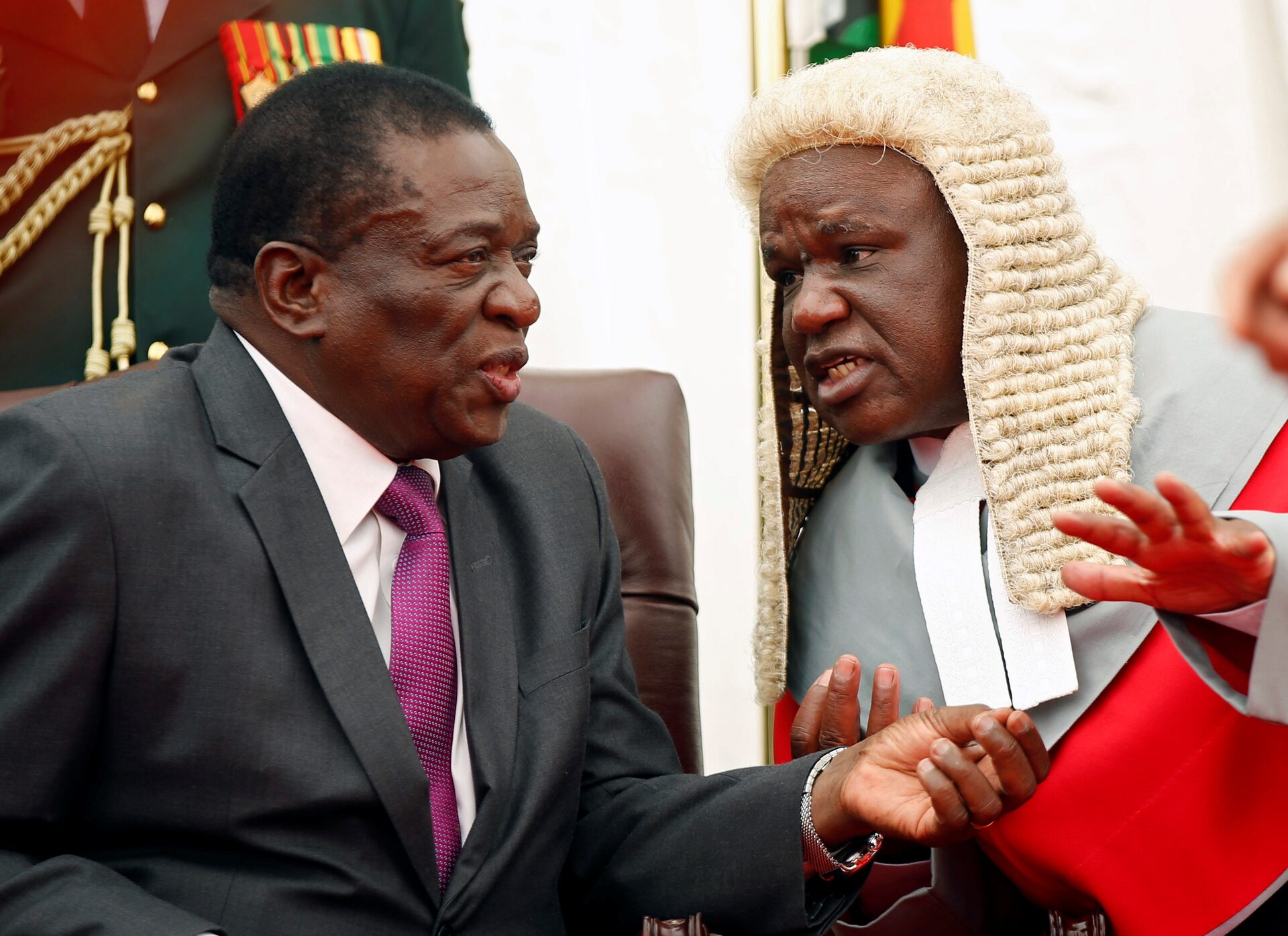
Zimbabwe’s judiciary has entered a new era following the retirement of Luke Malaba, one of the country’s most influential and controversial judicial figures of the modern constitutional era.
By Advent Shoko
Chief Justice Malaba officially stepped down after reaching the mandatory retirement age of 75, bringing to an end a tenure that shaped some of Zimbabwe’s most politically sensitive legal moments.
His retirement comes in line with Section 186(1) of the Constitution of Zimbabwe, which requires judges to retire upon reaching the age of 75 unless an extension is granted under special constitutional provisions.
For many Zimbabweans, Malaba’s departure marks more than the retirement of a senior judge. It closes a chapter defined by constitutional battles, politically charged court rulings and fierce national debate over the independence of the judiciary.
Having served as Chief Justice since 2017, Malaba presided over landmark constitutional cases that placed him at the centre of Zimbabwe’s political and legal discourse.
To supporters, he represented judicial stability and continuity during periods of intense political tension. Critics, however, viewed some of his rulings as evidence of growing proximity between the judiciary and the executive.
Perhaps no case defined his public image more than the televised Constitutional Court challenge that followed Zimbabwe’s disputed 2018 presidential election.
The case captured national attention after former MDC Alliance leader Nelson Chamisa challenged the victory of President Emmerson Mnangagwa, alleging that the Zimbabwe Electoral Commission had manipulated results in favour of the ruling ZANU PF candidate.
Millions watched the Constitutional Court proceedings live on television in what became one of the most dramatic legal moments in Zimbabwe’s recent history.
The hearings featured intense exchanges between judges and lawyers, with advocate Thabani Mpofu, representing Chamisa, dominating headlines with his complex legal arguments and courtroom language that quickly became the subject of public discussion.
Phrases such as “the pith” and “the fulcrum” trended widely on social media as Zimbabweans followed every moment of the proceedings.
In the end, the Constitutional Court unanimously ruled that Chamisa and his legal team had failed to provide sufficient evidence proving electoral fraud, effectively confirming Mnangagwa’s victory.
That judgment cemented Malaba’s place in Zimbabwe’s political history, but it also intensified criticism from opposition supporters and governance analysts who questioned the neutrality of the courts.
The controversy surrounding Malaba deepened further in 2021 after his term was extended beyond the initial retirement threshold through constitutional amendments backed by the government.
The move triggered heated legal and political debate, with critics arguing that the extension undermined judicial independence and created perceptions of executive influence over the courts.
Some legal experts at the time publicly advised Malaba against accepting the extension, warning that it risked overshadowing decades of judicial service and damaging public confidence in the judiciary.
Supporters of the extension, however, argued that continuity at the top of the judiciary was necessary during a politically sensitive period for the country.
Despite the political storms that often surrounded his office, Malaba also oversaw several reforms within Zimbabwe’s judicial system.
Under his leadership, the judiciary accelerated efforts to modernise court operations, improve digital systems and reduce case backlogs. His tenure also saw increased emphasis on virtual court processes and administrative restructuring within the justice system, particularly during and after the COVID-19 pandemic.
Colleagues within the legal profession have frequently described him as disciplined, firm and deeply knowledgeable in constitutional law, even as critics remained sharply divided over some of his most consequential rulings.
His departure now shifts attention to the next Chief Justice and the direction Zimbabwe’s judiciary could take in the coming years.
The succession process is expected to attract intense public and political interest, given the judiciary’s central role in electoral disputes, constitutional interpretation and governance issues.
Whoever takes over will inherit an institution facing growing public scrutiny amid continuing debates about judicial independence, accountability and constitutionalism in Zimbabwe.
For better or worse, Luke Malaba leaves behind a legacy that few judicial figures in Zimbabwe’s history can rival in visibility, influence or controversy.
His name will remain permanently linked to defining moments that shaped the country’s constitutional and political trajectory in the post-Mugabe era.
Leave a Reply