
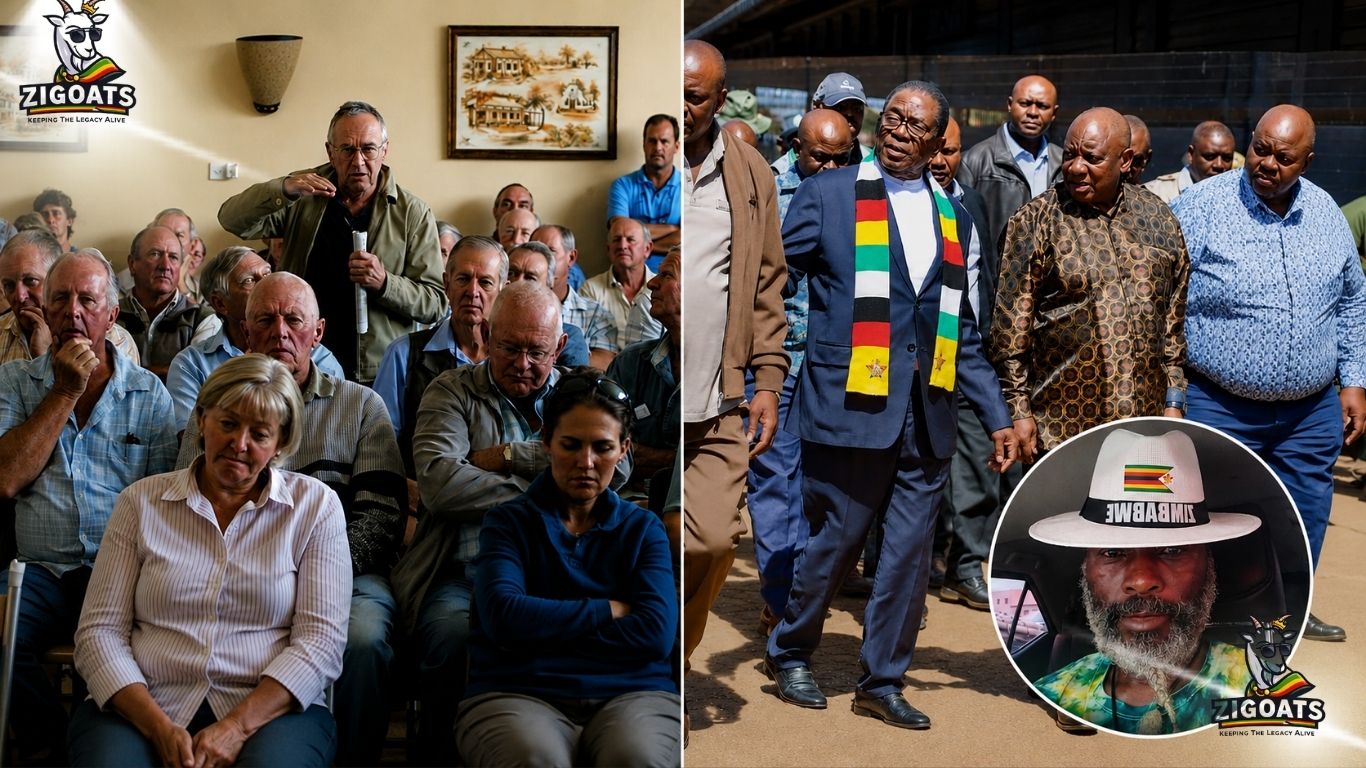
Excerpt: Joshua Maponga has triggered a fierce national debate after suggesting South African President Cyril Ramaphosa’s recent Zimbabwe visit may have been tied to behind-the-scenes negotiations over the return of white-owned farms seized during land reform. His remarks come as Harare moves to hand back 67 farms to European investors, reopening one of Zimbabwe’s most emotionally charged political wounds.
By Advent Shoko
A storm is brewing around Zimbabwe’s land question again, and this time, it is colliding with debt diplomacy, sovereignty, race politics and regional power dynamics all at once.
Zimbabwean Pan-Africanist and former Seventh-day Adventist pastor Joshua Maponga has ignited intense debate after suggesting that South African President Cyril Ramaphosa’s recent visit to Zimbabwe may have been linked to efforts to facilitate the return of white-owned farms seized during the country’s fast-track land reform programme.
The remarks have landed at a highly sensitive moment for President Emmerson Mnangagwa’s administration, which recently confirmed it is moving to return 67 farms to European investors protected under bilateral investment agreements.
To government officials, the move is a legal and diplomatic obligation designed to restore confidence in Zimbabwe’s investment climate.
To critics like Maponga, it signals something far deeper, a possible political retreat on one of the defining ideological battles of post-independence Zimbabwe.
And across social media, political circles and liberation war conversations, emotions are rapidly intensifying.
Maponga, known for his outspoken Pan-African views and anti-colonial rhetoric, questioned both the timing of Ramaphosa’s visit and the government’s handling of the issue. Maponga said:
“I stand corrected… the visit of Ramaphosa was a Stellenbosch assignment.
The relatives of the white farmers who were chased from Zimbabwe are related to Stellenbosch and Ramaphosa was sent here to negotiate their return.”
Although he presented the remarks as opinion rather than confirmed fact, the comments immediately resonated with a section of Zimbabweans who fear the country is being pushed into policy concessions under economic pressure.
Ramaphosa recently visited Zimbabwe during a private engagement hosted by Mnangagwa at his Precabe Farm in Kwekwe.
Neither government publicly disclosed the full details of the discussions held during the visit.
That silence has now become fertile ground for speculation.
The controversy exploded further after Agriculture Minister Anxious Masuka confirmed in Parliament that Zimbabwe was already processing the return of 67 farms covered under bilateral investment protection agreements involving European countries including Germany, Switzerland, Denmark and the Netherlands.
“We are in the process of returning those to them,” Masuka told lawmakers during a televised Question and Answer session.
While officials insist the farms fall under protected investment agreements signed before the land seizures, politically the distinction may not matter.
In Zimbabwe, land has never been just about agriculture.
It is history. It is identity. It is liberation politics. It is power.
The fast-track land reform programme launched around 2000 transformed Zimbabwe forever.
At independence in 1980, most fertile commercial farmland remained concentrated in white ownership despite the end of colonial rule. The Mugabe government later accelerated compulsory land acquisition, arguing it was correcting colonial imbalances that had dispossessed black Zimbabweans for generations.
But the consequences were enormous.
Commercial agricultural production collapsed across key sectors. Investor confidence evaporated. Food insecurity deepened. International isolation intensified. Hyperinflation exploded into one of the worst economic crises seen anywhere in the world during the 2000s.
Even today, Zimbabwe continues to battle the economic scars left by that collapse.
Now, more than two decades later, Mnangagwa’s government is attempting something politically delicate: convincing international creditors that Zimbabwe respects property rights without appearing to abandon the liberation-era principles that helped shape ZANU PF’s political identity.
That balancing act is becoming increasingly difficult.
Zimbabwe remains burdened by an external debt estimated at more than US$13 billion and continues to struggle for full re-engagement with international lenders and global financial institutions.
For creditors and investors, unresolved land disputes remain one of the biggest red flags.
For many ordinary Zimbabweans, however, the issue is emotional before it is economic.
Maponga tapped directly into that frustration.
“Why do whites deserve land when I have not received land?” he asked.
“Why does a citizen of Britain have priority before me?”
In another emotionally charged remark, he accused Western countries of continuing to exercise influence over African governments through economic pressure.
“You will give them your house, your land, your mother and child, they will still demand more,” he said.
Yet even within his criticism, Maponga acknowledged one uncomfortable reality haunting Zimbabwe’s land reform legacy.
“The farms are idle,” he admitted.
“They were given to comrades, not farmers.”
That statement reflects growing concern even among some defenders of land reform that political patronage, lack of agricultural financing, insecure land tenure systems and underutilisation of redistributed farms have weakened productivity in parts of Zimbabwe’s agricultural sector.
Analysts say the government now faces a painful contradiction.
The same land reform programme that became central to correcting colonial injustices also disrupted the agricultural backbone that once earned Zimbabwe its “breadbasket of Africa” reputation.
And the attempt to stabilise the economy may now require Harare to rebuild trust with the very Western financial system it once fiercely resisted.
Maponga also criticised the government for allegedly failing to openly consult citizens before making such a significant national decision.
“This issue has not gone to Parliament, not debated by the nation, no referendum,” he said.
“To decide on our land without us?”
For Mnangagwa, the political risks are enormous.
Moving too slowly on compensation and property disputes could prolong Zimbabwe’s financial isolation and frustrate debt restructuring efforts.
Moving too aggressively toward restitution could trigger backlash from liberation war loyalists and nationalist supporters who view any concession on land as ideological surrender.
That tension is now defining Zimbabwe’s next political chapter.
What began as a technical discussion around bilateral investment agreements is rapidly evolving into a national debate about sovereignty, economic desperation, historical justice and the true cost of re-engagement with the West.
For some, the return of the 67 farms represents pragmatic diplomacy necessary for economic recovery.
For others, it represents the beginning of a dangerous reversal.
And as the debate grows louder, one reality remains impossible to ignore:
More than two decades after the land reform programme shook Zimbabwe and the world, the land question still has the power to divide the nation, reshape politics and reopen the deepest wounds of its history.
Leave a Reply