
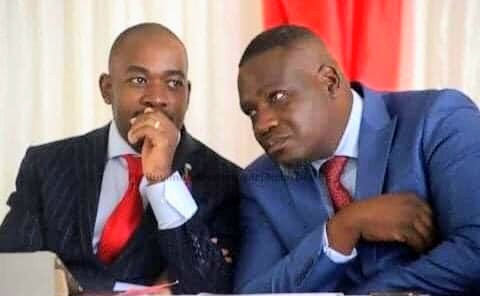
By AAdvent Shoko
Former Citizens Coalition for Change (CCC) secretary-general Chalton Hwende says one of the biggest mistakes of his political career was trying to save the opposition party from total collapse after its founding leader, Nelson Chamisa, walked away, admitting he underestimated the extent of the crisis that had engulfed the movement.
Hwende’s remarks have reignited debate over the collapse of Zimbabwe’s once formidable opposition, with supporters and critics alike revisiting the events that followed Chamisa’s dramatic departure from the CCC in 2024.
Chamisa quit the party after months of turmoil triggered by a wave of recalls of CCC Members of Parliament and councillors by self-proclaimed interim secretary-general Sengezo Tshabangu. The recalls, which followed the disputed 2023 harmonised elections, were recognised by Parliament and the Ministry of Local Government despite fierce opposition from Chamisa’s camp.
Chamisa maintained that the CCC had been infiltrated and effectively captured by the ruling ZANU PF, making it impossible to continue leading the party.
Following his departure, rival factions emerged, each claiming legitimacy before some senior members settled on a rotational leadership arrangement involving the party’s vice presidents. Hwende now says supporting that plan was a grave miscalculation.
“In my political journey, the biggest mistake I ever made was my decision to try and revive the CCC under a rotational presidency by the vice presidents after the departure of Nelson Chamisa,” Hwende said.
“I was blinded by my desire to keep the CCC as an institution, but at this stage, the mistake I made was to assume that the CCC could be redeemed. This was a mistake, and I must apologize. The level of infiltration in opposition politics shocked me, and this is a discussion for another day.”
His apology immediately drew mixed reactions online.
When some commentators urged him to join Chamisa’s new political movement, popularly referred to by supporters as the “Chapwati Movement”, Hwende dismissed the suggestion.
“Chapwati handiko hangu party yemunhu one. No,” he said, implying he was unwilling to join what he viewed as a one-man political project.
However, many commentators argued Hwende’s admission did not go far enough, insisting the problems that crippled the opposition predated Chamisa’s resignation.
One critic said Hwende and the party leadership had failed to build strong institutions after the 2019 MDC Congress, accusing them of placing personalities ahead of democratic structures.
“Trying to revive the CCC was not even a mistake, it was a blatant admission of dereliction of duty. Just as history shall be harsh on your President for dismantling the opposition, may it be harsh on all of you for the passive role you played,” the commentator wrote.
Others blamed personal ambition and internal power struggles for the opposition’s decline.
“Surely Morgan Tsvangirai left behind a movement. You guys could not hold together even for a year. Your greediness for power and money made you sell out to ZANU PF,” another commenter said.
Another contributor traced the roots of the crisis to the People’s Democratic Party (PDP), founded by former Finance Minister Tendai Biti after splitting from the MDC.
“PDP cabal destroyed CCC. Nqobizitha Mlilo is now Tshabangu’s spokesperson. Mafume is also former PDP spokesperson, while Tshabangu himself was PDP Matabeleland North chairperson,” the commenter claimed.
Others maintained that Hwende was overlooking Chamisa’s own explanation for leaving the CCC.
“Chamisa resigned from CCC because it was hijacked by ZANU PF and he was clear about it. You are trying to run away from accountability by feigning ignorance,” another commentator said.
Hwende’s remarks come at a time when Zimbabwe’s opposition remains deeply fragmented, with multiple factions competing for legitimacy while Chamisa has yet to formally launch a new political party despite commanding significant grassroots support.
The continued divisions have fuelled concerns about the opposition’s ability to mount a credible challenge in future elections. Since 2000, opposition politics in Zimbabwe has largely revolved around major parties including the MDC and later the CCC. However, repeated splits, leadership disputes, defections and allegations of state infiltration have steadily weakened the movement.
Critics have long accused ZANU PF of using tactics such as political violence, legal challenges, recalls of elected officials and alleged electoral manipulation to retain power, allegations the ruling party has consistently denied.
With the next general elections still years away, analysts say the opposition faces an uphill task rebuilding public confidence. Persistent infighting, blame-shifting, factionalism and mistrust continue to dominate the political landscape, leaving many Zimbabweans questioning whether a united alternative can emerge before the country next goes to the polls.
Leave a Reply