
By Advent Shoko
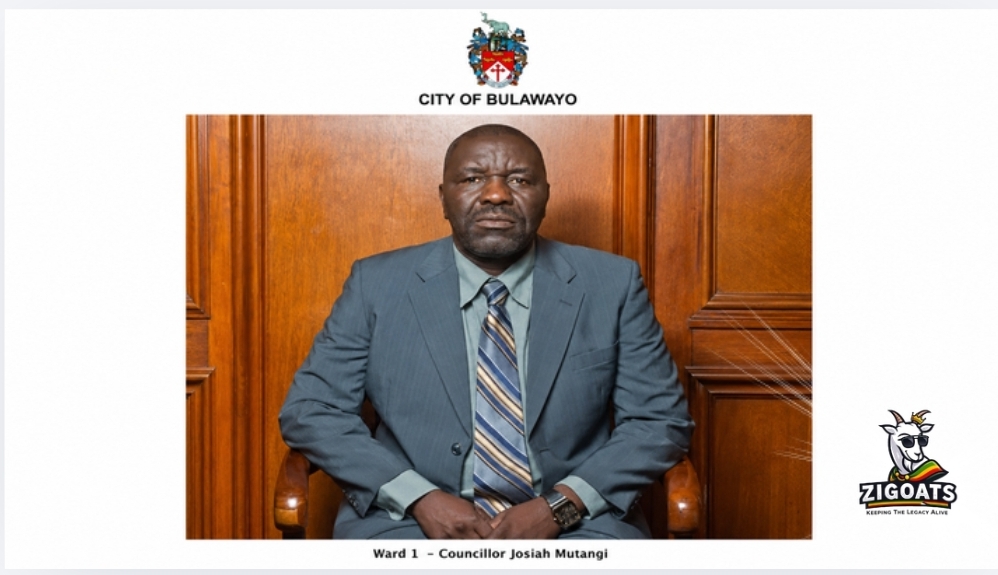
The Ministry of Local Government and Public Works has officially removed Bulawayo Ward 1 Councillor Josiah Mutangi from office after an independent tribunal found him guilty of gross misconduct, ending a political career overshadowed by a fraud conviction and setting the stage for a politically significant by-election.
Mutangi, a ZANU-PF councillor who won the traditionally opposition-held ward in a December 2023 by-election, had been suspended since May pending disciplinary proceedings.
His dismissal follows his December 2025 conviction on 14 counts of fraud, after a court found that he fraudulently obtained US$200 each from 13 street vendors by falsely promising them municipal vending bays.
He was sentenced to 490 hours of community service and ordered to give the victims all their money.
The Ministry said an independent tribunal subsequently found him guilty of gross misconduct, resulting in his dismissal in accordance with Zimbabwe’s local government laws.
The decision immediately creates a vacancy in Ward 1, with the Zimbabwe Electoral Commission (ZEC) now expected to organise a by-election in line with the Electoral Act.
From Urban Breakthrough to Political Setback
Mutangi’s election in December 2023 was celebrated by ZANU-PF as a rare and isolated victory in Bulawayo, a city that has consistently voted for opposition parties for more than two decades.
His removal now deprives the ruling party of one of its symbolic gains in Zimbabwe’s second-largest city while presenting the opposition with an opportunity to reclaim the seat.
Although only one council ward is at stake, political observers say the by-election is likely to attract national attention because of what it could reveal about the country’s shifting urban political landscape.
By-Election Comes Amid a Highly Charged Political Environment
The Ward 1 by-election will take place against the backdrop of Zimbabwe’s evolving political landscape, where urban voters have overwhelmingly backed opposition parties since the emergence of the Movement for Democratic Change (MDC) in 1999.
Since the watershed 2000 parliamentary elections, the MDC, and later the Citizens Coalition for Change (CCC), have dominated elections in major cities including Bulawayo, Harare, Gweru, Mutare and Masvingo.
While ZANU-PF has consistently retained power nationally, it has struggled to establish lasting control of most urban councils, where concerns over service delivery, unemployment, governance and corruption have often shaped voting patterns.
Zimbabwe’s electoral contests have, however, remained fiercely contested.
Opposition parties, civil society organisations and several international election observer missions have repeatedly alleged that elections have been characterised by political violence, intimidation, abuse of state resources, irregularities in the voters’ roll, vote buying and shortcomings in ballot printing, distribution and result management.
The 2023 harmonised elections came under particularly intense scrutiny after observer missions from the Southern African Development Community (SADC), the European Union (EU), the Carter Center and other organisations raised concerns over delays in the delivery of ballot papers at polling stations in Harare and Bulawayo, aspects of the legal framework and the overall electoral environment.
Opposition parties also alleged electoral manipulation, infiltration of opposition structures, politically motivated recalls of elected representatives and judicial interventions that they argued altered the political landscape after the elections.
ZANU-PF has consistently rejected allegations of election rigging, political violence or interference with opposition parties, maintaining that Zimbabwe’s elections are conducted freely, fairly and in accordance with the Constitution and electoral laws.
Similarly, ZEC has repeatedly denied accusations of bias or collusion with the ruling party, insisting that it operates independently and impartially.
The political climate has remained equally charged following the enactment of the Constitution of Zimbabwe Amendment (No. 3) Act (CAA3). Government says the amendments improve governance and strengthen State institutions, while opposition parties, constitutional lawyers and civil society organisations argue that some provisions weaken constitutional safeguards and could significantly influence Zimbabwe’s democratic trajectory.
Against that backdrop, the Bulawayo Ward 1 by-election is expected to serve as more than a contest for a single council seat. Analysts say it could provide an early indication of public sentiment in urban Zimbabwe ahead of future elections.
Corruption Continues to Shadow Public Institutions
Mutangi’s dismissal also adds to Zimbabwe’s long-running struggle against corruption, an issue that continues to dominate public debate.
Over the years, Zimbabwe has consistently ranked poorly on global corruption perception indices, with watchdog organisations citing weak accountability, limited transparency and slow prosecution of high-profile corruption cases as persistent challenges.
Successive reports by the Auditor General have exposed widespread weaknesses in financial management across government ministries, local authorities and State-owned enterprises, while the Zimbabwe Anti-Corruption Commission (ZACC) continues to investigate cases involving public officials.
At local authority level, allegations involving illegal land allocations, housing stands, procurement irregularities, tender manipulation and the allocation of vending spaces have repeatedly surfaced.
The rapid growth of Zimbabwe’s informal economy has also fuelled the emergence of so-called “space barons”—individuals accused of exploiting desperate vendors by demanding illegal payments in exchange for market stalls or vending bays.
Mutangi’s conviction has once again placed that practice under the spotlight, reinforcing calls for stronger oversight and greater accountability within local authorities.
A Test for Both Major Political Blocs
The impending by-election presents contrasting challenges for Zimbabwe’s two main political camps.
For ZANU-PF, it offers an opportunity to demonstrate that Mutangi’s conviction was an isolated incident and to defend one of its few electoral gains in Bulawayo.
For the opposition, it represents a chance to reclaim a ward that has historically been part of its urban stronghold and to reaffirm its support base despite years of internal divisions, recalls and organisational restructuring.
Beyond party politics, many residents say their priorities remain unchanged.
Reliable water supplies, functioning sewer systems, refuse collection, better roads, job creation and an end to corruption continue to rank above partisan interests.
Whoever wins the Ward 1 by-election will therefore inherit more than a council seat. They will face the challenge of rebuilding public trust in a city where voters increasingly judge politicians not by campaign promises, but by their ability to deliver tangible improvements to everyday life.
Leave a Reply