
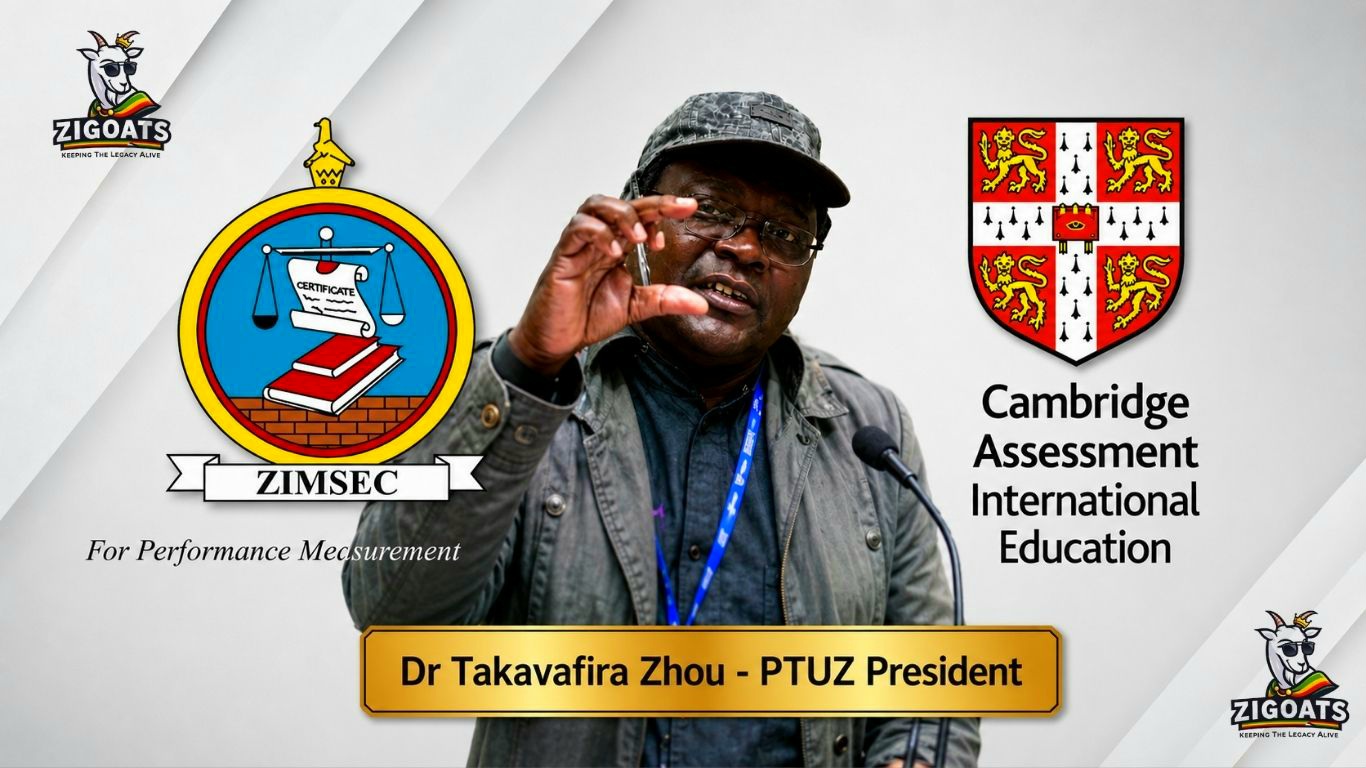
Zimbabwe’s education debate has intensified after the Ministry of Primary and Secondary Education moved to make ZIMSEC examinations compulsory from 2027, while allowing Cambridge examinations only under strict regulatory conditions. The policy shift has triggered fresh concerns over standards, credibility, and the future of the country’s examination system.
By Advent Shoko
The President of the Progressive Teachers’ Union of Zimbabwe (PTUZ), Dr Takavafira M. Zhou, says the move will not resolve the deeper crisis facing the Zimbabwe School Examinations Council (ZIMSEC), warning that enforcement alone cannot rebuild public trust.
His remarks come as the Ministry of Primary and Secondary Education, led by Minister Torerayi Moyo, pushes forward with reforms aimed at standardising national assessments and consolidating examination systems under ZIMSEC.
But Dr Zhou argues the problem runs far deeper than policy direction.
He says ZIMSEC is facing structural weaknesses, including alleged examination leakages, weak security systems, inadequate infrastructure, and persistent delays in paying exam markers. These challenges, he says, continue to undermine confidence in the system.
For many educators, the situation is already affecting morale and performance, with some markers reportedly working under financial pressure while handling high-stakes national examinations.
The impact is also being felt by families.
Across the country, more parents are reportedly shifting toward international examination systems such as Cambridge, which are seen as more stable and globally recognised, despite higher costs.
Dr Zhou warns that this trend risks widening inequality, as wealthier families opt out of ZIMSEC while ordinary learners remain fully bound to it, creating what he describes as a growing two-tier education system.
He argues that instead of strict compliance measures, government should prioritise investment, institutional reform, and restoration of credibility.
“The solution is not command and control,” his position suggests, “but rebuilding trust in the system through real reform.”
As the 2027 deadline approaches, Zimbabwe’s education sector faces a defining question: can ZIMSEC regain credibility through policy enforcement alone, or does it require a deeper reset of governance, funding, and trust?
Leave a Reply