
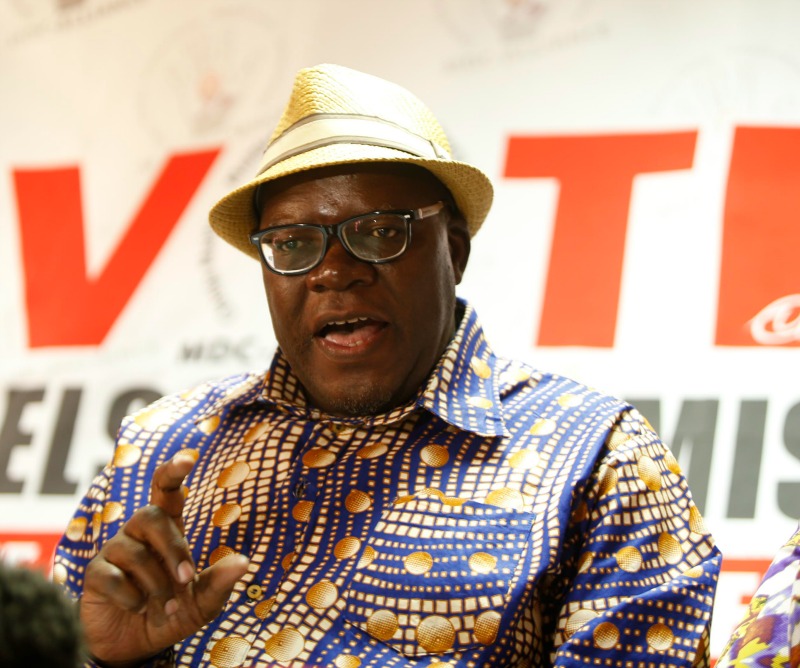
By Advent Shoko | ZiGoats
Zimbabwe’s former Finance Minister Tendai Biti has challenged the government’s claim that the country’s economy is now worth US$65.92 billion, arguing that repeated changes to national accounts have inflated its reported size without delivering comparable improvements in people’s lives.
In a strongly worded statement titled “Putting Lipstick on a Pig: The Myth of Zimbabwe’s Inflated GDP”, published in response to an October 21, 2026, report in The Herald, Biti questioned how Zimbabwe’s nominal gross domestic product (GDP) could have more than tripled from US$18 billion to nearly US$66 billion.
He argued that the headline figure masks structural weaknesses, persistent poverty, inadequate infrastructure and an economy that remains heavily informal.
“Sadly, there were no celebrations,” Biti wrote, questioning the significance of Zimbabwe being presented as Africa’s 14th-largest economy.
Biti Questions Repeated GDP Rebasing
At the centre of Biti’s argument is Zimbabwe’s repeated revision of its economic baseline, known as GDP rebasing.
Rebasing is a recognised statistical exercise that updates the reference year and incorporates changes in economic structure, prices and previously undercounted activities. Done properly, it can provide a more accurate picture of an economy.
However, Biti argues that Zimbabwe’s successive revisions have lacked sufficient scientific justification and have been used to support the government’s ambition of achieving upper-middle-income status by 2030.
He traces the reported expansion from US$18 billion to US$25.8 billion following a 2018 rebasing, then points to further revisions in 2025, when GDP figures were raised from US$35.2 billion to US$44.4 billion and subsequently to US$59.7 billion.
The latest reported projection of US$65.92 billion has intensified his criticism.
“It is sorcery to expand an economy by 84% through desk stop and ChatGtp without tangible growth on the ground,” Biti said, referring to official claims about growth in gross national income (GNI) per capita.
His central argument is that changes in statistical methods can increase measured GDP without an equivalent increase in actual production, household incomes or living standards.
The distinction is important: a larger measured economy does not automatically mean that citizens are wealthier or that productive capacity has expanded at the same pace. Establishing whether the latest figure is overstated, however, requires examining the underlying national accounts and methodology, rather than relying on economic indicators alone.
The scale of Zimbabwe’s US$65.92 billion economy projection becomes clearer when compared with other countries. The IMF’s October 2026 estimates put South Africa’s GDP at about US$489 billion, Nigeria’s at US$387 billion, Zambia’s at US$42 billion and Botswana’s at US$20 billion, while the United Kingdom’s economy is projected at roughly US$4.27 trillion.
Zimbabwe’s figure would therefore make its economy about 56% larger than Zambia’s and more than three times Botswana’s, but only around one-eighth the size of South Africa’s and one-sixtieth that of the UK. These comparisons show why the ranking has attracted attention, but they do not, on their own, prove that Zimbabwe’s GDP is overstated.
Nominal GDP measures the annual value of economic output in current US dollars; it does not directly measure productivity, electricity consumption, living standards or the strength of public services. The real test is whether the headline figure is supported by transparent statistical methods and reflected in productive capacity, jobs and household incomes.
Economic Analysts Challenge Government Over GDP Claim
Economic analyst Tinashe Murapata also weighed in, questioning how Zimbabwe could have a larger economy than Zambia despite differences in electricity and fuel consumption, and a GDP close to Uganda’s despite Uganda operating a national budget roughly twice Zimbabwe’s.
“Zimbabwe claims its economy is more than twice the size of Zambia’s and roughly the same size as Uganda’s,” Murapata said, arguing that such comparisons warrant closer scrutiny.
He defended the role of independent economic analysis, saying official statistics should be tested rather than accepted without question.
“Analysts have a duty to test claims and publish their findings. That is precisely what economic analysis is for. Official statistics are not holy writ,” he said, adding that analysts had already provided technical feedback on the figures.
Presidential spokesperson George Charamba pushed back, arguing that comparisons between the countries must account for their populations.
“What is the demography of both Zambia and Uganda vis-a-vis Zimbabwe?” Charamba asked, dismissing the criticism as “plain silly”.
Another commentator challenged that response, arguing that population size alone could not explain differences in electricity consumption. Switzerland, the commentator noted, has a much smaller population than Zambia or Uganda but consumes more electricity.
Charamba responded that electricity consumption alone could not settle a debate about GDP, arguing that the type of economic activity and the value generated by that activity were more important.
“We are talking GDP here!!! Power consumed is important; which areas and what value that consumption brings to the Economy is decisive!!!!” he wrote.
He pointed to the difference between copper production, which consumes substantial electricity, and lithium processing, arguing that the value generated by different industries matters more than energy consumption in isolation.
The Bigger Question
The exchange highlights the central dispute over Zimbabwe’s economic performance: whether the US$65.92 billion projection reflects a genuinely larger and more productive economy or a statistical revision that has outpaced improvements on the ground.
Both sides raise points that deserve consideration. Population, industrial structure, energy efficiency and the value generated by different sectors all matter when comparing economies. Electricity consumption, tax revenue, import levels and public spending can provide useful clues, but none can independently establish whether a GDP estimate is correct.
Ultimately, the question is not simply how Zimbabwe ranks against its neighbours. It is whether the figures are transparent, methodologically sound and consistent with other economic evidence.
For ordinary Zimbabweans, the measure of progress remains tangible: reliable electricity, better roads, productive businesses, decent jobs and incomes that can support a family. Until headline growth translates into those improvements, the debate over the country’s economic size is unlikely to go away.
Leave a Reply