
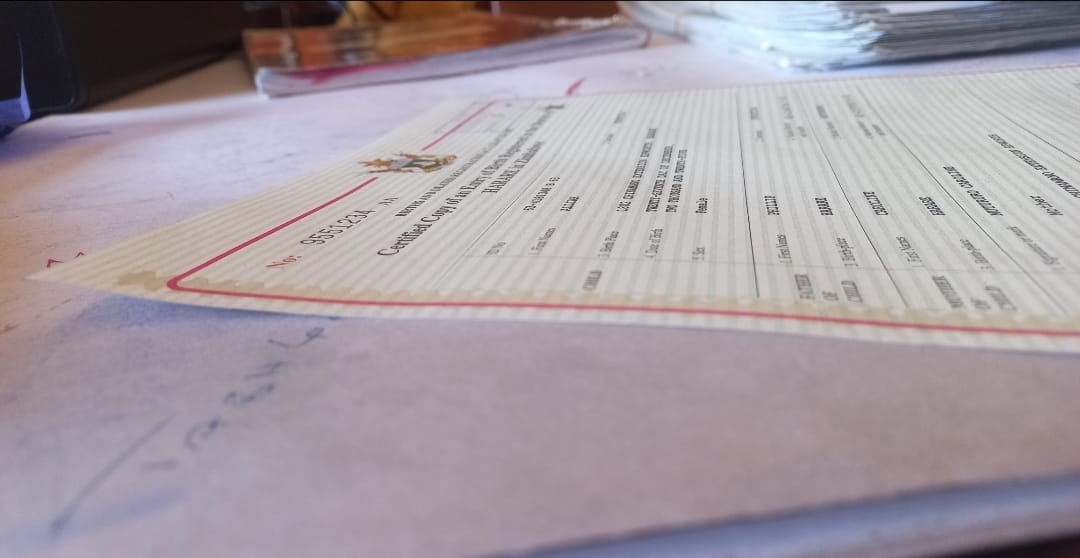
HARARE – For most Zimbabweans, applying for a birth certificate is expected to be a straightforward process. Yet for some, the wait stretches from weeks to months, and in rare cases, even years.
By Advent Shoko
While going through comments on ZiGoats’ recent guide on how to obtain a child’s birth certificate, one reader shared a frustrating experience that highlights a problem many quietly face.
“Ini ndakabhadara but harisati rabuda, gore rakukwana.”
Loosely translated, the reader said:
“I paid the required fees, but my birth certificate is still not out. It’s almost a year now.”
As painful as it sounds, such delays do happen.
In many cases, the problem is not that the application has been rejected. Instead, it has been placed on hold because of what the Civil Registry Department calls a “query“, an issue that must first be resolved before the certificate can be processed and printed.
Below are some of the most common reasons.
1. Problems With A Parent’s Identity Documents
One of the biggest causes of delays is when the details of one or both parents cannot be verified.
1.1 Parent Not In The National Database
This is more common than many people realise.
A parent may already possess a Zimbabwean identity document, such as a green waiting pass or an old handwritten birth certificate, but their records were never captured into the electronic national database.
In simple terms, they have a document, but their information is still offline.
Without matching records in the system, processing a child’s birth certificate becomes difficult because officials cannot verify the parent’s identity electronically.
“Many people are surprised when they are told, ‘Your ID is not in the system,’ despite having carried it for years,” a Civil Registry official familiar with registration procedures told ZiGoats.
Why Does This Happen?
One major reason is Zimbabwe’s nationwide mobile registration exercises.
These campaigns are designed to help people living in remote areas or communities with limited access to Civil Registry offices.
Many beneficiaries include people who:
- live far from registration centres;
- lack complete supporting documents;
- delayed registration for years; or
- belong to religious communities where home births are common.
In some apostolic sects, children are still born at home instead of health facilities.
When parents later apply for birth registration, they are usually required to produce documents such as a birth confirmation record and a child health card issued by medical institutions.
Without those records, applications become more complicated.
Mobile registration teams help document thousands of people in the field, often under difficult conditions.
However, information collected during these campaigns is not always uploaded into the national database immediately.
Officials frequently face challenges including:
- shortage of computers;
- poor internet connectivity;
- electricity outages;
- limited staff; and
- overwhelming workloads at district offices.
Some satellite offices cannot even print birth certificates or identity documents. They simply collect applications before forwarding them to larger processing centres.
As a result, documents may remain waiting to be captured into the system long after applicants have already received temporary paperwork.
Some offices are reportedly still working through data captured during registration exercises conducted several years ago.
2. Errors On Identity Documents
Sometimes the delay is caused by incorrect information.
Simple data entry mistakes can trigger a query that prevents processing.
Examples include:
- gender recorded as male instead of female;
- different ID numbers appearing across documents;
- incorrect district of birth;
- birthplace recorded simply as “Zimbabwe” or “Unknown”;
- spelling mistakes in names or places.
An applicant may carry documents that appear correct while the electronic database contains completely different information.
Until the office that originally issued the document corrects the discrepancy, the application cannot move forward.
“Even one incorrect digit on an ID number can stop the entire process until the records are corrected,” another registry official explained.
3. The Applicant Never Returns
Not every delay is caused by government systems.
Some applicants fail to return after submitting their applications.
Queries are sometimes discovered only after the applicant has already left the office.
If the applicant provided the wrong phone number or address, officials have no way of contacting them.
Months later, the applicant returns expecting to collect the certificate, only to discover that additional information was required all along.
Staff transfers can make matters worse, particularly if the application was set aside pending clarification.
Officials therefore encourage applicants to return on the date they are given instead of waiting several months.
4. Adults Follow A Different Process
Applications from adults generally take longer than those for young children.
Individuals aged 22 years and above usually undergo fingerprint vetting before a birth certificate can be issued.
The verification process is handled separately and can take time, especially as the responsible offices deal with large numbers of applications.
Meanwhile, Civil Registry offices prioritise the registration of newborn babies, as Zimbabwean law requires parents to register births within the six weeks after delivery.
Officials therefore advise parents not to delay registering their children, as early registration is generally quicker and helps avoid complications later in life.
Patience And Regular Follow-Ups Matter
A delayed birth certificate does not always mean the application has been lost.
In many cases, there is simply a query that needs to be resolved before processing can continue.
The best approach is to maintain regular contact with the office where the application was lodged, respond promptly to any requests for additional information and keep all supporting documents safe.
For thousands of Zimbabweans, a birth certificate is more than just a piece of paper. It is the key to obtaining a national identity card, passport, school enrolment and access to many other essential government services.
Understanding why delays occur can help applicants resolve problems sooner instead of waiting months, or even years, without knowing what has gone wrong.
Leave a Reply