
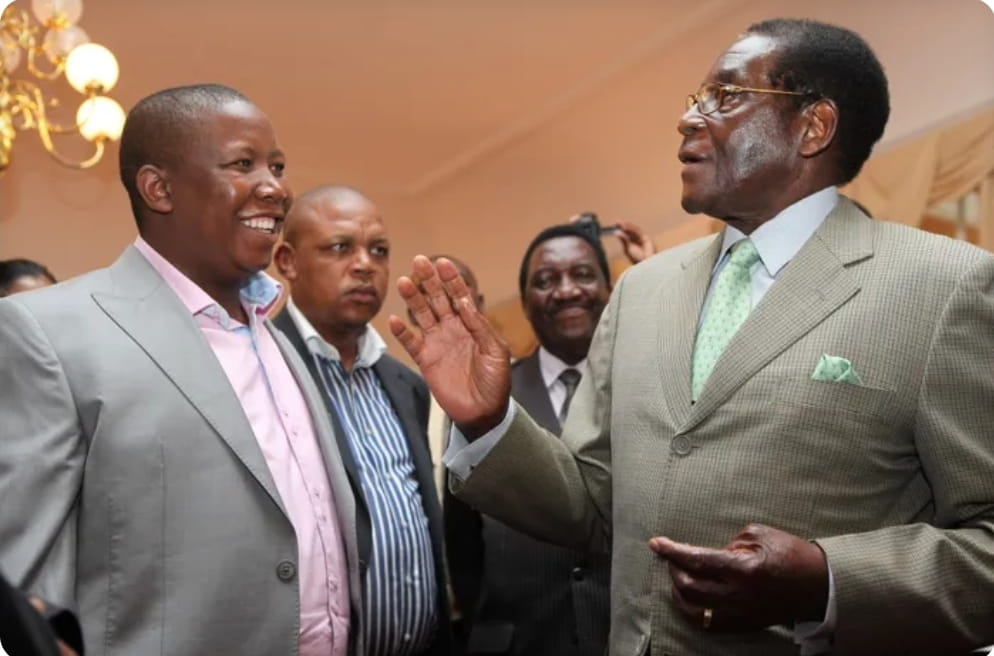
HARARE – South Africa’s opposition party, the Economic Freedom Fighters (EFF), has strongly criticised President Emmerson Mnangagwa’s decision to sign Constitutional Amendment No. 3 (CAB3) into law, saying Zimbabwe’s leadership should seek a fresh mandate from voters instead of extending its term through constitutional changes.
By Advent Shoko
In a statement issued on Tuesday, the EFF led by former ANC Youth leader Julius Sello Malema said the amendment, which extends the presidential term from five years to seven years and pushes the next general elections to 2030, raises serious concerns about democratic accountability.
“The extension of a presidential mandate through constitutional amendment, rather than through the freely expressed will of the people at the ballot box, represents a deeply disappointing development,” the party said.
“It creates the perception that constitutional instruments are being manipulated to entrench political power instead of strengthening democratic accountability.”
EFF: Liberation History Is Not a Lifetime Mandate
The South African opposition party acknowledged the historic role played by ZANU PF, Zimbabwe’s liberation movement, in ending colonial rule but argued that past achievements cannot guarantee permanent political power.
“The liberation of Zimbabwe from settler colonialism remains one of the greatest victories in the history of Africa,” the EFF said.
“However, no liberation movement acquires a permanent entitlement to govern simply because of its historic role in defeating colonialism. The legitimacy won on the battlefield must continually be renewed through the democratic consent of the people.”
The party accused ZANU-PF of increasingly behaving as though Zimbabweans owe it perpetual political loyalty because of its liberation credentials.
Focus Should Be the Economy, Says EFF
The EFF argued that Zimbabwe’s leadership should prioritise fixing the country’s economic challenges instead of changing the Constitution.
It pointed to unemployment, poverty, struggling public services and continued migration of Zimbabweans to neighbouring countries, particularly South Africa, as issues requiring urgent attention.
“Millions of Zimbabweans continue to leave their homeland in search of opportunities across the African continent and beyond because their own government has failed to create conditions for a dignified life,” the statement said.
“Instead of dedicating the full attention of the state to resolving these crises, the government has prioritised constitutional amendments that extend its stay in office.”
‘Political Power Belongs to the People’
The EFF said governments should regularly return to voters for a fresh democratic mandate.
“True revolutionaries understand that political power belongs to the people and that leadership is exercised on their behalf, not over them,” the party said.
“Any government that fears returning to the people for a fresh democratic mandate is one that is certain it has lost the will of the people.”
The party called on Zimbabwe’s government to focus on economic renewal, accountable governance and rebuilding public institutions instead of extending political terms.
CAB3 Remains Deeply Divisive
President Mnangagwa signed CAB3 into law this week after it passed through Parliament, making it one of the biggest constitutional changes since Zimbabwe adopted its 2013 Constitution.
The amendments extend the terms of office for the President, Members of Parliament and local authorities from five years to seven years while introducing several other governance reforms.
Government has defended the changes, arguing they will provide policy continuity, reduce constant election cycles and create a stable environment for long-term national development.
Critics, however, say the amendments weaken democratic accountability and concentrate more power in the Executive.
The EFF’s intervention underscores how Zimbabwe’s constitutional reforms have become an issue of regional and international debate. Opposition to CAB3 has already extended beyond Zimbabwe’s borders. In April, British peer Catharine Hoey criticised the proposed amendments in the UK Parliament, describing them as “an attack on democracy” and accusing ZANU-PF of governing through “terror and threat of terror.” With South Africa’s EFF now adding its voice, CAB3 is increasingly attracting scrutiny well beyond Zimbabwe as debate over the country’s constitutional future intensifies.
Leave a Reply