
By Advent Shoko | ZiGoats
President Emmerson Mnangagwa has warned against divisions within ZANU PF, calling on party members to close ranks and follow a common political and economic agenda as questions over his succession continue to cast a shadow over the ruling party.
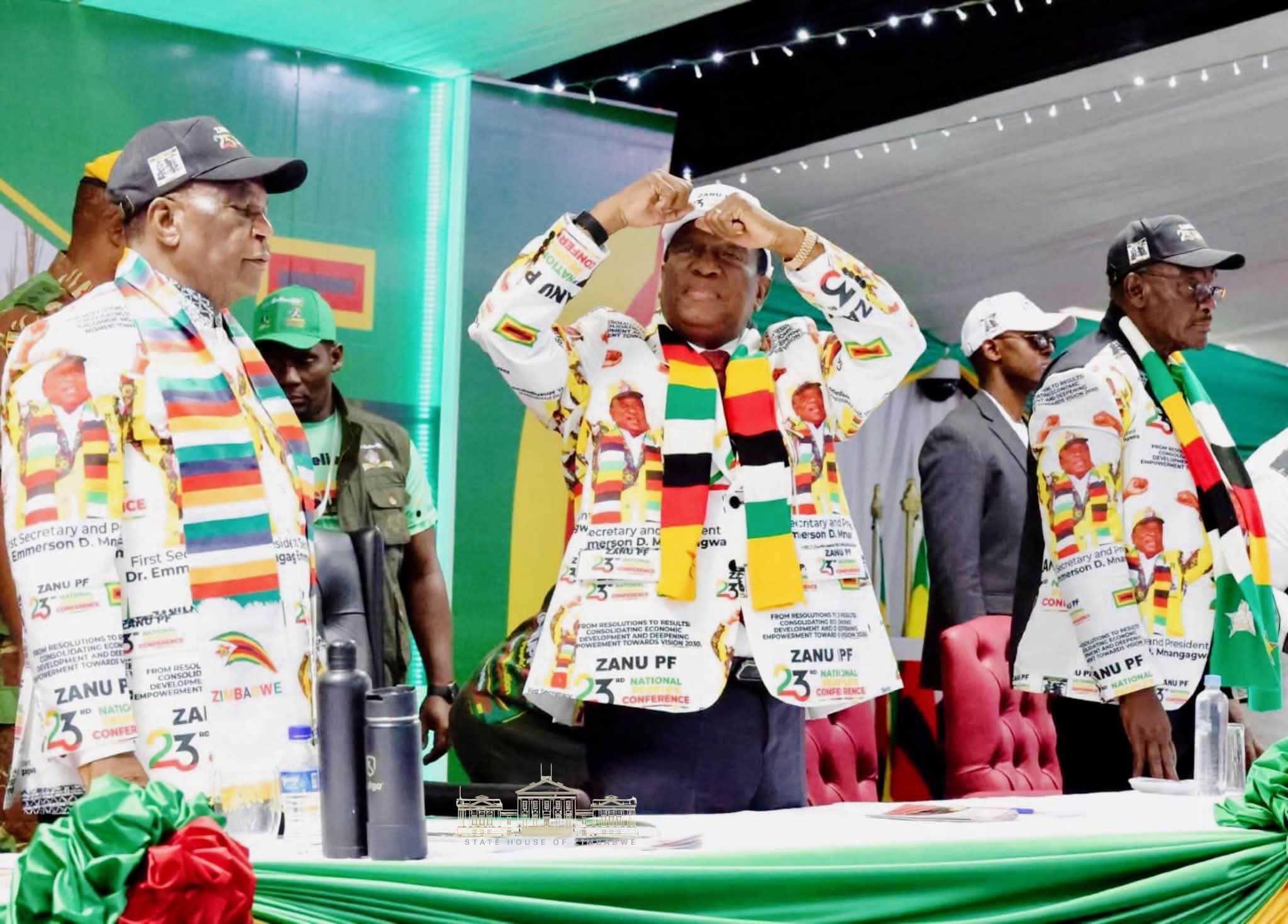
Addressing delegates at the party’s 23rd National People’s Conference, Mnangagwa said there was no room for individual agendas, urging members to remain united, disciplined and focused on delivering the party’s resolutions.
“MuZANU PF hamudi zvemazvake mazvake. Tinofanira kufamba tose, takabatana uye tiine gwara rimwe,” he said, warning against working in isolation or pulling in different directions.
“There is no room for solo efforts or dividing our focus—neither lagging behind nor running ahead out of step. We move forward together: step by step, brick by brick!”
His remarks come amid reports of growing tensions within ZANU PF, with claims of rival camps aligned to Mnangagwa and his deputy, Vice President Constantino Chiwenga.
Although the alleged divisions have not been formally acknowledged by the party’s leadership, succession politics have increasingly featured in discussions about ZANU PF’s future as Mnangagwa approaches the end of his constitutionally prescribed second term in 2030.
Succession Battle Hangs Over ZANU PF
At the centre of the reported tensions is the Constitutional Amendment Act No. 3, which, among other changes, extended Mnangagwa’s tenure by two years, allowing him to remain in office until 2030.
The extension has significant implications for the party’s succession question, particularly for Chiwenga, who has long been viewed as a potential successor to Mnangagwa.
The succession debate has also been fuelled by Mnangagwa’s recent appointment of businessman Kudakwashe Tagwirei to the party’s Politburo, reportedly against the wishes of his deputy.
Tagwirei’s entry into the influential decision-making body has added another dimension to the internal political calculations surrounding the party’s leadership and future direction.
Some have speculated that Mnangagwa favours Tagwirei as his preferred successor and could seek to leave power in his hands, potentially retaining influence behind the scenes through a proxy arrangement.
Such a scenario would draw comparisons with Russia, where Vladimir Putin remained influential after stepping down as president in 2008, with Dmitry Medvedev taking over before Putin returned to the presidency in 2012.
Reported disagreements potentially obscure the longstanding relationship between Mnangagwa and Chiwenga, whose political and military ties stretch back to Zimbabwe’s liberation struggle.
After independence, Mnangagwa served in government, including as Defence Minister, while Chiwenga rose through the military ranks and became a central figure in the events that led to the end of Robert Mugabe’s presidency in 2017.
Chiwenga also played a key role in the political transition that brought Mnangagwa back to Zimbabwe after Mugabe dismissed him from government.
The reported fissures therefore represent a significant development in a relationship built over decades, with the question of who leads ZANU PF beyond Mnangagwa’s tenure emerging as a major source of political uncertainty.
Conference Tests Party Unity
The National People’s Conference provides a platform for ZANU PF to review its policies, assess progress on previous resolutions and set priorities for the coming year.
This year’s theme, “From Resolutions to Results: Consolidating Economic Development and Deepening Empowerment Towards Vision 2030,” places economic performance and the government’s development agenda at the centre of the gathering.
Mnangagwa told delegates that leadership was a responsibility to serve, urging party members to promote and defend ZANU PF’s ideology, policies and resolutions.
“Leadership is a duty to serve,” he said, adding that every member had a responsibility to advance the party’s agenda.
He also invoked the sacrifices made during the liberation struggle, paying tribute to the Chinhoyi Seven, the late former President Robert Mugabe and other liberation heroes from Mashonaland West.
“We stand on the shoulders of giants,” Mnangagwa said, linking the party’s historical legacy to its present responsibility to deliver development and improve livelihoods.
He further argued that unity within the party and peace across the country demonstrated the effectiveness of the current leadership, saying government policies and programmes were producing visible benefits for ordinary citizens.
Mnangagwa also said the Chitepo School of Ideology was open to the private sector, which could request tailored training programmes to align its activities with the country’s development vision.
Will The Conference Settle The Succession Question?
While the conference is an important fixture on ZANU PF’s political calendar, its influence over the succession question remains a subject of debate.
Party conferences provide a formal setting for leaders to articulate policy positions and reinforce political direction. However, critics have questioned how much room they leave for genuine leadership contests when provincial structures and other party organs have already expressed preferences for a particular candidate.
Under such circumstances, the conference could reinforce an existing leadership arrangement rather than produce a fresh contest over who should lead the party.
If support for Mnangagwa’s continued leadership remains dominant within the party’s structures, the gathering could strengthen his position and, by extension, his influence over the country’s political direction.
But the underlying succession question is unlikely to disappear simply because party leaders publicly call for unity.
Mnangagwa’s warning against divisions signals the importance he attaches to maintaining discipline as ZANU PF navigates competing political interests, economic pressures and uncertainty over its future leadership.
For now, his message is clear: the party must move together. Whether that call for unity can contain the reported succession tensions remains one of the key questions hanging over ZANU PF’s political future.
Leave a Reply