
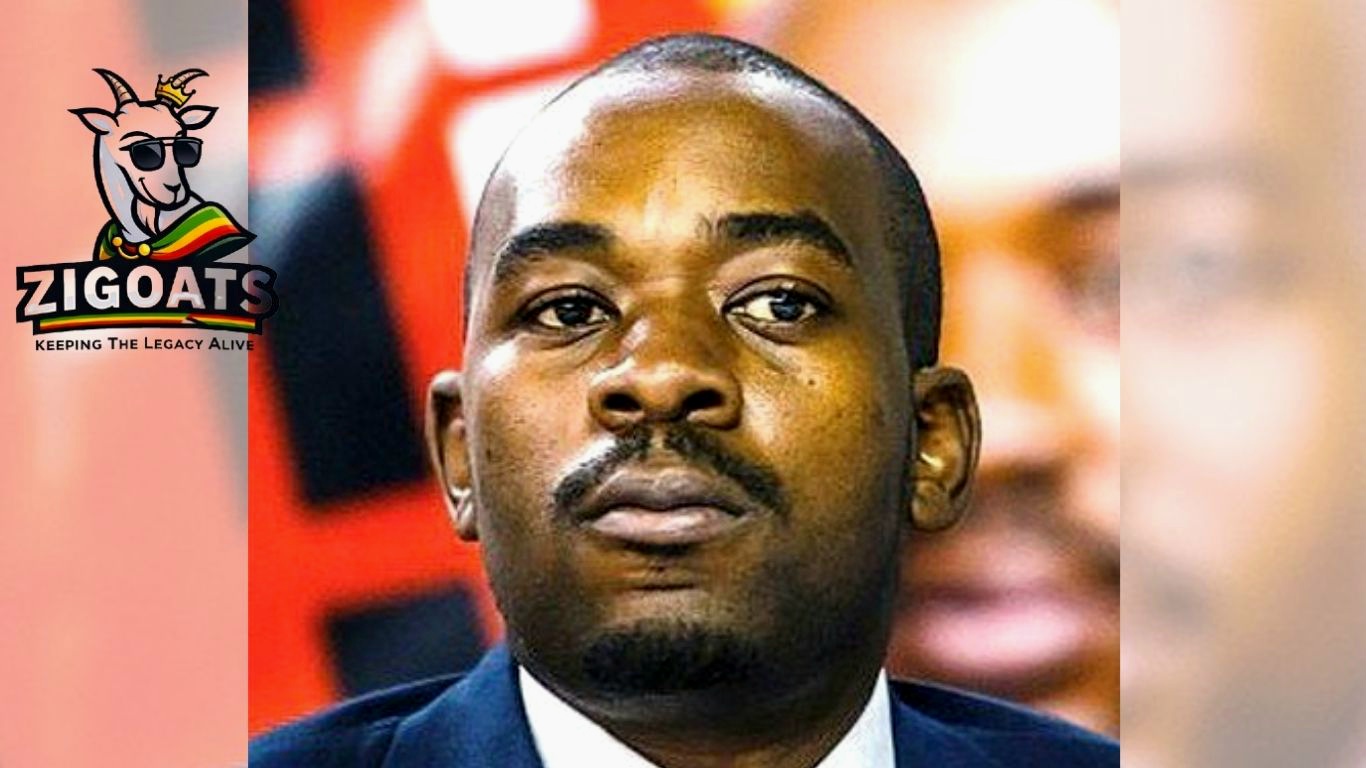
Former Citizens Coalition for Change (CCC) leader Nelson Chamisa has pushed back against reports claiming he dismissed a proposed opposition coalition fighting Constitutional Amendment Bill No. 3 of 2026, describing the story as “misleading” and accusing sections of the media of manufacturing statements in his name.
By Advent Shoko
The controversy erupted after a local newspaper published a front-page headline reading: “This engineered pact is hopeless,” Chamisa says about the proposed new opposition coalition.
The article quickly sparked backlash online, with some critics accusing Chamisa of undermining efforts by opposition parties and civic groups attempting to resist the proposed constitutional changes.
Among the most vocal critics was Zimbabwean journalist and government critic Hopewell Chin’ono, who questioned why Chamisa would allegedly attack citizens trying to organise against Constitutional Amendment No. 3.
“Does Nelson Chamisa want Zimbabweans to simply sit back and watch Constitutional Amendment No. 3 being pushed through without resistance?” Chin’ono wrote in a strongly worded response shared online.
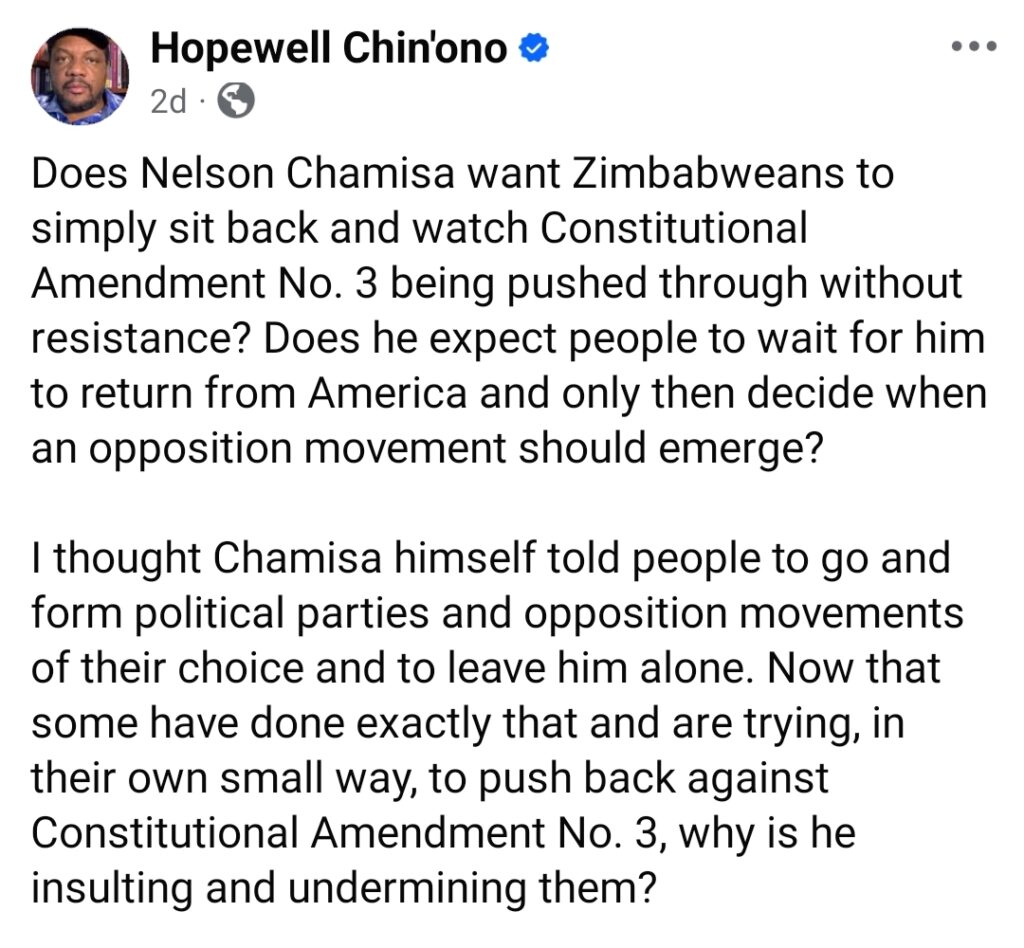
He further questioned whether Chamisa expected Zimbabweans to wait for his political return before organising themselves, arguing that people had taken Chamisa’s earlier advice to form their own political movements and opposition initiatives.
“At a time when Zimbabwe desperately needs unity against constitutional manipulation, attacking those trying to organise only weakens the broader democratic struggle and benefits the very people pushing these dangerous amendments,” Chin’ono said.
The criticism rapidly gained traction across social media platforms, reigniting debate over Chamisa’s political strategy, his prolonged silence over national issues, and his relationship with opposition politics since stepping away from frontline political activity.
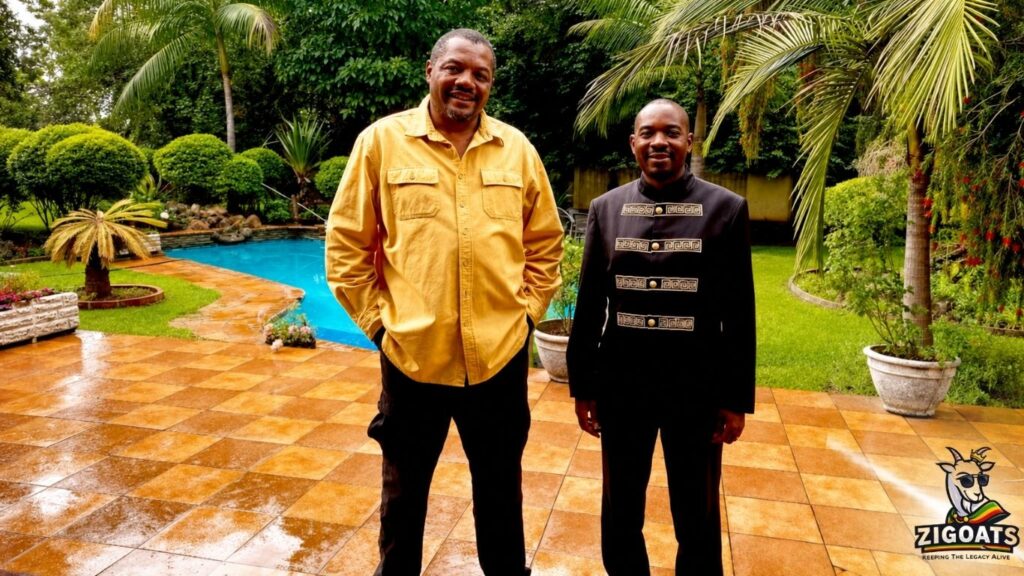
But Chamisa has now firmly denied making the remarks attributed to him.
In a statement responding to the article, Chamisa accused the publication of engaging in what he called “editorial fiction” aimed at damaging his reputation.
“IGNORE THE MISCHIEF,” Chamisa wrote.
“I have noted with deep concern the Daily News front-page story titled, ‘This engineered pact is hopeless,’ which appears to allege that I have dismissed the efforts of others to advance the struggle for a better Zimbabwe in a manner they consider appropriate.”
“Regrettably, the story is misleading, is a work of editorial fiction, and is intended to inflict injury,” he added.
Chamisa said journalism should focus on reporting facts rather than creating narratives, warning that compromised editorial standards threaten public trust and democratic freedoms.
“It is a fundamental principle of journalism that reporters should report the news, not manufacture it,” he said.
Despite distancing himself from the reported remarks, Chamisa reiterated that he remains committed to Zimbabwe’s political future and hinted at plans he intends to unveil later.
“I remain fully committed to representing the interests of the citizens of Zimbabwe and to advancing the struggle for a better country. In due course, I will be rolling out a plan aimed at achieving that goal,” Chamisa said.
“Any attempts to distract us from this objective will not succeed.”
Disputes of this nature often lead to legal action, including lawsuits or formal demands for retraction and public apology. However, Chamisa did not address that aspect in his response.
The latest dispute comes as Chamisa continues to navigate a politically sensitive comeback following a near two-year sabbatical from active politics.
Since re-emerging into the public spotlight, the former opposition leader has faced growing skepticism from sections of both the opposition and civil society, with some accusing him of strategically remaining distant while the opposition landscape fragments around him.
Others have gone further, alleging that his silence and political approach indirectly benefit ruling party Emmerson Mnangagwa’s government and ZANU PF at a time when opposition forces are struggling to unite.
Chamisa has repeatedly rejected those allegations, insisting that the claims are part of a deliberate campaign by political opponents to destroy his credibility and weaken his influence among Zimbabwean voters.
The debate surrounding Constitutional Amendment Bill No. 3 has intensified political tensions in recent weeks, with critics arguing that the proposed changes could further reshape Zimbabwe’s political and constitutional landscape.
As pressure mounts for a united opposition response, Chamisa’s latest intervention is likely to fuel even more debate over leadership, strategy, and the future direction of Zimbabwe’s opposition movement.
Leave a Reply