
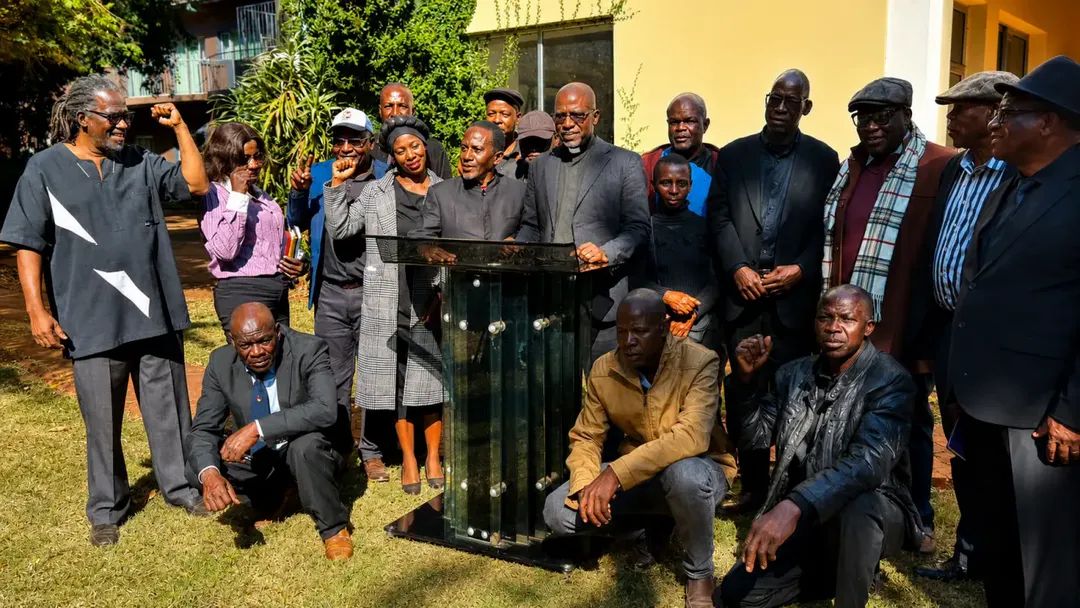
HARARE – President Emmerson Mnangagwa’s signature may have turned Constitutional Amendment No. 3 (CAB3) into law, (CAA3), but Zimbabwe’s constitutional battle is entering what opponents describe as a new and more coordinated phase.
By Advent Shoko
Rather than conceding defeat, a broad alliance of opposition parties, churches, labour unions, constitutional lawyers, civic organisations and war veterans says the campaign has only just begun.
The coalition, operating under Sungano Yevanhu/Ubumbano Lomphakathi (The People’s Coalition), is now pursuing a three-pronged strategy: constitutional litigation, peaceful civic mobilisation and regional advocacy.
The development comes as MDC leader Douglas Mwonzora has already approached the Constitutional Court seeking to invalidate key provisions of the amendment, while other constitutional experts are preparing separate legal challenges.
‘The Struggle Is Only Beginning’
Across Zimbabwe’s opposition spectrum, the message has become remarkably consistent since CAB3 became law.
Constitutional lawyer Thabani Mpofu said signing the Bill merely opened another phase of resistance.
“Its promulgation opens the door to, and indeed ushers in, another wave of challenges. These challenges will be pursued in many ways. We shall not abdicate. We shall not be cowed.”
Another legal expert Doug Coltart echoed the sentiment.
“The fact that the President has signed CAB3 does NOT mean the struggle is over. In fact, it’s only just beginning.”
National Constitutional Assembly leader Lovemore Madhuku also insisted the President’s assent does not settle the constitutional dispute.
“ED’s signing into law of CAB3 was always going to happen. That signature is NOTHING… It is now war in TWO battlegrounds: courts and peaceful political resistance.”
Coalition Maps Out Next Steps
The People’s Coalition says it intends to challenge CAA3 beyond Zimbabwe’s borders if domestic remedies fail.
According to the coalition, its roadmap includes:
- pursuing Constitutional Court litigation;
- petitioning the African Commission on Human and Peoples’ Rights if necessary;
- organising peaceful nationwide civic action;
- mobilising citizens under its “Let the People Decide” campaign.
Coalition convenor Reverend Dr Kenneth Mtata has argued that constitutional amendments affecting citizens’ democratic rights should be decided directly by Zimbabweans through a referendum.
Gwisai Signals Mass Mobilisation
Veteran politician and labour activist Munyaradzi Gwisai has also signalled that organised civic action will form part of the campaign.
Addressing supporters, Gwisai urged Zimbabweans to prepare for peaceful demonstrations challenging what he described as unconstitutional amendments.
“Be prepared!”
His remarks suggest opponents are preparing to complement courtroom litigation with public mobilisation.
Growing Alliance
The coalition brings together organisations that have often operated separately, including the Zimbabwe Congress of Trade Unions (ZCTU), National Constitutional Assembly (NCA), Constitution Defence Forum (CDF) , Defend the Constitution Platform (DCP) and several political parties and civic organisations.
Former opposition leader Job Sikhala confirmed that his National Democratic Working Group had joined the alliance despite his absence from its unveiling.
“Many more leaders are coming on board. This is a people’s alliance and no one can stop it.”
A Battle Beyond Parliament
Former Finance Minister Tendai Biti argues CAB3 fundamentally changes how political power is exercised in Zimbabwe.
“In this reality where democracy has been hijacked… focus should be on resisting CAB3. Anything else is a diversion.”
Political Science Professor Jonathan Moyo, however, has defended aspects of the amendments, arguing that several criticisms misrepresent what the law actually provides.
The differing interpretations have deepened one of Zimbabwe’s most polarising constitutional debates since the adoption of the 2013 Constitution.
Where Is Chamisa?
One notable absentee from the coalition is former Citizens Coalition for Change (CCC) leader Nelson Chamisa, Zimbabwe’s most popular opposition figure in recent years after securing more than two million votes in both the 2018 and 2023 presidential elections.
His absence has reignited debate over the opposition’s ability to unite against Constitutional Amendment Act No. 3 (CAA3). Relations between Chamisa and some leaders now driving the coalition have reportedly been strained, with critics accusing him of distancing himself from collective opposition initiatives. Chamisa has previously maintained that the fight against CAA3 is far from over, but has also questioned whether some groups have a legitimate mandate to speak on behalf of Zimbabweans.
His stance has fuelled speculation, including recurring allegations from political opponents that he is secretly working with ZANU-PF, claims amplified by a widely circulated audio attributed to Apostle B. Java, in which dismisses Chamisa is dismissed as “mambara” (someone useless) and argued that Zimbabwe’s “real opposition” ended with the late Morgan Tsvangirai.
Chamisa has repeatedly rejected the allegations, insisting they are politically motivated attempts to damage his credibility and weaken his support. With the opposition remaining fragmented, analysts say the absence of its biggest vote-getter from the emerging anti-CAA3 coalition could prove significant as the constitutional battle moves from Parliament to the courts and the streets. Chamisa could easily mobilise the masses.
Leave a Reply