

EXCERPT: A WhatsApp message from a Nigerian number claiming links to Zimbabwean businessman Wicknell Chivayo quickly raised red flags. What followed was a pattern of persistent calls, vague promises of cash, requests for personal information and a series of inconsistencies that exposed the anatomy of a suspected online scam.
By Advent Shoko
A Simple “Hello” That Triggered Alarm Bells
It began with a message from an unfamiliar Nigerian number: +234 814 542 8826.
The WhatsApp profile carried the name “Boss Wicknell”, an obvious reference to Zimbabwean businessman and philanthropist Wicknell Chivayo.
The account appeared relatively new, having reportedly joined WhatsApp recently. While that alone is not evidence of wrongdoing, it was enough to make me cautious.
As is my standard practice with unknown contacts, I had disappearing messages activated for new conversations. Shortly after the chat started, WhatsApp notified me that the other party had turned off the disappearing messages feature.
That was the first major red flag.
The Conversation Starts
The stranger opened with a friendly greeting.
“Hello Uri sei shamwari yangu“
My automatic away message responded first.
The person replied:
“Okay“
A few moments later came the question:
“Where are you chatting from“
When I did not respond immediately, the caller attempted to phone me multiple times.
The persistence was unusual.
The following day, another message arrived:
“Maswera seiko nhasi Mukoma“
Chivayo calling me Mukoma? That was new. He calls Jah Prayzah “Mupfana,” then call me Mukoma? To test whether I was dealing with someone genuinely familiar with Zimbabwean culture, I responded in a blend of colloquial Shona and Ndebele commonly understood by many Zimbabweans:
“Mushe sitereki kanjani“
The response suggested the sender did not understand the expression. It was just a “hello” and I did not bother to explain myself.
For someone presenting themselves as a Zimbabwean public figure, that inconsistency stood out.
The Identity Shift
Soon afterwards, WhatsApp displayed a security notification indicating that the contact had changed devices while retaining the same number.
The sender then began attaching photographs of Wicknell Chivayo.
The apparent objective was clear: create the impression that the account belonged to the businessman.
However, photographs alone prove nothing.
Social media images of public figures are readily available online and are frequently used by scammers attempting to gain credibility.


Then Came The Promise Of Money
The conversation soon shifted toward financial gifts.
The sender asked:
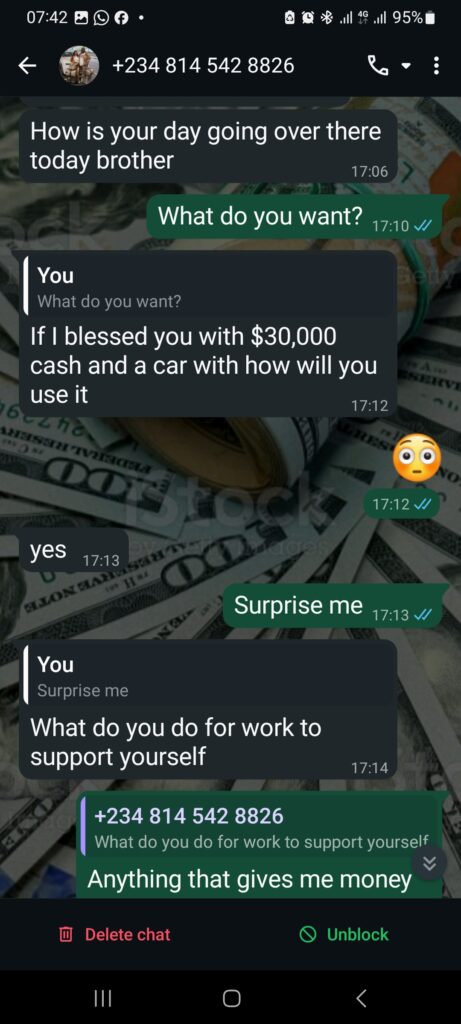
“If I blessed you with $30,000 cash and a car with how will you use it”
Don’t mind the broken English.
When asked what they wanted, the response was another question:
“What do you do for work to support yourself“
I answered casually:
“Anything that gives me money“
The conversation then became even more suspicious.
The sender wrote:
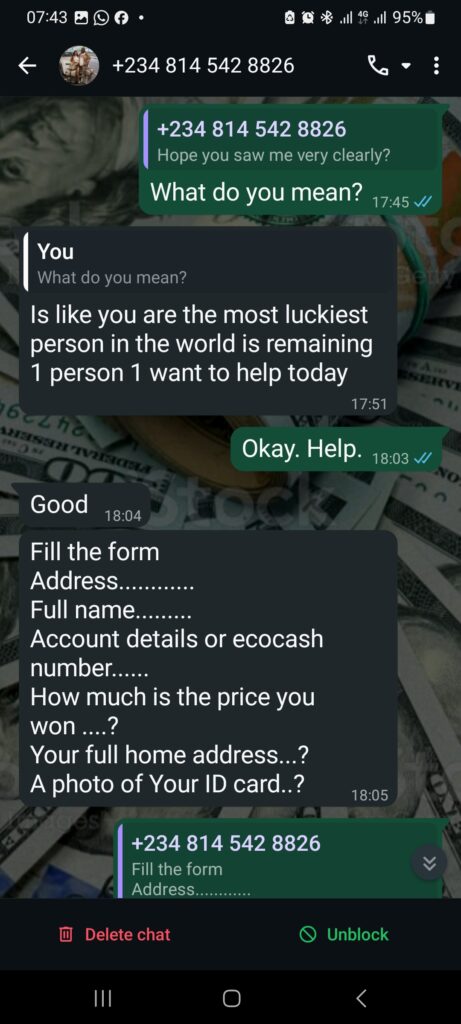
“Hope you saw me very clearly?“
This was an apparent reference to the attached pictures of Wicknell Chivayo. But I had to act confused.
When I asked what that meant, they responded:
“Is like you are the most luckiest person in the world is remaining 1 person I want to help today”
The classic scam formula was beginning to emerge.
A stranger claiming to offer a large amount of money with no clear reason.
The Information Harvesting Stage
The next message as shown in the picture attached above, revealed the likely objective.
The sender instructed:
“Fill the form“
The requested information included:
- Full name
- Home address
- Bank Account details
- EcoCash number
- Amount supposedly won
- Photograph of an ID card
At that point, one question became unavoidable:
Won where?
I asked exactly that.
The response?
“OK“
I won? But there is:
- No explanation.
- No competition.
- No promotion.
- No giveaway details.
- No evidence that any prize existed.
Yet the requests for personal information continued.
The Calls Would Not Stop
When the information request failed, the caller intensified efforts to establish direct contact.
There were repeated voice calls and video calls.
I deliberately avoided answering video calls because there was no legitimate reason for a supposed prize giver to require visual confirmation.
Later, the sender messaged:
“why are you not picking my call“
I replied:
“Good evening. I can’t take calls at the moment.”
That did not stop the attempts.
Another video call followed.
Then another message:
“okay so what are you doing right now“
I responded:
“Cooking“
The reply:
“okay all right I will call you later“
More calls followed.
Eventually, I blocked the account.
The Story Didn’t Add Up
Several questions remained unanswered throughout the exchange.
If the sender genuinely intended to give away US$30,000 and a vehicle:
- Why did they contact a complete stranger?
- Why did they need my address before explaining the giveaway?
- Why did they not know how much money I had supposedly won?
- Why could they not explain where the competition took place?
- Why did they need a copy of my identification document?
- Why did they repeatedly push for voice and video calls?
Most importantly:
Why would somebody offer a life-changing amount of money while simultaneously asking basic questions about who I am, where I live and what I do?
What Real Chivayo Giveaways Usually Look Like
One of the biggest clues was the misuse of Wicknell Chivayo’s name.
Chivayo’s public donations and gifts are widely documented on his social media platforms, Facebook and X, formerly Twitter. Recipients are usually announced publicly, and the process is generally visible to followers.
In many cases, beneficiaries are selected directly by him or through publicly documented interactions.
There is no evidence that legitimate giveaways linked to Chivayo require random recipients to submit ID copies, banking details and home addresses through unsolicited WhatsApp chats originating from foreign numbers.
Cybersecurity Experts Warn Against Sharing Personal Details
Online fraudsters frequently use celebrity names, business brands and public personalities to create a false sense of trust.
Their goals can include:
- Identity theft
- Financial fraud
- SIM swap attacks
- Account takeovers
- Social engineering scams
Once personal information is surrendered, victims can face risks extending far beyond the initial conversation.
A copy of an ID card, combined with a phone number and address, can become valuable information in the hands of criminals.
They can take loans in your name. They can withdraw all your money. They can use your account to fund crime. They can do all sorts of things.
The Bigger Lesson
This conversation serves as a reminder that scammers do not always begin with demands for money.
Sometimes they begin with a promise.
- A promise of cash.
- A promise of a car.
- A promise of a better life.
The bait is designed to trigger excitement before critical thinking takes over.
In this case, the inconsistencies appeared quickly enough to expose the scheme.
A Nigerian number claiming to be a Zimbabwean businessman. Questions that should have had answers but did not. Requests for personal information before any proof of a prize. Persistent calls aimed at building trust and urgency.
The warning signs were everywhere.
Leave a Reply