

Zimbabwean political activist Youngerson Matete has approached the High Court seeking a declaratory order compelling the government to hold a national referendum on the controversial Constitutional Amendment Bill No. 3 if it secures a two-thirds majority in Parliament.
By Advent Shoko
The legal challenge comes at a time when the Bill is widely expected to pass through Parliament, with the ruling Emmerson Mnangagwa-led ZANU PF holding a commanding two-thirds majority in both houses. Justice Minister Ziyambi Ziyambi has already indicated that the ruling party will use its whipping system during voting, meaning legislators are expected to vote along party lines rather than through a secret ballot.
Matete, the founder and executive director of Project Vote 263, argues that some provisions contained in the proposed constitutional changes affect entrenched sections of the Constitution and therefore cannot legally take effect without approval from citizens through a referendum.
The court application escalates an already heated national debate around Constitutional Amendment Bill No. 3, commonly referred to as #CAB3, which is expected to be introduced in Parliament next week.
- UK Baroness Slams Zimbabwe Constitutional Bill As “Attack on Democracy” As UK Turns To Quiet Diplomacy
- Zimbabweans In Uk Protest As Constitution Bill Sparks Democracy Fears, Chivayo’s $10k MP Donation Raises Eyebrows
- WATCH: UZA Leader Elisabeth Valerio Says Constitutional Amendment Bill No. 3 Is About “Power Retention”, Not The People
Court Challenge Targets Parliament, Mnangagwa And Justice Ministry
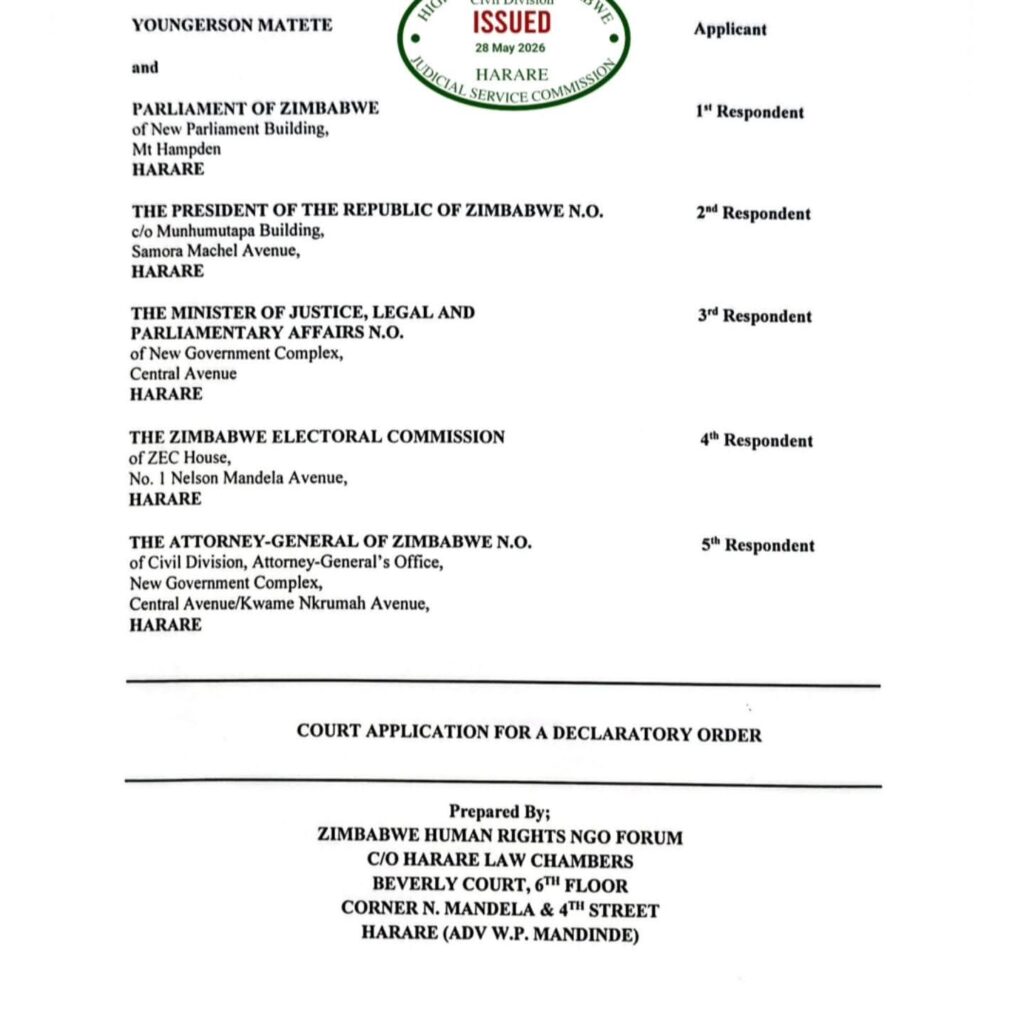
In the application filed before the High Court, Matete cites Parliament of Zimbabwe, President Emmerson Mnangagwa, Justice Minister Ziyambi Ziyambi, the Zimbabwe Electoral Commission (ZEC) and Attorney-General Virginia Mabiza as respondents.
Court papers show the matter was prepared by the Zimbabwe Human Rights NGO Forum through Harare Law Chambers, represented by Advocate W.P. Mandinde.
The application seeks to stop Parliament from forwarding the Bill to the President for assent before a referendum is conducted.

Matete Says Constitution Must Be Defended
Shortly after filing the application, Matete posted a strongly-worded statement on social media defending the legal challenge and framing it as a battle to protect Zimbabwe’s constitutional democracy.
“Today, I filed a court application at the High Court of Zimbabwe seeking a declaratory order compelling Parliament and the Ministry of Justice to refer the Constitution of Zimbabwe Amendment (Number 3) Bill to the Zimbabwe Electoral Commission for a referendum if it secures a two-thirds majority in Parliament,” he said.
“The application seeks to stop Parliament from forwarding #CAB3 to the President for assent before a referendum is conducted, as some clauses seek to amend entrenched constitutional provisions protected under Section 328 of the Constitution.”
“The Constitution belongs to the people. Democracy and constitutionalism must be defended.”
Government, Legal Experts And Critics Clash Over Referendum Requirement
CAB3 has triggered one of Zimbabwe’s most heated constitutional and political debates in recent years, sharply dividing government officials, opposition leaders, constitutional lawyers, church organisations and civic groups over whether the Bill must legally go to a national referendum.
The government insists a referendum is not necessary, arguing that the proposed amendments do not remove presidential term limits but instead seek to adjust the electoral cycle and make governance-related constitutional changes.
However, critics of the Bill argue that the proposed amendments touch on entrenched constitutional provisions protected under Section 328 of the Constitution, making direct approval by voters mandatory before the Bill can become law.
Among those demanding a referendum are former Finance Minister Tendai Biti, constitutional lawyer Fadzayi Mahere, constitutional expert Lovemore Madhuku, church organisations and several civic society groups.
Critics argue that if the proposed constitutional changes genuinely enjoy public support, the government should allow Zimbabweans to decide through a referendum instead of relying solely on Parliament.
The debate has also attracted international attention, with some activists and political figures warning that the Bill could weaken democratic accountability and public participation in governance.
Zimbabweans in the United Kingdom recently staged protests over the proposed amendments, while some foreign observers and democracy campaigners have described the Bill as a potential threat to constitutionalism.
At the centre of the legal argument is whether CAB3 alters protected constitutional provisions in a way that automatically triggers a referendum requirement under Section 328 of the Constitution.
Zimbabwe’s self-exiled former Information Minister and political science professor Jonathan Moyo has strongly rejected calls for a referendum, insisting the Constitution itself already settles the matter.
In a lengthy constitutional argument shared online ahead of parliamentary debate on CAB3, Moyo said demands for a referendum were largely political rather than constitutional.
He argued that some groups pushing for a referendum were attempting to “fill a vacuum in opposition politics” or revive fading political relevance.
Moyo also questioned pressure coming from influential church bodies, including the Zimbabwe Heads of Christian Denominations, the Zimbabwe Council of Churches and the Zimbabwe Catholic Bishops’ Conference.
According to Moyo, Zimbabwe’s constitutional history shows that referendums have historically been reserved for major constitutional transitions rather than ordinary constitutional amendments.
He noted that Zimbabwe has only held nine referendums between 1922 and 2026, most linked to major constitutional changes such as independence arrangements, constitutional replacements or political system transitions.
“Not a single one of these nine referendums was ever held on a mere adjustment or amendment to an existing constitution,” Moyo argued.
He further pointed out that the Lancaster House Constitution was amended 19 times between 1980 and 2009 without a referendum.
Moyo cited Section 328 of the Constitution, arguing that referendums are only constitutionally required when amendments affect Chapter 4, which contains the Declaration of Rights, Chapter 16 on Agricultural Land, or Section 328 itself.
“The Constitution requires referendum only for amendments to Chapter 4, Chapter 16, or Section 328 itself. That is the constitutional text, plain, deliberate, and binding,” Moyo said.
A major part of the debate revolves around Section 328(7), which critics say becomes relevant because CAB3 proposes extending presidential and parliamentary terms from five years to seven years.
Moyo rejected that interpretation, arguing that Section 328(7) only applies where amendments directly extend personal term-limit protections for office holders, not institutional electoral cycles.
To support his argument, Moyo relied heavily on the Constitutional Court ruling in Marx Mupungu v Minister of Justice, Legal and Parliamentary Affairs & Others (2021), which he said clarified that Section 328(7) protections apply only when amendments directly extend personal tenure limits.
According to Moyo, CAB3 does not alter the two-term presidential limit contained in Section 91(2), but instead adjusts the institutional election cycle under Section 95(2).
“The provision does not impose any limit on the cumulative time any individual person may serve as President,” Moyo argued.
He added that changing the presidential term from five years to seven years should therefore be viewed as an institutional adjustment rather than a personal extension of office.
Moyo also compared the proposal to Constitutional Amendment No. 2 of 2021, which extended the retirement age of superior court judges from 70 to 75 without requiring a referendum.
“The rule of law is not optional,” Moyo said.
“The sovereign will of the people, expressed in 2013 about when to hold a referendum, demands nothing less.”
Despite those arguments, critics remain unconvinced and continue warning that the proposed amendments risk weakening constitutional safeguards and concentrating excessive power within political elites.
As Parliament prepares to debate CAB3, the controversy has evolved far beyond a technical legal dispute into a broader national conversation about democracy, constitutionalism, political accountability and the future direction of Zimbabwe’s governance system.
Leave a Reply