
By Advent Shoko
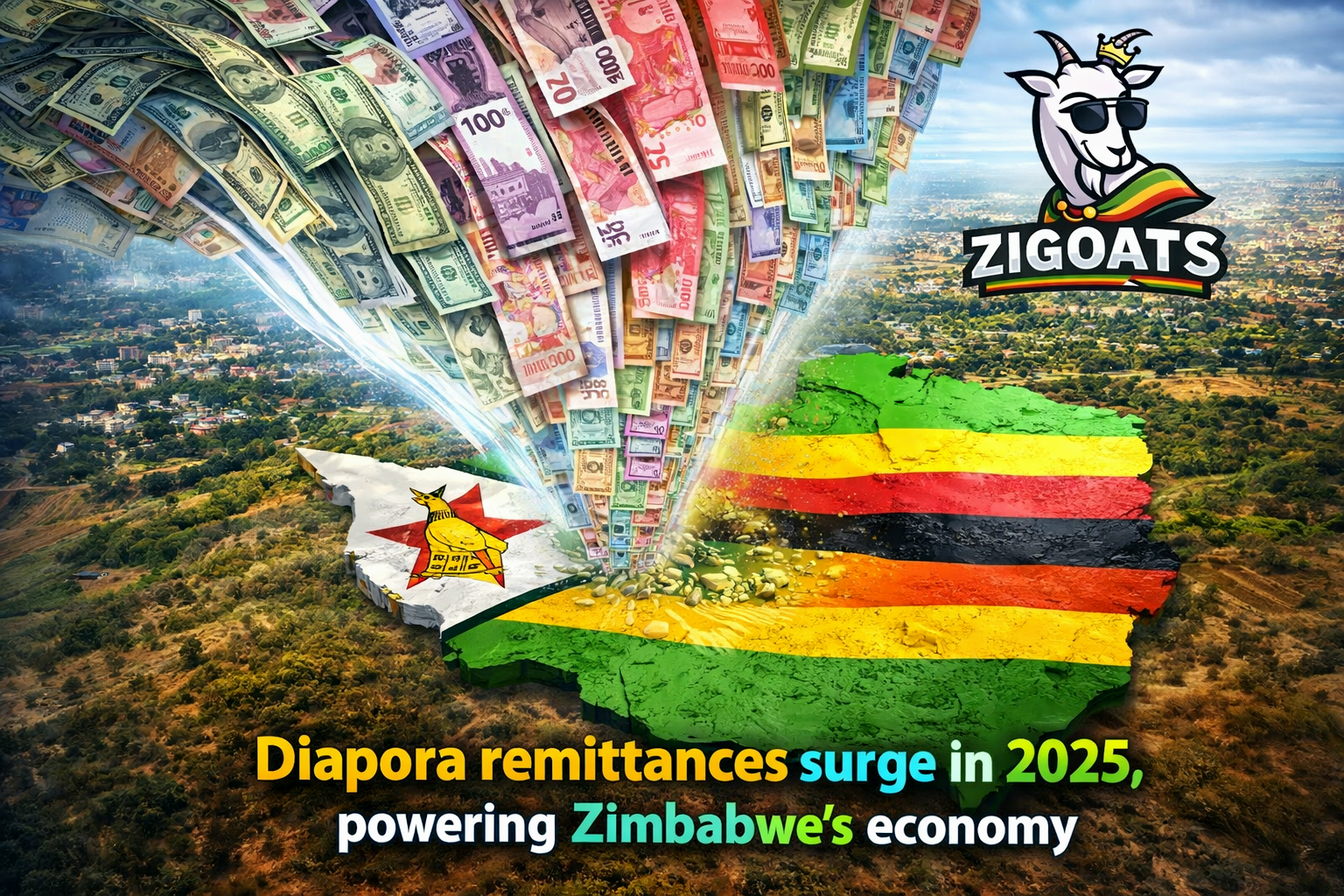
HARARE – Zimbabwe’s economy is increasingly being powered by money sent home from Zimbabweans abroad, with diaspora remittances reaching US$2.45 billion in late 2025, up about 14 % from US$2.15 billion in 2024. That means Zimbabwe received an extra US$840,000 in hard currency every single day compared with the previous year, a significant boost in foreign exchange at a time when other revenue streams remain unstable.
On average, Zimbabweans abroad remitted US$6.72 million per day in 2025, up from US$5.88 million daily in 2024, underscoring how crucial these inflows have become to households, consumption and foreign currency reserves.
A Growing Share of Foreign Currency Receipts
Central bank and finance ministry figures show remittances don’t just help families, they are a key pillar of Zimbabwe’s foreign currency receipts. In the first half of 2025 alone, diaspora inflows surpassed US$1 billion, accounting for roughly 15 % of total foreign currency receipts for that period. This means remittances are now often second only to major export earnings such as mining, which still drives the majority of foreign exchange through gold, diamonds and other mineral sales.
Indeed, diaspora remittances grew at a steady annual pace, with data showing a 7.5 % year-on-year rise in February 2025 alone. Analysts note that as traditional export earnings fluctuate, especially in agriculture and manufacturing, diaspora cash provides a reliable buffer that sustains imports of essential goods and supports households struggling with inflation and high living costs.
Shift in Where Money Comes From
Another revealing trend is where the remittances originate. While South Africa still hosts the lion’s share of Zimbabweans living abroad, the United Kingdom is poised to overtake South Africa as the top source of remittance value in the near future, reflecting changing migration patterns and higher average earnings among diaspora communities in Europe. The UK accounted for around 28.6 % of remittance inflows in early 2025, with South Africa close behind at 27.5 %, while the United States, Australia, Canada and other countries also contributed meaningful shares.
This diversification of source countries matters because it reduces concentration risk and embeds Zimbabwe more firmly in global income flows, not just regional ones. It matters particularly given that Zimbabwe Exemption Permit (ZEP) holders, approximately 180 000 Zimbabweans living and working in South Africa, have repeatedly faced legal uncertainty and threats of deportation until courts intervened and permits were extended to May 2027, safeguarding their right to remain and work legally.
Beyond Cash: Economic Impact and Policy Questions
Economists and policymakers are paying close attention because remittances now make up a significant slice of Zimbabwe’s foreign exchange earnings, in some analyses, roughly 15–17 % of total foreign currency receipts. In past years, World Bank data suggested personal remittances accounted for around 8 % of GDP, reflecting the role of the diaspora in cushioning the economy during persistent downturns and inflationary pressures.
But this growing inflow also raises “so what?” questions for long-term structural development. Critics argue that while remittances provide essential support for families, covering food, education, healthcare and small businesses, they are typically spent on consumption rather than investment. This limits their ability to transform the broader economy, where local production, exports and foreign direct investment still lag behind.
Finance Minister Mthuli Ncube and others have acknowledged the importance of remittances but also flagged the need for policies that leverage the diaspora for investment and economic development, not just short-term foreign currency relief. Plans are in motion for a Diaspora Policy that could help channel more financial flows into productive sectors at lower cost, reduce transaction fees, and encourage formal investment from Zimbabweans abroad.
Projections suggest that remittances could surpass US$2.7 billion in 2025 and possibly reach around US$2.8 billion in 2026, underpinning economic resilience even as other revenue sources remain vulnerable to global price swings and domestic structural issues.
For Zimbabwe’s economy, diaspora money is no longer just a lifeline, it’s a core economic driver. The key challenge now is transforming these daily inflows of hard currency into broader development finance, supporting job creation, industrialisation and sustainable growth, beyond the remittance buffer that has kept the economy afloat.
Please Note:
Final audited data for total diaspora remittances in 2025 has not yet been released; what is available are official projections from the 2026 National Budget Statement, which estimates that remittances will surpass US $2.7 billion in 2025 and reach around US $2.8 billion in 2026. This is the most reliable figure currently available because government reporting cycles and statistical compilation lag behind calendar years, meaning end-of-year totals are often published many months later.
Leave a Reply