
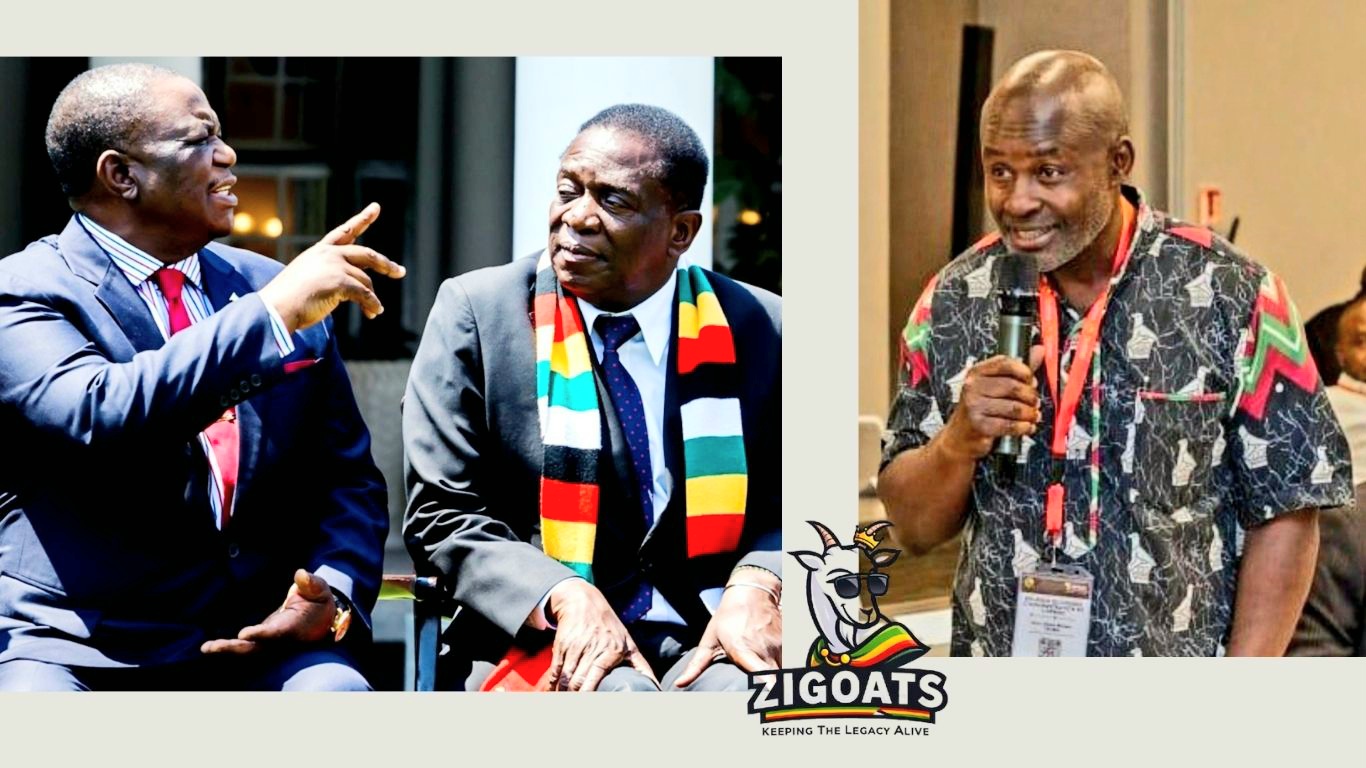
Zimbabwe’s fragile political equilibrium has been jolted by an explosive war of words that is as symbolic as it is strategic, after former Norton MP Temba Mliswa openly demanded Vice President Constantino Chiwenga’s resignation, accusing him of launching a veiled but “brazen” attack on President Emmerson Mnangagwa through a biblical allegory that has gripped the nation.
By Advent Shoko
What began as a seemingly routine church address in Murewa has now spiralled into a full-blown political moment, drawing in questions of loyalty, succession, and the real meaning behind coded language in high office.
Addressing a Roman Catholic congregation, Chiwenga invoked the story of King Hezekiah, a ruler who, after being granted 15 extra years to live, witnessed unintended consequences that would later haunt his kingdom. Without naming Mnangagwa directly, the Vice President warned that “extra years are not always a blessing,” a statement that immediately lit up political discourse, especially against the backdrop of the contentious Constitutional Amendment Bill No. 3 (CAB3), widely interpreted as a pathway to extend presidential tenure.
The Hezekiah narrative is not a neutral one. Rooted in scriptures from the books of 2 Kings, Isaiah, and 2 Chronicles, it tells of a king who secured more time through prayer, only for that extension to produce a successor, Manasseh, whose reign reversed reforms and plunged Judah into moral and political decline. It is a cautionary tale about legacy, timing, and the cost of clinging to power.
For many, the parallels were impossible to ignore.
And for Mliswa, they were unacceptable. In remarks that did little to mask the deepening fissures within the ruling establishment, Mliswa said:
“This is as brazen an attack on the President as one can ever give and coming from his own Deputy its shocking. For one so close to the President to resort to this is diplomatically gross and strategically poor.”
He did not stop there.
“The VP is now seriously endangering his standing by pandering to the whims of social media and the opposition by indulging in content creation. The subject matter which he poorly dresses in Biblical frocks instead of explicitly stating his opposition to CAB3, as any serious politician would do, shows his level of frustration.”
Mliswa’s intervention cuts to the heart of a growing tension within ZANU PF, the uneasy coexistence between official party positions and emerging dissent, however coded. His argument is simple but politically loaded: if Chiwenga disagrees with the direction of the party, particularly on CAB3, then he must step aside.
“Politically the man has been outmanoeuvred and if he is sincere that he opposes what ZANU PF has come to represent then he should resign like any self-respecting leader. What he is contesting is a party decision and he can’t continue within an entity whose thinking and direction he doesn’t accept! Resigning, not metaphors, is the only redemptive path for him.”
The bluntness of that message reflects more than personal opinion, it underscores the stakes. CAB3 is no ordinary piece of legislation. It has passed through party structures, from conference resolutions to Cabinet approval, and now inches toward Parliament, carrying with it the weight of long-term political implications.
Mliswa reinforced that point with a detailed indictment of Chiwenga’s political positioning:
“He failed to block the resolution from the Conference, Politburo, Central Committee, Cabinet, Public Hearings and we are now reaching the Parliament stage. For the ruling party he has become the main opposition, providing fodder for continued tension and instability through such veiled attacks.”
In a political landscape where silence often speaks louder than words, Mnangagwa’s own response, or lack thereof, adds another layer of intrigue. Mliswa frames it as calculated restraint.
“Fuelled by this ‘virtual army’ he has instigated multiple political infractions goading President Mnangagwa who has himself remained dignified and quiet. ED’s patience and Long-Game tactics are clearly unsettling him.”
But beyond personalities, this moment is about something deeper, the power of metaphor in Zimbabwean politics, and how history, scripture, and symbolism are often deployed to say what cannot be said directly.
Chiwenga’s Hezekiah analogy may have been cloaked in scripture, but its political resonance has been anything but subtle. It has reopened debate about leadership tenure, succession planning, and whether internal dissent is beginning to find voice in unconventional ways.
Mliswa, however, sees danger in that ambiguity.
“For the ruling party he is becoming a liability publicly questioning party resolutions and feeding the public mentality with treasonous thoughts.”
The language is strong. The implications even stronger.
At its core, this unfolding saga is not just about a Vice President’s speech or a former MP’s reaction. It is about a ruling party navigating its own internal contradictions in real time, balancing unity with dissent, loyalty with ambition, and strategy with perception.
And hovering over it all is the lesson Chiwenga himself chose to highlight: that sometimes, the extra years leaders fight for can reshape not just their legacy, but the destiny of an entire nation.
In Zimbabwe’s current political moment, that is no longer just a biblical reflection, it is a live question.
Leave a Reply