
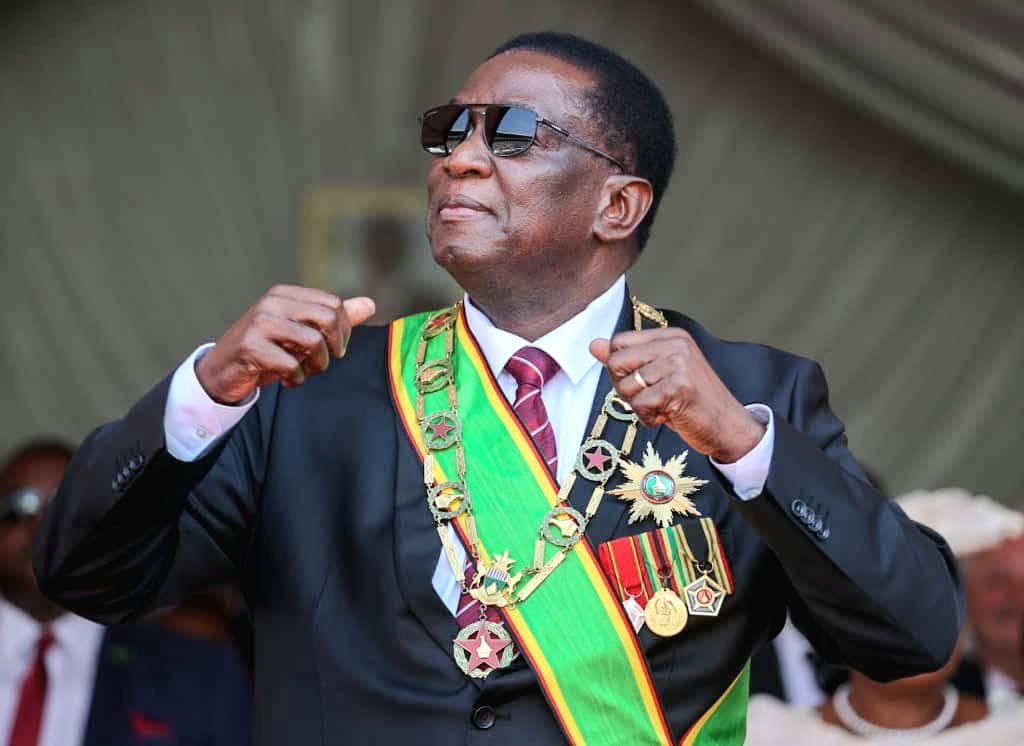
By Advent Shoko
Former Citizens Coalition for Change (CCC) leader Nelson Chamisa has criticised President Emmerson Mnangagwa over the decision to make September 15 an annual public holiday, a move that coincides with the president’s birthday.
The government has officially named the day Munhumutapa Day, presenting it as a celebration of Zimbabwe’s pre-colonial heritage and the historical Mutapa Empire.
But for Chamisa, Zimbabwe ‘s former ICT Minister during the 2009-2013 Government of National Unity (GNU), the timing raises questions about the personalisation of state institutions and national symbols.
“ZIMBABWE NEEDS SENSIBLE LEADERS…” Chamisa said in a statement published as Zimbabwe marked the first Munhumutapa Day on Tuesday.
“#JustImagine If every U.S. president had declared his own birthday a national public holiday, the United States could theoretically have 45 additional presidential birthday holidays, because 45 different individuals have served as president.”
He added: “In Zimbabwe, we need a new direction! #JustImagine #NewPolitics”
Trump’s Washington Makeover Provides A Striking Comparison
Chamisa’s reference to the United States comes at an interesting time, as President Donald Trump faces his own controversy over the reshaping of prominent public spaces and institutions.
On September 2, crews removed the 24-foot “Blue” sculpture by American artist Joel Shapiro from the grounds of the John F. Kennedy Center for the Performing Arts in Washington, D.C.
The abstract sculpture, which depicted a stick figure with an outstretched arm and leg, had stood at the Kennedy Center since 2019. Its removal was part of a broader redesign of Washington’s public spaces under the Trump administration, Reuters reported.
The development came amid a wider battle over the Kennedy Center itself, including controversy over the addition of Trump’s name to the institution and efforts to reshape its architectural and artistic identity.
The circumstances are different from Zimbabwe’s Munhumutapa Day debate, but the underlying question is similar: how far should a sitting president’s influence extend over national institutions, public spaces and symbols?
That makes Chamisa’s comparison particularly pointed.
His argument is that national institutions should represent the country and its people beyond the personality or tenure of an individual president.
In Zimbabwe, that debate has now been brought into sharper focus by a national holiday whose date coincides with Mnangagwa’s birthday.
Why 15 September?
Under Statutory Instrument 148 of 2026, gazetted this month, President Mnangagwa declared September 15 a public holiday every year, to be known as Munhumutapa Day.
The notice states: “It is hereby declared that the 15th of September every year hence forth, shall be a public holiday to be known as Munhumutapa Day.”
The date is also Mnangagwa’s publicly recognised birthday, making the decision politically sensitive.
The government has linked the holiday to the legacy of the Munhumutapa, the title associated with rulers of the historic Mutapa state, which flourished across parts of present-day Zimbabwe and Mozambique.
Officials have described the holiday as a celebration of pre-colonial greatness and Zimbabwe’s development ambitions under the country’s Vision 2030 agenda.
The government, however, has not publicly explained why September 15 specifically was selected for the historical commemoration.
That coincidence has fuelled criticism that the historical name may be providing a national-heritage cover for what is, in practice, also a celebration held on the president’s birthday.
Chamisa Raises Personalisation Concerns
Chamisa’s criticism taps into a broader debate that has followed Mnangagwa’s presidency: whether state institutions, public spaces and national events are becoming too closely associated with the sitting president.
The debate is not entirely new.
In 2019, the government approved the renaming of a number of roads, places and government buildings after national heroes and political figures.
Among them was Harare’s Enterprise Road, which became Emmerson Dambudzo Mnangagwa Road. Several other roads in cities including Bulawayo, Gweru, Mutare, Bindura, Chegutu and Masvingo were also given the president’s name.
The government defended the wider renaming exercise as an effort to reflect Zimbabwe’s history, identity and national liberation legacy.
But the decision to attach the sitting president’s name to major public roads generated criticism, with opponents arguing that leaders should not be celebrated through state institutions while they are still in office.
The latest holiday decision has revived that debate.
More Than A Holiday?
For Mnangagwa’s supporters, Munhumutapa Day is about reclaiming Zimbabwe’s pre-colonial history and giving greater recognition to the Mutapa legacy.
For critics, however, the problem is not the historical figure behind the name but the choice of date.
September 15 is not an arbitrary date. It is Mnangagwa’s birthday.
That has created an unavoidable political question: is Zimbabwe celebrating its history, the president, or both?
Chamisa’s argument is that national holidays should unite citizens around shared historical, cultural or civic milestones rather than become associated with an individual political leader.
His comparison with the United States was intended to underline that point, although the American federal holiday calendar does not treat the birthdays of sitting presidents as national holidays.
The Statue Question
The latest controversy has already fueled speculation about how Mnangagwa’s legacy will eventually be commemorated.
Zimbabwe already has monuments and statues dedicated to former leaders, most notably the late founding president and vice president Robert Mugabe and Joshua Mqabuko Nkomo, respectively.
Some predict that Mnangagwa will eventually receive similar permanent monuments although that is currently a matter of speculation, not government policy.
And as Zimbabwe observes its first Munhumutapa Day, Chamisa’s question is likely to remain part of the national conversation: where should the line be drawn between celebrating a country’s history and celebrating its political leaders?
Leave a Reply