
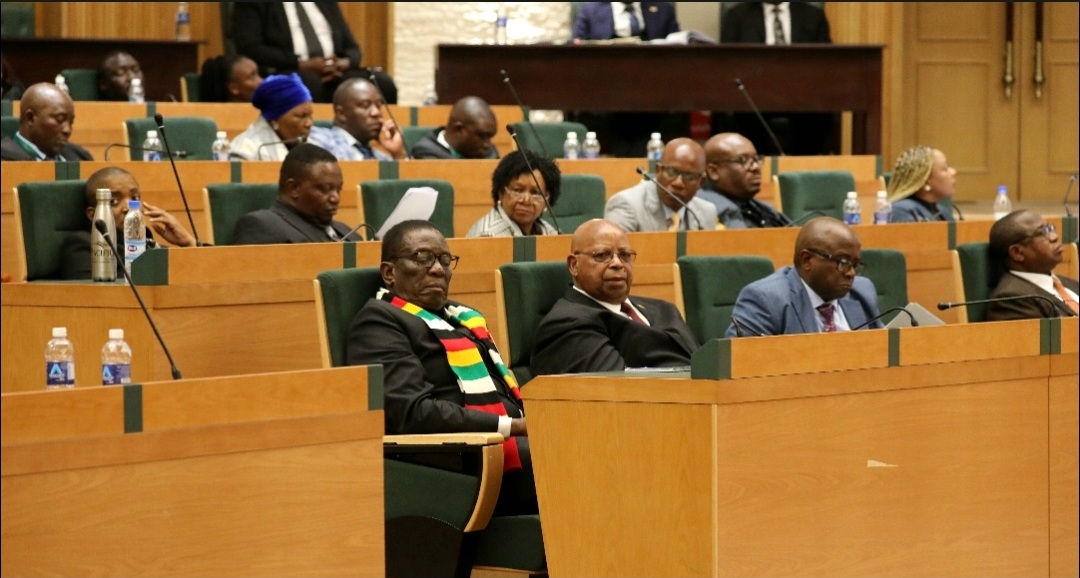
HARARE – President Emmerson Mnangagwa has summoned the National Assembly to an extraordinary sitting next week, bringing lawmakers back to Parliament ahead of schedule to consider changes made by the Senate to the controversial Constitution of Zimbabwe Amendment (No. 3) Bill before it is sent to him for assent.
By Advent Shoko
The extraordinary sitting, set for Tuesday, June 30, 2026, at 2:15pm, marks what could be the final parliamentary hurdle for one of Zimbabwe’s most consequential constitutional reform bills in recent years.
The announcement was made through an Extraordinary Government Gazette published on June 26.
The Gazette states:
“PURSUANT to section 110(2)(c) of the Constitution of Zimbabwe, His Excellency the President, Dr. E. D. Mnangagwa, has summoned the National Assembly to sit on Tuesday, 30th June, 2026, at 1415 hours. The summoning of the National Assembly is meant to enable the National Assembly to consider the Constitution of Zimbabwe Amendment (No. 3) Bill (H.B. 1B, 2026). All Members of the National Assembly must, therefore, attend the extraordinary sitting of the National Assembly at Parliament on Tuesday, 30th June, 2026, at 1415 hours.”
The notice, published under General Notice 1003 of 2026, was issued in terms of Section 110(2)(c) of the Constitution, which empowers the President to summon Parliament to an extraordinary sitting.
- Chamisa Echoes Biti, Mandaza and Dendere Calls for Transitional Government Amid CAB3 Storm
- Gift Ostallos Disowns CC MPs Who Voted For CAB3
- It Is My Turn To Feel The Pain – Mpofu On CCC MPs Who Voted For CAB3
- Chamisa Says CAB3 Fight Far From Over
Why Parliament Is Meeting Again
Although the Constitutional Amendment Bill has already passed both the National Assembly and the Senate, the upper house introduced amendments during its deliberations.
Under Zimbabwe’s legislative process, any amendments made by the Senate must be approved by the National Assembly before the Bill can be presented to the President for signature.
Justice, Legal and Parliamentary Affairs Minister Ziyambi Ziyambi has previously indicated that once both Houses agree on the final text, the Bill will be presented to President Mnangagwa for assent, after which it will become law.
What Changed in the Senate?
Among the most significant amendments is a provision aimed at resolving a constitutional gap that would arise if Zimbabwe adopts the proposed system under which Parliament, rather than voters, elects the President.
Under the current Constitution, the President is sworn into office before summoning Parliament to its first sitting.
However, if Parliament is responsible for electing the President, there would be no President in office to convene that inaugural sitting.
To address this, the Senate amended the Bill to empower the Clerk of Parliament to convene the first sitting following a general election.
Another amendment clarifies presidential succession.
The revised wording provides that the Vice-President who most recently acted as President would serve as interim President until Parliament elects a substantive President.
The Senate also inserted a 14-day deadline within which Parliament must hold its first sitting after a general election.
Supporters argue that these amendments remove practical and administrative inconsistencies that would otherwise complicate implementation of the proposed constitutional framework.
Leave a Reply