
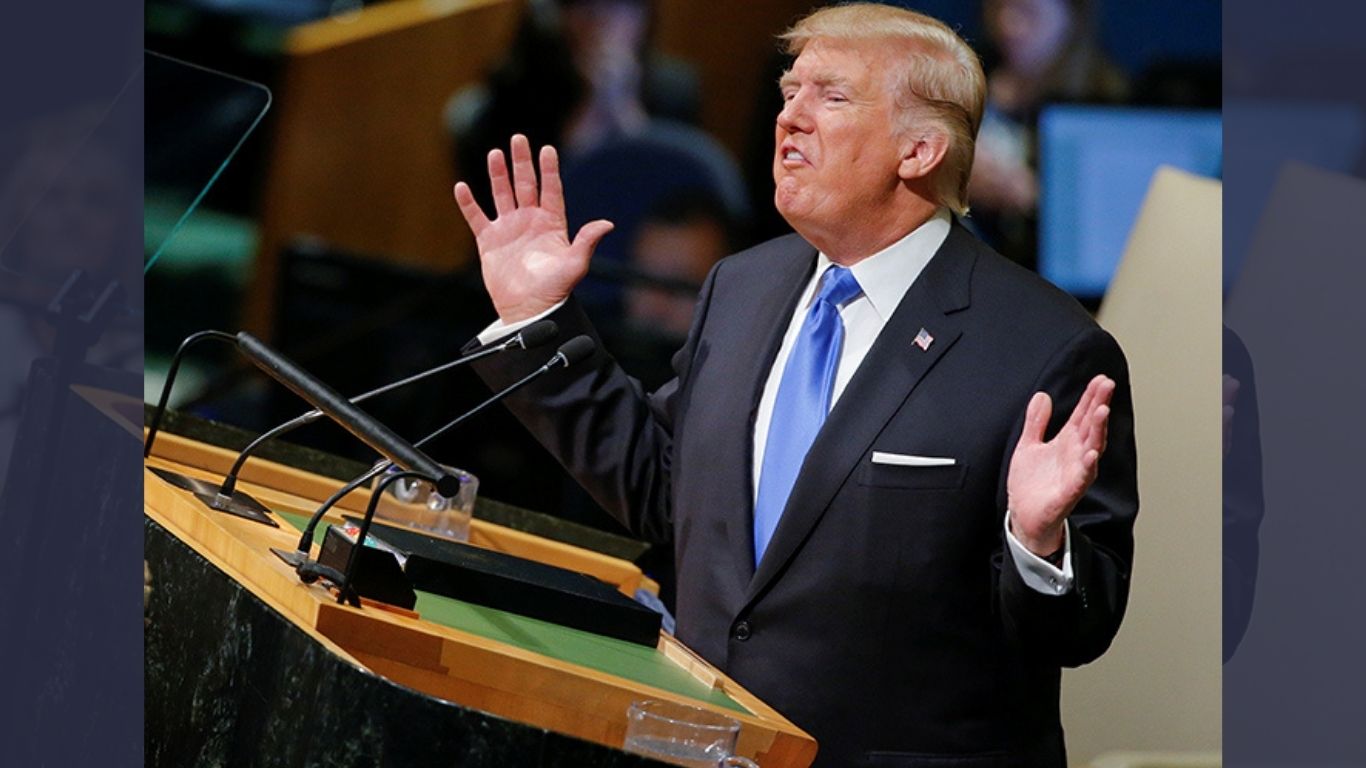
The geopolitical temperature in the Gulf has sharply escalated after President Donald Trump announced that the United States Navy would begin a blockade of the Strait of Hormuz following the collapse of talks with Iran over its nuclear programme.
By Advent Shoko
The move comes at a time when the world’s energy markets are already under strain after Iran moved to restrict traffic through the strategic waterway in response to the ongoing war involving Israel and the United States. With Washington now threatening a full naval blockade, analysts warn the crisis could spiral into a broader economic and legal confrontation with global consequences.
What Trump Said
In a strongly worded statement, Trump said the meeting with Iran had gone well on most issues, but claimed the central question of nuclear development remained unresolved.
He then declared that the U.S. Navy would move to block “any and all ships” trying to enter or leave the Strait of Hormuz.
He further threatened to interdict vessels in international waters that had allegedly paid tolls to Iran and vowed to remove any mines said to have been laid in the channel.
The rhetoric was unusually escalatory even by recent standards, including threats of direct military action against Iranian assets and personnel.
From an international relations perspective, this signals a shift from coercive diplomacy to overt maritime power projection.
Why Strait Of Hormuz Matters
The Strait of Hormuz is one of the most strategically important chokepoints in the world.
Roughly one-fifth of global oil supply moves through this narrow corridor linking the Persian Gulf to the Arabian Sea.
Major energy exporters including Saudi Arabia, Iraq, Kuwait, Qatar, and the United Arab Emirates depend on it for seaborne exports.
Any disruption here immediately affects:
- global crude oil prices
- insurance costs for shipping
- LNG supply chains
- inflation expectations
- currency stability in import-dependent economies
This is why even the threat of a blockade sends markets into panic mode.
The Geoeconomics Shockwave
From a geoeconomics standpoint, the implications are severe.
If both Iran’s restrictions and a U.S.-led blockade materialise simultaneously, the result could be a dual choke on global energy flows.
That means:
- immediate spike in Brent crude prices
- increased freight and war-risk premiums
- pressure on Asian importers like China, India, Japan, and South Korea
- renewed inflationary shocks in Europe and Africa
For economies already battling high fuel costs, this may translate into rising transport prices, food inflation, and currency pressure.
Countries such as Zimbabwe, which are sensitive to imported fuel price movements, could feel secondary economic effects quickly through pump prices and cost-of-living increases.
The International Law Question
Legally, this is where the issue becomes highly contentious.
Under international law, especially the UN Convention on the Law of the Sea (UNCLOS), the Strait of Hormuz is regarded as an international strait used for transit passage.
This generally means ships of all states enjoy the right of continuous and expeditious passage.
A unilateral blockade by any state raises serious legal questions, unless justified under:
- self-defence under Article 51 of the UN Charter
- Security Council authorisation
- law of armed conflict principles during active hostilities
Similarly, Iran’s imposition of tolls or threats to close the waterway would also face scrutiny under the same legal framework.
In short, both sides are moving into legally dangerous waters.
This is not just a military standoff.
It is also a test of international maritime law and the rules-based order.
Leave a Reply