
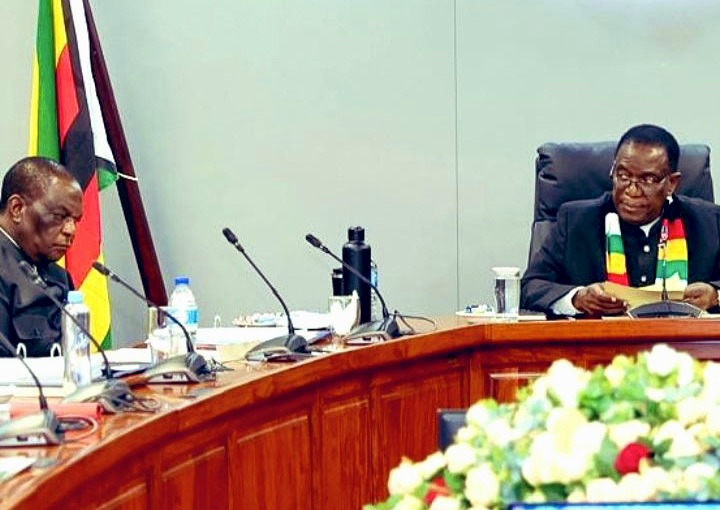
Vice President Constantino Nyikadzino Guvheya Chiwenga reportedly expressed strong reservations during a recent Cabinet meeting that adopted Constitutional Amendment Bill No. 3 of 2026, describing the proposed changes as a departure from the founding ethos of Zimbabwe’s liberation struggle.
According to reports by online publication ZimLive, the normally reserved former army commander openly challenged aspects of the Bill during deliberations, triggering what insiders described as a tense exchange at the highest level of government.
The Proposed Changes
The Bill, which has now been gazetted, proposes far-reaching constitutional amendments. Among the most consequential are:
- Extending the presidential term from five to seven years
- Aligning the electoral calendar to the longer tenure
- Altering the method of electing the President
- Restructuring succession mechanisms
- Abolishing the Gender Commission and the National Peace and Reconciliation Commission
One of the most controversial provisions seeks to transfer the election of the President from direct popular vote to Members of Parliament, a shift critics argue would fundamentally alter the “one man, one vote” principle embedded in the 2013 Constitution.
The amendments are also widely viewed through the prism of succession politics. If passed, they would effectively extend President Emmerson Mnangagwa’s tenure to 2030.
Tense Cabinet Exchange over Constitutional Amendment Bill 2026
Sources cited by ZimLive say Vice President Chiwenga “angrily interjected” Attorney-General Virginia Mabhiza during the meeting after she referenced South Africa and Botswana as comparative models for constitutional changes.
Chiwenga reportedly objected to the comparison, arguing that South Africa should not be cited alongside liberation movements that fought armed struggles for independence. One source claimed he described South Africa as “not independent” and said it should not be mentioned in the same breath as Zimbabwe’s liberation movement.
President Mnangagwa is said to have intervened, urging calm and reminding Cabinet of the importance of maintaining order during deliberations. At one point, according to reports, he asserted his authority, saying:
“I’m the president!”
Chiwenga allegedly insisted on finishing his prepared remarks, reiterating that a central grievance of the liberation struggle was the demand for “one man, one vote,” and warning that the proposed amendments undermined that foundational principle.
Liberation Credentials and Internal Friction
The debate reportedly widened beyond electoral systems.
Defence Minister Oppah Muchinguri-Kashiri is said to have pushed back against both Chiwenga and Sports Minister Lt Col (Retired) Anselem Nhamo Sanyatwe, who also reportedly opposed aspects of the amendments. Sources claim Muchinguri-Kashiri challenged what she viewed as attempts to monopolise liberation credentials.
Sanyatwe is reported to have criticised Justice Minister Ziyambi Ziyambi, accusing him of expanding the amendments beyond the scope of a ZANU PF resolution that initially sought to extend the President’s term by two years.
A Cabinet minister quoted in the reports suggested the confrontation reflected deeper succession dynamics within the ruling party. The minister reportedly said:
“The bigger issue is clearly succession politics and how leadership will be determined going forward.”
Parliamentary Process Begins
The Bill has been formally gazetted and is expected to be tabled in Parliament by Speaker Jacob Mudenda. Once introduced, it must undergo a constitutionally required public consultation period of at least 90 days before lawmakers vote.
With ZANU PF holding a two-thirds majority in Parliament, the Bill is widely expected to pass if party discipline holds. However, legal challenges are already emerging.
Legal Challenge and Referendum Debate
Prominent constitutional lawyer and academic Professor Lovemore Madhuku has argued that amendments fundamentally altering the method of electing a President go beyond routine revisions and may require a national referendum.
Madhuku has already filed an application at the Constitutional Court on behalf of six war veterans challenging the constitutionality of the proposed changes.
Legal analysts say the courts may ultimately determine whether Parliament alone can enact such sweeping reforms, or whether the people must be directly consulted.
Leave a Reply