
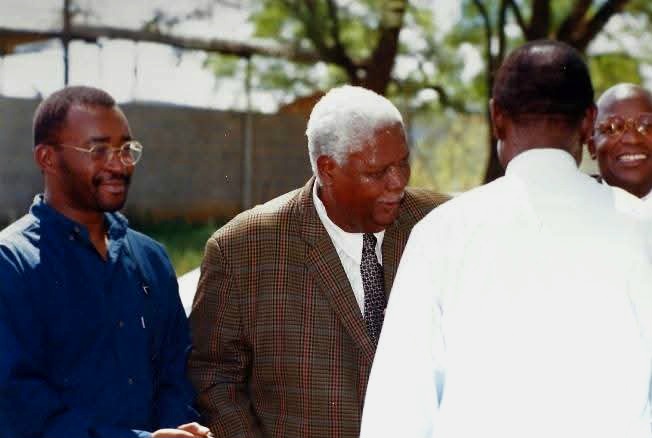
Zimbabwean billionaire telecoms entrepreneur Strive Masiyiwa has opened up about his close personal relationship with the late former Vice President Joshua Mqabuko Nkomo, describing a bond that went far beyond politics.
In a reflective post seen by ZiGoats, Masiyiwa said to claim that Nkomo loved him would be “an understatement of the century,” revealing private conversations that shaped his thinking on business, infrastructure and the role of private capital in national development.
A Grandfather-Grandson Bond With “Father Zimbabwe”
Masiyiwa described his relationship with Nkomo, widely known as “Father Zimbabwe” — as more like that of a grandfather and grandson than a political acquaintance.
According to Masiyiwa, Nkomo’s wife once told him that whenever the veteran nationalist was grumpy, a call to Strive would instantly cheer him up. Masiyiwa shared:
“He would often ask me questions to try to understand how young people thought about things.”
One recurring topic was whether private companies should build and run critical infrastructure such as telephone networks, railways and power stations.
The Telephone Debate: Government vs Private Sector
At a time when state control dominated strategic industries across much of Africa, Masiyiwa found himself defending the idea of private ownership of telecoms infrastructure. Nkomo once asked him:
“Strive, why do you want to run a telephone network? Surely those kinds of things should be done by governments?”
Masiyiwa responded by explaining that in countries like the United States, essential services, including telephones, railways, airports and even water services, were largely privately operated.
Nkomo was stunned.
“What? I don’t believe you!”
Masiyiwa promised to compile a report, in an era before the internet made research easy. When he returned with his findings days later, Nkomo reportedly admitted:
“There’s so much I don’t know about business… I had no idea that private business people could be trusted to do these things.”
That exchange would later prove prophetic.
Masiyiwa would go on to found Econet Wireless, breaking state monopoly control and ushering in a new era of private-sector-led telecommunications across Africa.
Radical Ideas, Political Realities
Masiyiwa recalls that Nkomo cautioned him to be careful. Nkomo told him:
“You have very radical ideas. People are really scared by what you say. This telephone thing has many people calling you a spy.”
At the time, the notion that private entrepreneurs could build and manage national infrastructure was controversial, even dangerous.
Yet three decades later, the continent tells a different story.
From Doubt To African Billionaires Building Infrastructure
Masiyiwa reflected on how Nkomo might have reacted if he saw what African entrepreneurs are achieving today.
He cited Nigerian industrialist Aliko Dangote, whose conglomerate spans cement, oil and gas, and refining.
He also referenced Tony Elumelu, known for major investments in power generation and financial services across Africa.
Today, in many African countries, telecommunications is largely driven by private companies. Some nations no longer even operate state-owned telecom providers, a dramatic shift from the ideological debates of the 1990s.
An Open Mind In Leadership
For Masiyiwa, what stood out most was not just Nkomo’s stature as a liberation icon, but his willingness to learn. Masiyiwa reflected:
“What I loved about him, was that a man in his late seventies and early eighties was so willing to have an open mind and learn new things that were so different from what he had previously believed.”
In today’s fast-moving tech economy, where artificial intelligence, renewable energy and digital finance are reshaping industries, that lesson may be more relevant than ever.
The question Masiyiwa leaves behind is simple yet powerful:
What have you learnt recently that has shifted a previously held viewpoint?
Because in business, and in life, growth often begins with the courage to rethink what we thought we knew.
Leave a Reply