
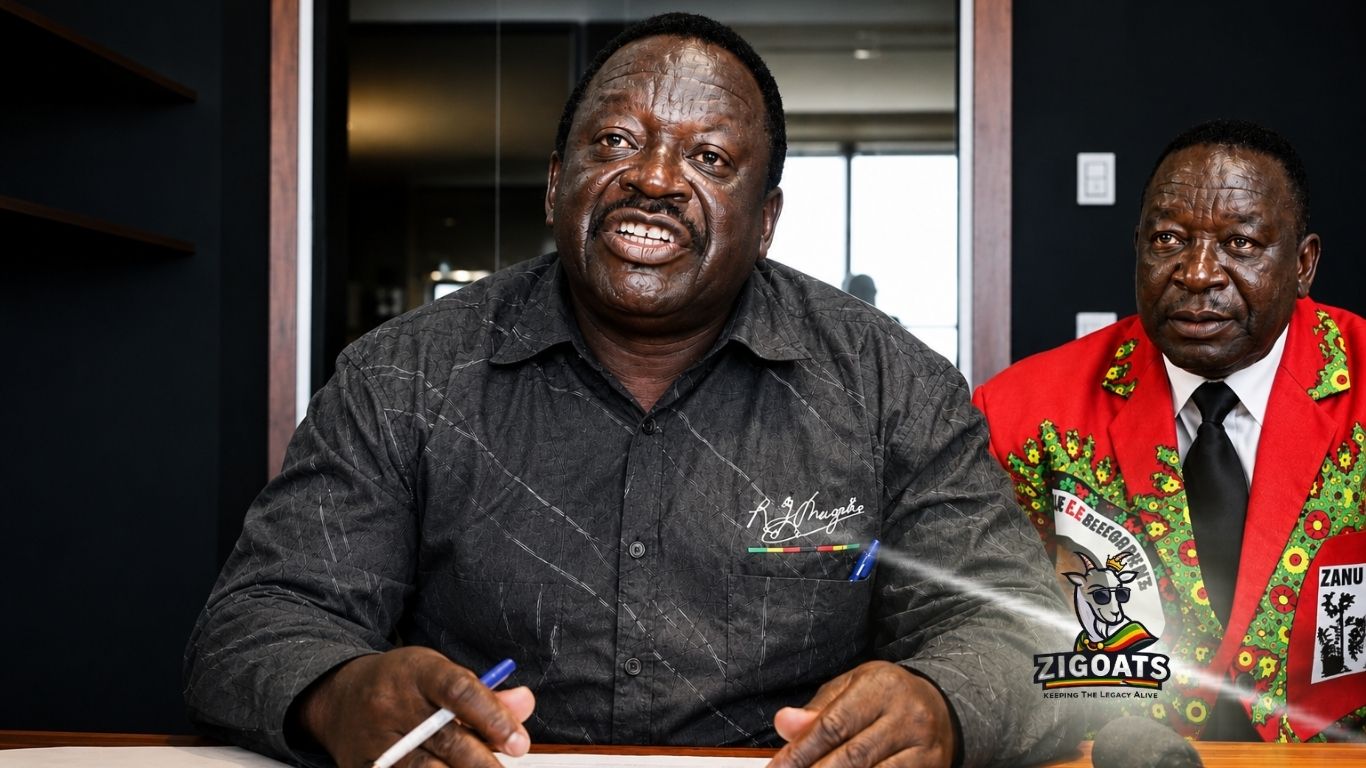
Zimbabwe’s ambassador to Mozambique and the Kingdom of Eswatini, Victor Matemadanda, one of the country’s most polarising war veterans and a key figure in the political currents that helped usher President Emmerson Mnangagwa to power in 2017, has died. He was 66.
By Advent Shoko
Matemadanda who was from Gokwe died on Saturday night, according to Information Secretary Nick Mangwana, who announced the death on Sunday.
Mangwana said the ambassador had represented both Zimbabwe and President Mnangagwa with dedication, commitment and distinction.
“Ambassador Victor Matemadanda passed away last night. This is a deeply saddening loss,” Mangwana said.
“Dr Matemadanda served as Zimbabwe’s Ambassador to the Republic of Mozambique and the Kingdom of Eswatini. Sincere condolences go to His Excellency the President, whom he represented with dedication, and to his family, friends, colleagues and the nation at large.”
His death closes the chapter on a political life that straddled liberation war credentials, war veterans’ activism, ZANU PF factional battles, government service and diplomacy. To his admirers, Matemadanda was a blunt, fearless liberation war stalwart who stood his ground when it mattered. To his critics, he was a deeply political war veteran whose influence rose with Zimbabwe’s succession wars and whose career mirrored the turbulence of the country’s post-independence power struggles.
A former secretary-general of the Zimbabwe National Liberation War Veterans Association, Matemadanda was among the war veterans who became vocal critics of the late former president Robert Mugabe during the final years of the First Republic. Together with other influential veterans, he railed against what they described as the capture of Mugabe by the G40 faction, a grouping they accused of hijacking both the ruling party and the liberation legacy.
That resistance would prove politically consequential.
As ZANU PF’s succession battles intensified ahead of the November 2017 military-assisted transition that ended Mugabe’s nearly four-decade rule, Matemadanda emerged as one of the war veterans who publicly backed Mnangagwa’s camp. In the years that followed, his role in the anti-G40 mobilisation earned him a reputation in some political circles as a kingmaker, one of the war veterans whose defiance helped tilt the balance in Mnangagwa’s favour.
It was not a cost-free role.
Matemadanda was arrested several times during the Mugabe era as war veterans turned against the veteran leader they had once fiercely defended. Their rebellion was not simply about personalities. It was also about succession, access to power and the growing belief among sections of the liberation movement that Mugabe had lost control of both the state and the party.
When the Second Republic took shape after Mugabe’s removal, Matemadanda was rewarded with influence. He was appointed ZANU PF Political Commissar, one of the ruling party’s most important mobilisation posts, placing him at the centre of the organisation’s political machinery. He also served in government as Deputy Minister of Defence, cementing his place within Mnangagwa’s post-2017 political order.
Yet like many figures who rose during the succession wars, Matemadanda remained a complicated and sometimes controversial actor.
Outspoken, combative and rarely shy to air his views, he was never a natural fit for quiet politics. His later deployment to diplomacy, first as Zimbabwe’s ambassador to Mozambique and concurrently to Eswatini, was read differently in different quarters. Officially, it was another phase of public service. Unofficially, it triggered whispers of tension between the outspoken war veteran and the political establishment back home, including unproven claims of friction with the President.
Those claims were never substantiated. But among some analysts and political observers, his posting abroad was interpreted as a way of removing a “loud” and potentially “troublesome voice” from the centre of domestic politics without humiliating him outright.
That interpretation, whether fair or not, speaks to the kind of figure Matemadanda was in Zimbabwean politics: “not easily ignored“, “not easily boxed in“, and almost never neutral.
His political journey also captured the arc of Zimbabwe’s war veterans themselves, from liberation icons to kingmakers, from defenders of the state to critics of it, and then, in some cases, back into the heart of power again. Few groups have shaped Zimbabwe’s post-independence politics as profoundly as the war veterans, and few moments illustrated that influence more starkly than the events leading to Mugabe’s fall in 2017. Matemadanda was part of that story.
In recent years, he had largely stepped away from the daily noise of frontline politics, serving in the diplomatic arena while Zimbabwe navigated difficult regional relationships, including security and political developments in Mozambique. But even in diplomatic office, his name remained tied less to protocol than to the rough-edged politics that made him.
For ZANU PF and the war veterans’ movement, his death is likely to reopen memories of one of the most volatile periods in the country’s recent history, the years when old comrades turned on Mugabe, liberation war veterans broke ranks, and the ruling party was consumed by a succession battle that reshaped the state itself.
For others, Matemadanda’s death marks the passing of one of the men who stood at the crossroads of war memory, party power and state politics, a veteran fighter who became both a symbol of liberation struggle legitimacy and a participant in the brutal factional contests of the republic he helped build.
Funeral and burial arrangements had not yet been announced by the time of publication.
Leave a Reply