
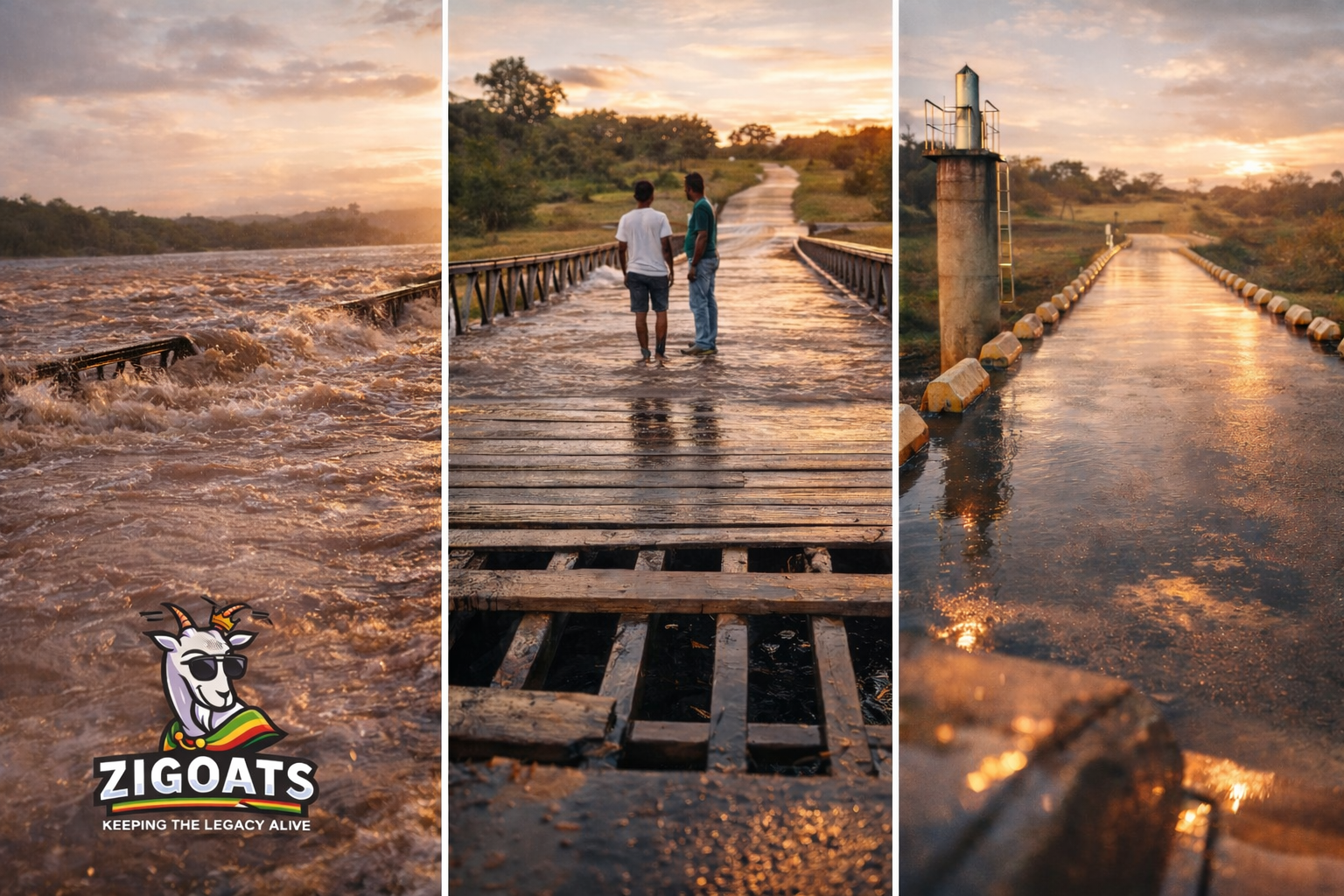
A growing humanitarian and infrastructure crisis in Mberengwa has triggered urgent calls for a state of disaster, with historian and Progressive Teachers Union of Zimbabwe (PTUZ) president Dr Takavafira Zhou delivering a powerful, first-hand account of devastation caused by heavy rains and Cyclone Gezani.
Zhou, who regularly visits his rural home, described a harrowing journey that turned into a survival ordeal. Roads have effectively vanished, rivers have swallowed bridges, and what should be a short drive now takes up to ten hours. He recounted, painting a picture of isolation and risk faced daily by residents:
“There was no road after Chamawanga… crossing the river around 19:30 hrs… retrieving the car by 11:00 hrs the next day.”
Collapsed Infrastructure at the Core of the Crisis
At the centre of the crisis is collapsed infrastructure. Key routes such as Yorks–Chomukoto, Yorks–Dholo, and Mabika–Chegato are now impassable. Health centres like Mnene and Jeka are difficult to access, while schools such as Gwayi, Mahindi, and Munyikwa have suffered structural damage. Food insecurity is worsening after crops failed due to erratic weather patterns, first excessive rains, then heatwaves, followed by flooding.
Livestock losses from January disease have compounded the crisis, wiping out what Zhou describes as “African banks” for rural households. He added:
“Dipping cattle has long ceased… government has totally failed to supply dipping chemicals.”
JEKA BRIDGE: Eight Years of Broken Promises
A particularly stark example of neglect is the Jeka Bridge over the Nuanetsi (Mwanezi) River, first destroyed by Cyclone Dineo in 2017. Authorities promised swift reconstruction, and by 2018, the government announced a $175 million road rehabilitation fund, with allocations for five bridges, including Jeka. Reports suggested $7 million was earmarked specifically for Jeka Bridge. Yet, nearly a decade later, the bridge remains a makeshift structure of wooden planks and iron bars, unstable, unsafe, and a nightmare during the rainy season.
Chief Mahlebadza Mudavanhu publicly accused former ministers Saviour Kasukuwere (Local Government) and Sydney Sekeramayi (Defence) of allegedly looting $6.8 million donated by the United Nations for Mberengwa’s roads. The Chief claimed the funds were collected on behalf of the community but were never properly accounted for.
Even Dr. Joram McDonald Gumbo, the then Transport Minister and a native of Mberengwa, appears to have taken no meaningful action to ensure a permanent solution. The prolonged delay raises an uncomfortable question: Can these officials be trusted to manage development funds responsibly? Years of unfulfilled promises leave communities frustrated and vulnerable to disasters that could have been mitigated.
A resident, speaking on condition of anonymity, lamented the chronic neglect in Mberengwa:
“Mberengwa is treated as nothing more than a vote bank for political elites. Politicians appear only during election season to secure votes and vanish like mist or migratory birds once the polls are over.”
Mberengwa has been a ZANU PF stronghold since independence, consistently delivering electoral victories. Analysts argue that the district’s persistent underdevelopment is partly because of this political loyalty: even with chronic neglect, voters continue to support the ruling party. The district now comprises three constituencies, Mberengwa West, Central, and East, all firmly in ZANU PF hands, a continuity that stretches back to 1980, when there were four constituencies.
Despite producing numerous high-ranking officials and influential figures, including the late Dr Sibusiso Moyo (Minister of Foreign Affairs), Dr McDonald Gumbo (Minister of Transport), Dr Friedrick Musiiwa Makamure Shava (Minister of Foreign Affairs), Rugare Gumbo (Minister of Economic Development), Dr Nkosana Moyo (Minister of Finance), July Moyo (Minister of Local Government), Zhou Tafanana and Zhou Tsitsi (Mines and Mining Parliamentary Portfolio Committee members) , and Dr Takavafira Zhou (PTUZ President), tangible development outcomes remain minimal. The district’s political loyalty, it seems, has not translated into meaningful infrastructure, services, or long-term investment.
Legal Threshold for Disaster Declaration
Zhou argues the situation meets the legal threshold under Zimbabwe’s Civil Protection Act for a disaster declaration, which would unlock emergency resources. He said:
“Mberengwa certainly deserves to be declared a state of disaster… the time is now.”
Governance, Accountability, and Community Development
The unfolding crisis in Mberengwa is no longer just about weather; it is a test of state responsiveness, accountability, and equitable development. Despite rich mineral deposits, including lithium, emeralds, asbestos, gold, and chrome, local communities remain underdeveloped. Critics argue that resource extraction has brought environmental damage without corresponding investment in critical infrastructure.
Without swift government action, residents will continue to suffer needlessly from disasters that were entirely avoidable with proper planning, oversight, and accountability.
Leave a Reply