
By Advent Shoko | ZiGoats
The leadership of the Apostolic Faith Mission of Zimbabwe (AFM) has been thrown into uncertainty after the High Court nullified the church’s May 3, 2025 election and ordered fresh polls within 30 days.
High Court Judge Justice Tawanda Chitapi ruled that the church’s National Apostolic Council acted outside its constitutional powers when it changed the maximum age for candidates seeking top leadership positions from 65 to 70.
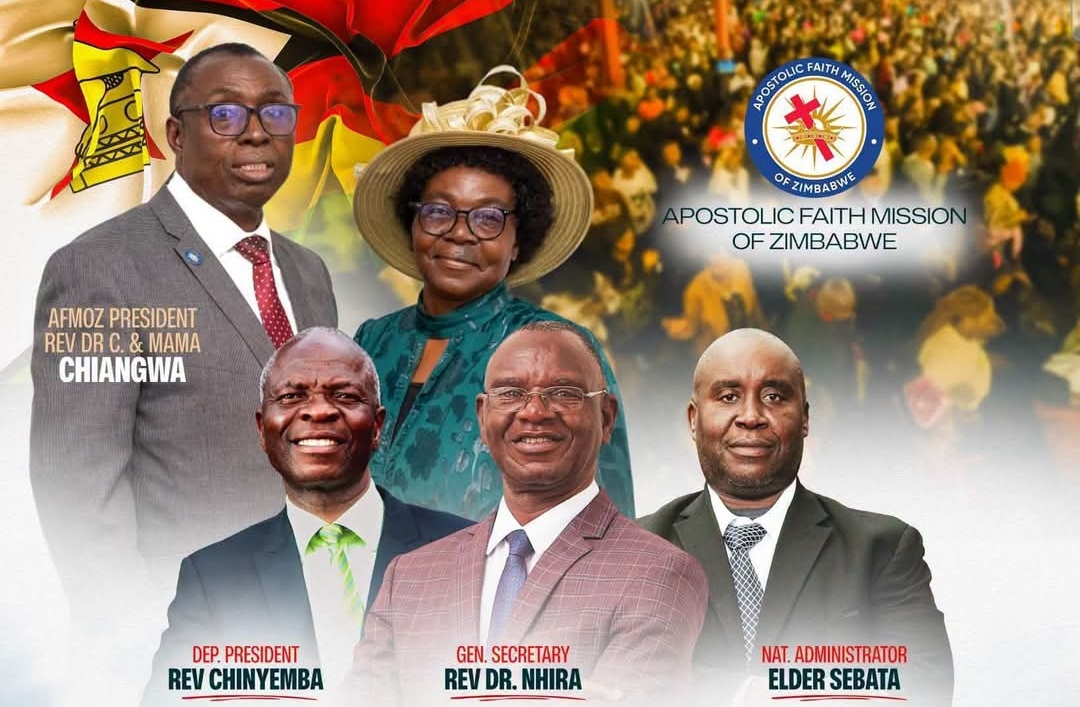
The ruling effectively invalidates the election of Reverend Dr Cossam Chiangwa as president, Reverend Amon Chinyemba as deputy president, Dr Nathan Nhira as general secretary and Shepherd Sebata as national administrator.
But the dispute is about more than an election. It has exposed a constitutional battle inside one of Zimbabwe’s oldest and most influential Pentecostal churches.
What triggered the AFM leadership dispute?
The controversy dates back to February 8, 2025, when the National Apostolic Council met at Mufaro Conference Centre in Mushagashe, Masvingo.
At that meeting, members resolved to increase the maximum age for candidates for the church’s top offices from 65 to 70.
That decision became critical because it opened the door for candidates who would otherwise have been too old to contest the May 3 election.
Church members Daniel Mhlanga and Dennis Maposa challenged the move in the High Court under Case Number HCH2288/26.
They argued that the National Apostolic Council had no authority to amend Clause 14.2.1 of the AFM constitution in the manner it did.
Justice Chitapi agreed.
The court held that the 65-year limit remained binding and that the February 8 resolution had no legal effect.
As a result, the May 3, 2025 election was declared unlawful, null and void.
Chiangwa, Chinyemba and Nhira barred from fresh poll
The ruling goes further than simply ordering a new election.
Justice Chitapi ordered that Chiangwa, Chinyemba and Nhira cannot contest the fresh election.
Only candidates who were constitutionally eligible to contest as of May 3, 2025 may stand.
The church must now elect a new president, deputy president, general secretary and national administrator within 30 days.
The judge ordered that the election must be conducted in accordance with the AFM constitution and a memorandum dated April 12, 2024.
The court also nullified major decisions and resolutions made by the disputed leadership after the May 3, 2025 election, including controversial provincial delimitation exercises.
Interim leadership ordered
To prevent an administrative vacuum, the High Court ordered the church to establish an interim committee of five former overseers.
The committee must be elected within 48 hours of the judgment and will have a tightly defined role.
It can handle administrative matters and prepare for the fresh election but cannot make policy decisions concerning the church.
Justice Chitapi said:
“The interim committee shall not be allowed to make policy decisions concerning the affairs of the first respondent.”
Dr Nhira was ordered to convene the Apostolic Council meeting needed to establish the interim committee.
The temporary structure will automatically cease to exist once a new leadership is elected or after 30 days, whichever comes first.
Why the court struck out AFM’s opposing papers
An important part of the case turned on a technical legal issue.
Lawyer C Makorokotera, representing Mhlanga and Maposa, challenged the validity of an opposing affidavit sworn by Dr Chiangwa.
The applicants argued that the date on the affidavit had been inserted by Chiangwa rather than by the Commissioner of Oaths.
AFM’s lawyer, Obey Shava, argued that there was nothing irregular about the procedure.
Justice Chitapi disagreed.
The judge held that the commissioner must administer the oath and endorse the date at the same time.
“The commissioner must also endorse the date on which the oath was administered, and those acts must occur contemporaneously,”
the judgment said.
The court consequently struck the respondents’ opposition papers from the record.
The application was therefore effectively unopposed when the substantive issues were considered.
Chiangwa disputes constitutional-breach claims
Chiangwa has acknowledged the judgment but rejected the suggestion that AFM breached its constitution.
He said the church’s position was that the matter had been decided by default because of a technical problem with the court papers.
“The High Court has not found any constitutional breaches by AFMoZ,” Chiangwa said.
“The correct position is that the matter fell on a default judgment owing to a technicality with the court papers.”
He added that the church had already used available legal remedies and was waiting for the court’s decision.
“As the matter is sub judice, we cannot discuss it further,” he said.
Nhira also confirmed that the church would issue a formal statement after its meeting.
Leave a Reply