
By Advent Shoko | ZiGoats
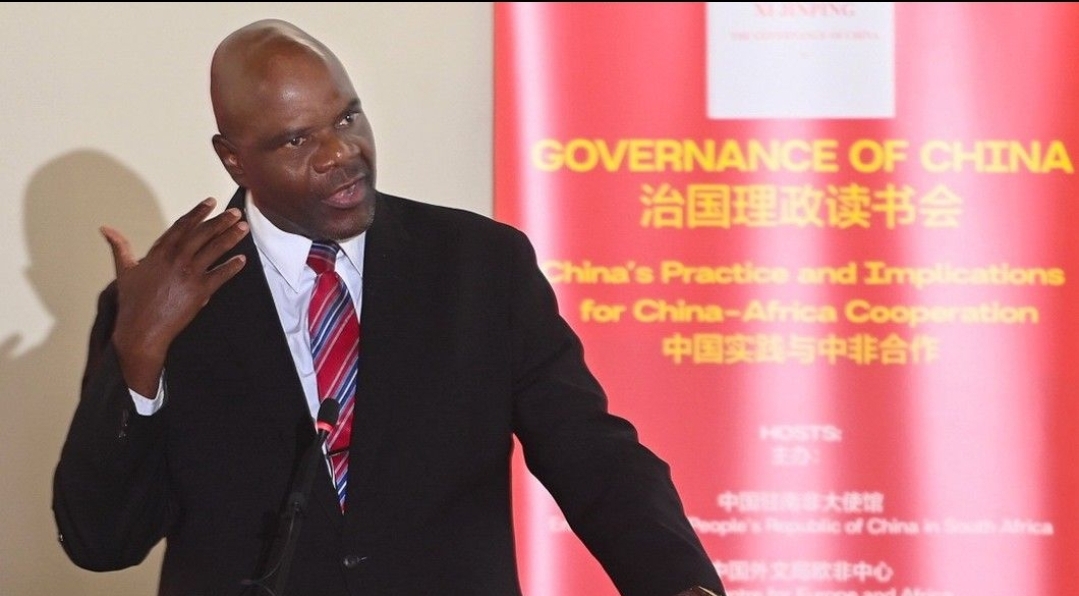
Zimbabwe’s former Deputy Prime Minister Arthur Mutambara has challenged African leaders to stop negotiating with China individually, learn from its development model and demand partnerships that prioritise local manufacturing, technology and value addition.
Mutambara called on African countries to abandon bilateral deals with China and negotiate exclusively through regional economic blocs and the African Union (AU), arguing that the continent must use its collective strength to secure better economic returns.
In a strongly worded speech delivered before Chinese and African leaders, academics and diplomats, Mutambara demanded an end to raw mineral exports to China and urged governments to prioritise partnerships that bring processing, manufacturing and industrial development to Africa.
“There must be NO export of raw materials to China. ZERO,” he declared.
“There must be partnerships with China for beneficiation, value addition, and manufacturing on the continent.”
Mutambara said Africa needed to change how it approached China while learning from the Asian giant’s governance, economic planning and investment in science and technology.
He divided his argument into two areas, namely, lessons Africa should draw from China and changes required to make Africa-China relations more beneficial.
“Whatever we do with China, we want a win-win situation,” he said.
But achieving that outcome, he argued, would require African governments to confront weaknesses in leadership, governance and economic cooperation.
‘Allow Our Best Minds’ To Lead Africa
Mutambara identified meritocratic leadership as one of the most important lessons Africa could learn from China, arguing that technical competence and the ability to implement policies should carry greater weight in selecting national leaders.
He challenged his audience to examine the educational backgrounds of China’s recent presidents and senior political leaders.
“China is allowing some of their best minds to run China,” he said.
He contrasted this with what he described as Africa’s failure to consistently place capable people in positions of authority.
“And you in Africa allow mediocrity and decency to run your country,” he said.
Mutambara argued that democratic systems should not prevent countries from selecting leaders with the expertise and ability to address complex economic and social challenges.
“The concern is, yes to democracy, yes to all these goodies, but let us allow our democracies to allow our best minds in government,” he said.
He extended the argument to cabinets, prime ministers and presidents, questioning why African countries could not do more to place highly capable people in senior decision-making positions.
His argument was that development requires more than political legitimacy. It also requires competent leadership, sound economic strategies and the capacity to implement policies effectively.
However, technical qualifications alone do not guarantee good leadership. The broader challenge is to combine expertise with democratic accountability, institutional checks and public participation.
‘When You Steal In China…’
Mutambara also turned his attention to corruption, which he identified as a major obstacle to accountable governance and economic development across Africa.
Using China’s severe penalties for corruption as an example, he challenged African leaders and officials who admire the country’s economic achievements but resist the disciplinary measures associated with its governance system.
“When you steal in China, you love China, don’t you? You work there from China, don’t you? When is going to be your first firing squad?” he asked rhetorically.
He specifically referred to corrupt ministers, police commissioners and members of parliament, arguing that public officials who abuse their positions must face serious consequences.
His remarks were deliberately provocative, questioning whether African governments were willing to confront corruption with the same determination they admired in China’s development experience.
The reference to firing squads was part of Mutambara’s argument about China’s punitive approach, rather than a proposal that African countries had formally adopted.
Mutambara’s underlying challenge was that declarations against corruption mean little without credible enforcement.
Infrastructure, AI And Critical Minerals
Beyond leadership and corruption, Mutambara identified infrastructure, technology, science, artificial intelligence and critical minerals as areas where Africa needed to strengthen its capabilities.
These priorities are closely connected to his demand that Africa move beyond exporting raw materials.
The continent possesses substantial mineral resources used in batteries, renewable energy technologies and other industrial applications. Yet exporting unprocessed resources can leave much of the value created by refining, component production and manufacturing in other countries.
Mutambara wants that pattern reversed through partnerships that establish processing plants, factories and other industrial capabilities on African soil.
His proposed changes were unequivocal.
“There Must Be NO Export Of Raw Materials To China. ZERO.”
“There must be partnerships with China for beneficiation, value addition, and manufacturing on the continent.”
The proposal would require African governments to negotiate investment agreements that support domestic industries rather than relying primarily on the extraction and export of commodities.
It would also demand significant investment in reliable electricity, transport networks, technical skills, financing and industrial infrastructure.
Without those foundations, a blanket restriction on raw mineral exports could create economic difficulties for countries that depend on commodity revenues but lack the capacity to process their resources competitively.
The practical challenge, therefore, is how to turn Mutambara’s demand into workable industrial policies that create jobs, attract investment and retain a greater share of mineral wealth within Africa.
‘No Bilateral Deals. None.’
Mutambara’s most sweeping proposal concerned how African countries should engage China.
He argued that individual countries negotiating separately risk weakening the continent’s collective bargaining power.
“Engagement with China must occur only at the level of the Regional Economic Blocs (SADC, EAC, ECOWAS, etc.) and the African Union,” he said.
“There must be NO bilateral deals between China and any individual African country. None.”
The proposal would fundamentally change the current approach to Africa-China relations, which combines China’s engagement with individual national governments and its cooperation with continental and regional institutions.
Under Mutambara’s model, regional blocs such as the Southern African Development Community (SADC), East African Community (EAC) and Economic Community of West African States (ECOWAS) would negotiate common terms with China.
The African Union would provide a continental framework for coordinating priorities and strengthening Africa’s position in trade, investment and development negotiations.
Collective negotiations could help countries pursue common standards for mineral pricing, local processing, technology transfer and industrial investment.
However, the approach would require governments with different economic priorities, resource endowments and financing needs to agree on shared conditions.
For example, a country seeking urgent infrastructure financing might have different immediate priorities from one seeking investment in mineral processing or manufacturing. Reconciling those interests would be essential to making Mutambara’s proposal workable.
Africa Must Change The Terms Of Engagement
Mutambara’s speech comes against the backdrop of longstanding concerns about Africa’s position in global commodity markets and the distribution of economic benefits from its natural resources.
China is a major trading partner and investor for many African countries, supporting infrastructure projects, trade and industrial development. At the same time, the structure of trade between the two sides remains a concern, particularly where African economies export commodities and import higher-value manufactured goods.
Mutambara’s argument is not that Africa should disengage from China. Rather, he wants the continent to negotiate from a stronger position and demand partnerships that deliver more lasting benefits.
His proposed approach also raises questions about African unity. Regional cooperation and the African Continental Free Trade Area (AfCFTA) offer opportunities to develop larger markets and strengthen intra-African trade, but coordination and implementation remain critical.
Ultimately, Mutambara wants African leaders to combine lessons from China’s economic development with a more assertive approach to trade and investment.
His message to the continent is that access to African minerals should not come at the expense of African industrialisation.
“There’s no such thing as a free lunch,” he said.
For Mutambara, the challenge is to ensure that Africa-China relations produce a genuine win-win outcome, with African countries gaining not only revenue from their resources but also the industries, technologies, skills and jobs needed to transform their economies.
Leave a Reply