
By Advent Shoko | ZiGoats
United Family International Church leader Prophet Emmanuel Makandiwa has claimed that businessman Wicknell Chivayo and his wife, Lucy Muteke, knew their time of death was approaching and were rushing to complete their charitable work.
The claim comes days after the couple died in a helicopter crash near Marondera, raising fresh questions about prophecy, spiritual guidance and the repeated predictions that surrounded Chivayo during his life.
Chivayo, 43, Muteke and four others were killed when their helicopter crashed in rural Marondera on Wednesday, September 30. Authorities said there were no survivors, while the cause of the crash remains under investigation.
Makandiwa, who had a close relationship with the couple, made the remarks in a condolence message issued on behalf of his family and church.
‘They knew their time was near’
Makandiwa said the couple were aware that their time was limited and wanted to use the remaining period to finish helping others.
“What is important to note, for those that care, is that the couple knew their time to be taken and desired for that time to be while they were at their best,” Makandiwa said.
He said their determination to give to others had led them to accelerate their charitable activities.
“Their giving and helping people was to be completed on time — hence they were in a rush to give and indeed SAVED THE BEST FOR LAST,” he said.
The wording immediately drew attention because Chivayo had used almost identical language in his final social-media post on the morning of his death.
“APPRECIATING RELATIONSHIPS BUILT OVER DECADES…SAVED THE BEST FOR LAST,” Chivayo wrote while announcing luxury gifts for two lawyers.
The post was published hours before the helicopter crash and has since generated widespread speculation online about whether Chivayo had somehow sensed that his life was coming to an end.
Makandiwa addresses the prophecy question
Makandiwa’s comments come amid criticism of Zimbabwean religious leaders who had close relationships with Chivayo.
The businessman was known to associate with several prominent Pentecostal and Apostolic church leaders, including Makandiwa, Nehemiah Mutendi and Uebert Angel.
Some social-media users have questioned why prophets who interacted closely with Chivayo did not publicly warn him about the fatal journey.
Makandiwa directly addressed the issue in his message.
“I have never seen everything, I don’t see everything, and I won’t see everything, only God does,” he said.
His explanation is significant because it rejects the idea that prophetic ministry means having complete knowledge of future events.
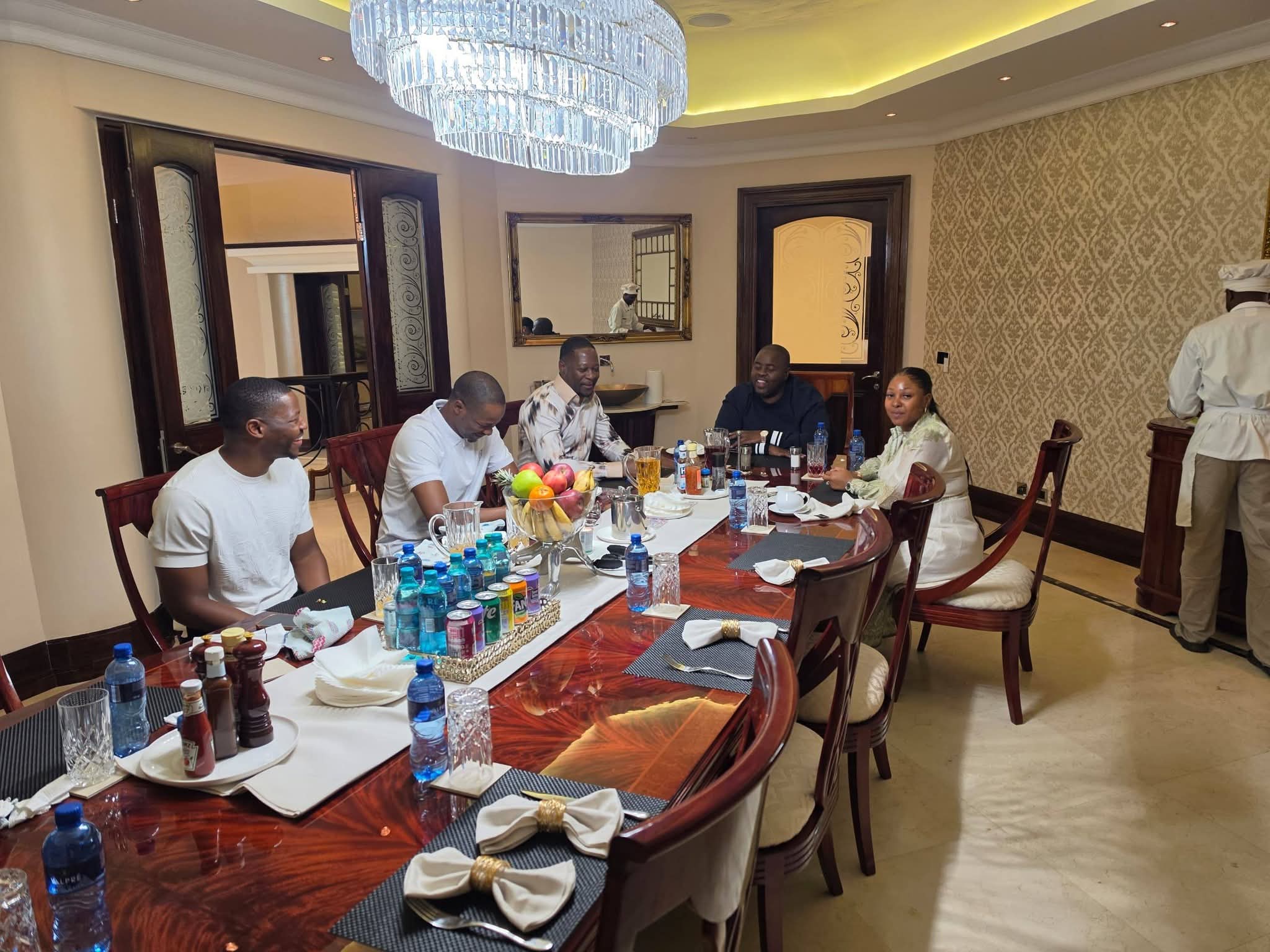
Makandiwa also recalled spending time privately with Chivayo and Muteke, including having supper at their home and holding discussions with them.
He said the details of those conversations would remain confidential.
Prophecies surrounding Chivayo
The debate has been amplified by a series of predictions and claims about Chivayo that have resurfaced following his death.
One of the most widely circulated examples is a May 2025 social-media post by Susan Mutami, who wrote that Chivayo would die in a plane crash and told readers to “save this post”. The prediction has resurfaced after the helicopter crash, although a past prediction matching a later event does not establish that it was genuinely prophetic or that the writer had foreknowledge.
Another video attributed to Prophet Passion Java has also resurfaced, with social-media users interpreting comments about an aircraft in the context of Chivayo’s death. Reports circulating online say the video was recorded in December 2025, but its relevance to the crash remains an interpretation by those sharing it.
There have also been claims in Apostolic circles about Chivayo’s future extending years ahead, including reports of prophecies suggesting he would continue enjoying extraordinary prosperity into the early 2030s.
Those claims have not been independently verified and should be treated as religious assertions rather than established predictions.
Chivayo believed in prophecy
Chivayo himself was publicly interested in prophecy and often spoke about his relationship with God.
In 2024, he claimed that a prophecy dating back to 1994 had told him he would become extraordinarily wealthy.
At the time, he said he was worth more than US$100 million and believed he was destined to become a billionaire within nine years or less.
“I just need nine years chete, if not less,” he said, claiming that he had been told during a period of prayer that becoming a billionaire was “in the works”.
That history helps explain why questions about prophecy have become so prominent following his death.
But it also highlights the difference between a person’s faith in a prediction and independently verifiable evidence that a particular prophecy accurately foretold a future event.
A relationship built around faith and generosity
Makandiwa was not simply commenting on Chivayo as a distant observer.
The two had a close public relationship, with Chivayo among the businessman’s prominent supporters.
Earlier this year, Chivayo announced a US$1 million donation towards Makandiwa’s church and publicly praised the preacher’s ministry. Reports also said he gifted Makandiwa and his wife, Ruth, a luxury vehicle.
Chivayo’s generosity towards religious leaders formed part of a much wider pattern.
He regularly announced large donations and expensive gifts to churches, musicians, sports teams, lawyers and individuals.
His final social-media post was another example, with luxury vehicles and hundreds of thousands of dollars promised to lawyers Wilson Manase and Advocate Sylvester Hashiti.
‘Only God’ knows
For Makandiwa, however, the central message following Chivayo and Muteke’s deaths is not whether every event can be predicted.
It is that human beings do not possess complete knowledge of what lies ahead.
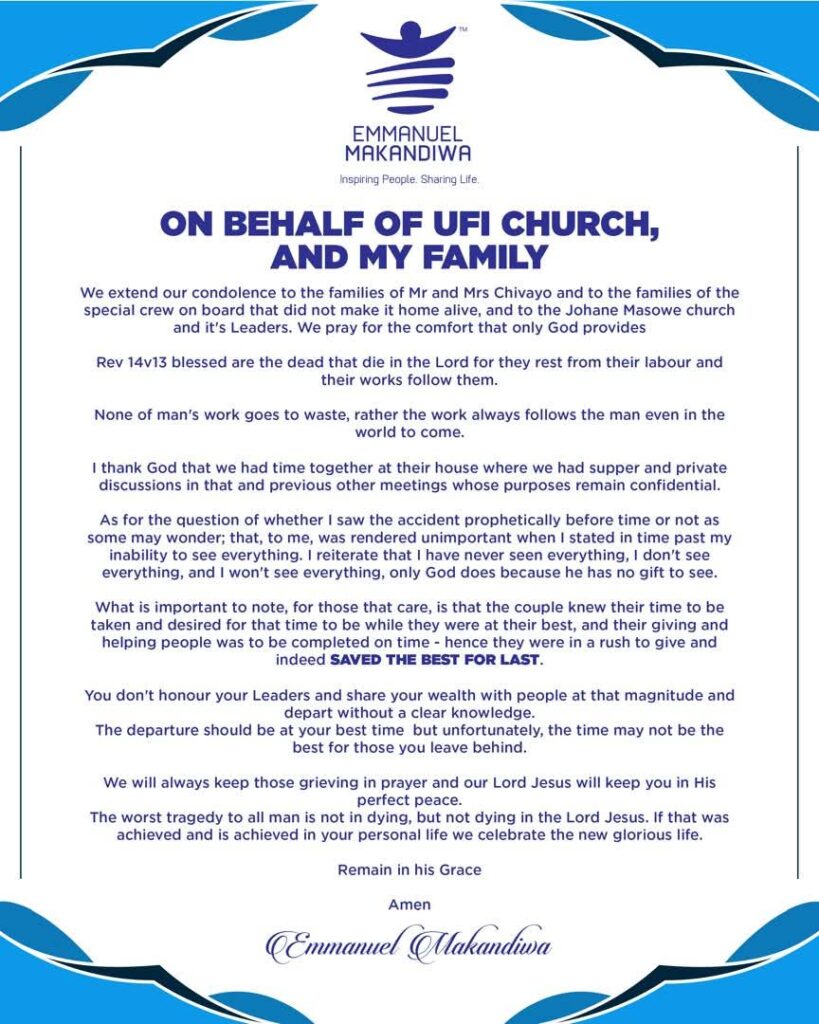
His statement, “I have never seen everything, I don’t see everything, and I won’t see everything, only God does”, is likely to become one of the most scrutinised passages of his condolence message.
It comes at a time when Zimbabwe’s religious community is facing difficult questions about prophecy, accountability and the expectations placed on spiritual leaders.
Makandiwa’s account presents the Chivayos as a couple determined to finish their work of helping others before their lives ended.
Whether readers accept that explanation as a matter of faith is ultimately personal.
What is not in dispute is that the couple’s final journey ended unexpectedly on September 30, and that the questions surrounding the prophecies associated with Chivayo are likely to continue long after the crash investigation is completed.
Leave a Reply