
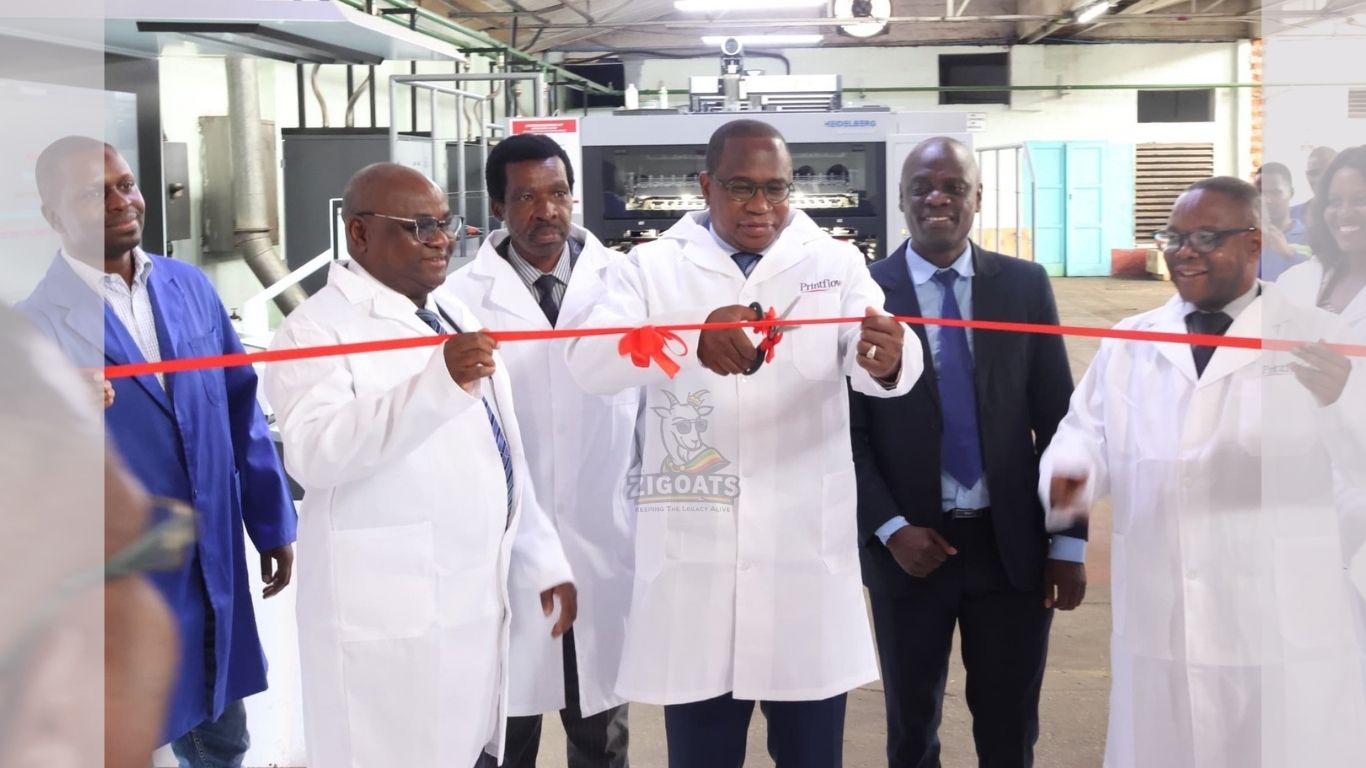
HARARE – Zimbabwe has taken a decisive step to modernise one of its most strategic but often overlooked institutions after Finance, Economic Development and Investment Promotion Minister Professor Mthuli Ncube commissioned US$3.35 million worth of advanced printing and packaging equipment at Printflow (Private) Limited, the country’s official State printing house.
Printflow is not a new player. It is the commercialised successor to the Government Printers, the entity historically responsible for producing examination papers, ballots, gazettes, passports, security documents, textbooks and official Government publications since the early years of the Zimbabwean State.
FROM GOVERNMENT PRINTERS TO PRINTFLOW
Under the Commercialisation Act of 2006, Government Printers was transformed into Printflow (Private) Limited, with a mandate to operate on commercial principles while retaining its strategic national role.
However, years of undercapitalisation and obsolete machinery left the institution struggling to compete with private printers and regional peers, until now.
The newly commissioned equipment includes the Heidelberg CX104, a world-class commercial press widely used by leading global print houses, marking Printflow’s most significant technological leap in decades.
WHY GOVERNMENT IS INVESTING
Addressing stakeholders at the commissioning ceremony in Harare, Prof Ncube stressed that Printflow remains central to Government functionality, especially in sectors where security, confidentiality and speed are non-negotiable.
“The printing and packaging industry, particularly Printflow, provides essential printing and packaging services that are critical for the smooth flow of Government operations,” he said.
The Minister also encouraged ministries, departments, agencies and private sector entities to utilise Printflow’s services, positioning the company as a national printing and packaging hub rather than a legacy institution.
The investment also comes at a time when several Registrar-General’s offices across the country are facing acute shortages of birth and death registration forms (BD1), forcing some centres to turn away clients daily. The shortage has created bottlenecks in civil registration, delaying access to essential documents required for schooling, examinations, passports and social services. With Printflow now equipped to scale up secure document printing, the upgrade is expected to ease pressure on the Registrar-General’s Department, stabilise supplies of critical forms and reduce service disruptions experienced by the public.
BEYOND POLITICS AND PAPER
Printflow’s relevance stretches far beyond routine Government work. It plays a critical role in:
- Public examinations and education materials
- Elections and democratic processes
- Official legal and policy documentation
- Secure packaging for sensitive materials
With the new machinery, Printflow’s production capacity, turnaround time, print quality and security features are expected to improve significantly, reducing reliance on external printers and cutting costs for the State.
A TEST CASE FOR STATE ENTERPRISE REFORM
The recapitalisation is also being read as a practical test of Zimbabwe’s State enterprise reform agenda. Rather than privatisation, Government has opted for commercialisation with strategic control, aiming to prove that State-linked entities can be efficient, competitive and sustainable.
By boosting Printflow’s efficiency and output, Treasury is effectively betting that the entity can reclaim its position as the first-choice printer for Government and a serious competitor in the private market.
A QUIET BUT CRITICAL RESET
In an economy where manufacturing capacity has steadily declined, the revival of Printflow signals a quiet but important industrial reset.
It may not grab headlines like mining or mega-infrastructure, but for education, governance, elections and public administration, a functioning, modern national printer is indispensable.
With its new equipment now operational, Printflow is no longer just a former Government department with a new name, it is being repositioned as a modern State-backed commercial printer, built for efficiency, security and scale.
Leave a Reply