
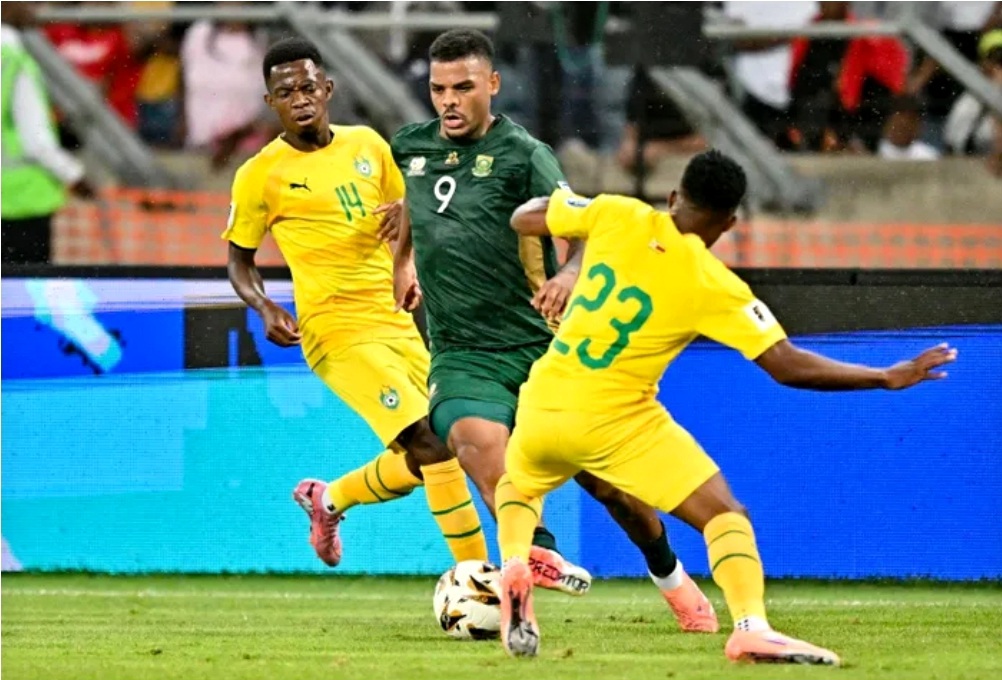
South Africa’s legendary football voice Baba Mthethwa has delivered a passionate defence of Bafana Bafana’s frontline, insisting the national team does not have a striker crisis despite comparisons with Europe’s elite number nines.
By Advent Shoko
In trademark straight-talking style, the renowned commentator said South Africa may not boast a natural goal machine in the mould of Erling Haaland or Robert Lewandowski, but the country has forwards whose game perfectly fits the demands of modern football.
“Honestly, we don’t have a striker problem in Bafana Bafana because we qualified for the World Cup with Lyle Foster and Evidence Makgopa.”
That statement cuts to the heart of a debate that has dominated South African football circles in recent months, with fans and pundits questioning whether Lyle Foster and Evidence Makgopa can consistently deliver on the biggest stage.
But Baba Mthethwa is having none of it.
He argues that the duo have already answered critics by helping Bafana Bafana secure qualification for the 2026 FIFA World Cup, ending years of frustration and returning the nation to football’s grandest stage.
According to Mthethwa, modern football has evolved beyond the traditional reliance on a physically dominant number nine.
“In modern football you don’t need a natural-born striker. What you need is a false nine and an attacking midfielder.”
It is a tactical point that resonates strongly with how many top national teams now operate.
Rather than building their attack around one prolific centre-forward, teams increasingly spread the goal burden across attacking midfielders, wide forwards, and supporting runners.
For Bafana Bafana, that model has worked.
During their successful World Cup qualifying campaign, goals came from across the team, including Thalente Mbatha, Mofokeng, Oswin Appollis, and Makgopa himself.
Mthethwa pointed directly to that collective contribution.
“Mbatha scored for us, Mofekong scored for us, Appollis scored for us, all of them scored. That’s modern football.”
His comments arrive at a time when some former players and analysts have questioned the continued inclusion of Foster and Makgopa in Hugo Broos’ plans.
Yet the veteran broadcaster believes criticism of the pair ignores the bigger tactical picture.
Foster brings movement, pressing intensity, and intelligent runs into space, while Makgopa offers physical presence, aerial strength, and an ability to link play in the final third.
Those qualities, Mthethwa suggests, are just as important as raw goal numbers.
That said, one issue continues to cast a shadow over the growing optimism surrounding Bafana Bafana’s World Cup return, their conversion rate in front of goal.
While South Africa have shown encouraging attacking movement, pace in transition, and an ability to create promising openings, supporters remain concerned by the number of chances that go begging.
In several recent outings, Bafana have controlled large spells of the game and fashioned clear opportunities, only to lack the clinical finish needed to put matches beyond reach.
This is where the anxiety among fans truly lies.
It is not necessarily the absence of a Haaland-type striker that worries supporters, but rather the team’s ability to turn dominance into goals against elite opposition.
Ahead of the World Cup, that lingering inefficiency in the final third has fed a sense of pessimism among sections of the fan base, who fear that missed chances on the global stage could prove far more costly than they did in qualifying.
Even Baba Mthethwa’s defence of the current attacking options indirectly points to the same concern.
“The only problem we have is how to convert our chances.”
That frank admission may well be the most important line in the entire debate.
Because at World Cup level, opportunities are often few and far between.
Against top-tier nations, failing to convert one or two clear openings can be the difference between qualification for the knockout rounds and an early flight home.
Still, Mthethwa remains convinced that South Africa’s strength lies in collective attacking football rather than individual star power.
“We don’t have Erling Haaland in South Africa, we don’t have Lewandowski in South Africa, but we have our Evidence Makgopa and Lyle Foster.”
That line is likely to resonate with supporters who understand that Bafana’s strength lies in system football rather than superstar dependence.
It is also a reminder that international football success often comes from balance, discipline, movement, and collective execution.
Baba Mthethwa, famous for his electrifying Sesotho commentary and the iconic “Ho thaaata banna!”, remains one of the most respected voices in South African football media.
Having begun his career at SABC in 1997, he has covered numerous Soweto derbies, AFCON tournaments, and FIFA World Cups from 2002 to 2022, building a reputation for tactical insight as much as passion.
As Bafana Bafana prepare for the World Cup, the real question may no longer be whether they have a Haaland-type striker.
Instead, it is whether this modern attacking unit can become ruthless enough in front of goal when it matters most.
And if Baba Mthethwa is right, South Africa already has the players, they now simply need the finishing touch.
Leave a Reply