
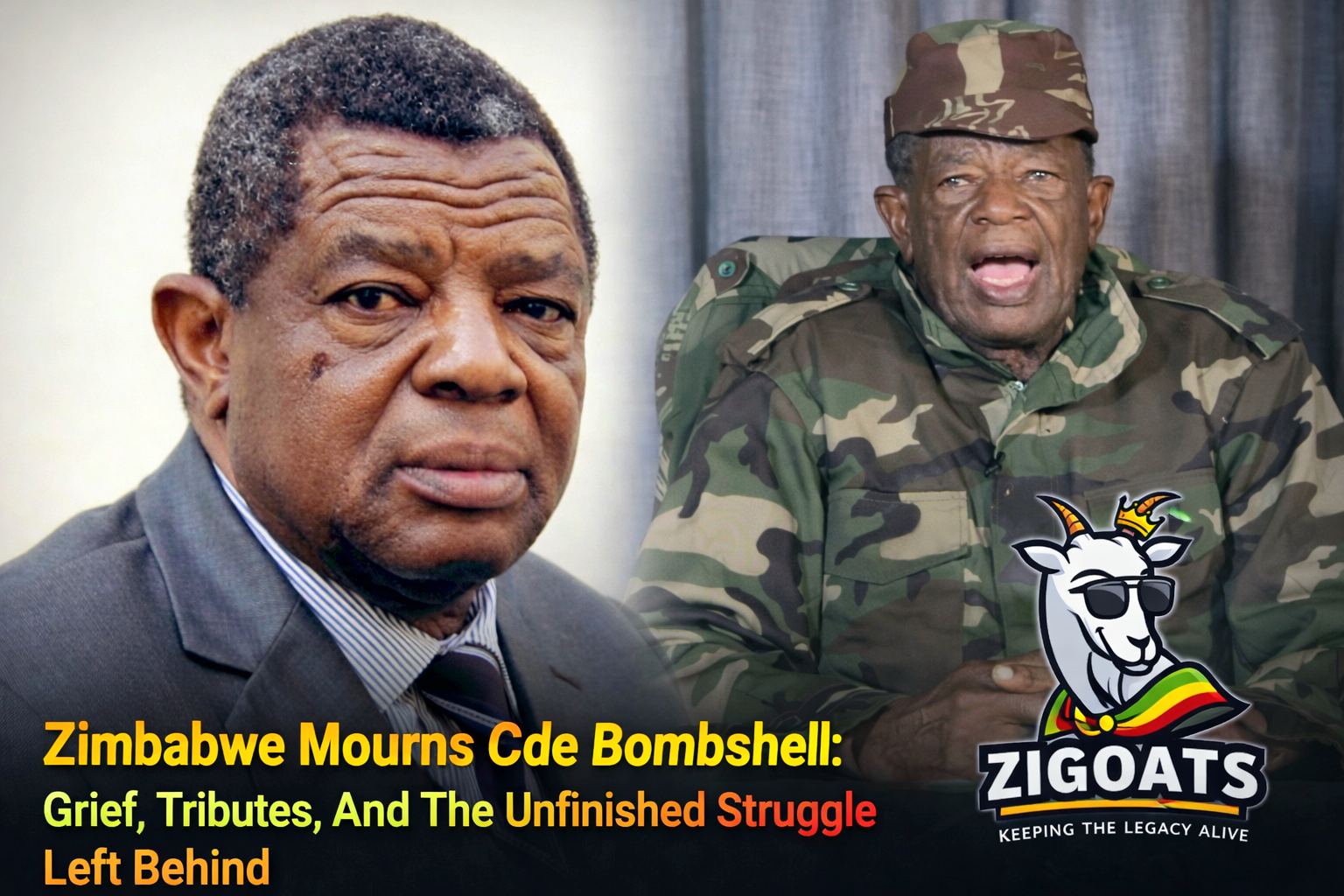
Zimbabwe Mourns Cde Bombshell: Grief, Tributes, And The Unfinished Struggle Left Behind
By Advent Shoko
Zimbabwe woke up on Friday, 6 February 2026, to a heavy, unsettling silence. The kind that settles before bad news fully arrives. By mid-morning, that silence had broken into disbelief, whispered phone calls, and frantic refreshes of social media timelines as word spread that war veteran Blessed Runesu Geza, popularly known as Cde Bombshell, had died in exile in South Africa after a long battle with cancer.
By afternoon, his name had become a refrain on WhatsApp statuses, murmured in commuter omnibuses, debated cautiously in workplaces where politics has learned to live behind lowered voices. Some mourned openly. Others grieved quietly. Many argued. All felt the weight of it.
He was a liberation fighter, a former ruling party insider, a rebel voice, a hunted dissident, a polarising figure, and to many, a man who chose conscience over comfort when it mattered most.
In a brief but emotionally loaded statement, the Geza family confirmed his passing at a cardiac hospital in South Africa, urging Zimbabweans to mourn with dignity and warning against opportunists seeking to “cash in” on his death.
“Mr Geza touched many lives with his fight for justice to ensure that all Zimbabweans realise their aspirations,” the family said, adding that funeral arrangements would be announced in due course.
The statement landed like a final punctuation mark on a life that had refused to end quietly.
- Madzibaba Veshanduko Sends Regards From Prison
- Zimbabwe JSC Confirms Chief Justice Malaba’s Retirement – Why It Matters
- Video: Why Tongogara Never Entered Independent Zimbabwe – Not Just A Car Crash
A Flood Of Tributes – And Questions
Reactions poured in within minutes, cutting across political divides and exposing old wounds.
Former Local Government minister and ZANU PF political commissar Saviour Kasukuwere, himself living in exile, struck a tone heavy with loss and irony. Kasukuwere said:
“He fought for our country during the liberation struggle when many were afraid… He went when he was a very young man.
It is very unfortunate that he had to die in a foreign country, away from the land for which he sacrificed everything.”
For many Zimbabweans, that line hit painfully close to home. Exile has become a shared national condition, not just an elite political fate.
Kasukuwere framed Geza as part of a restless liberation generation, fighters who never stopped arguing with power when they believed the struggle had gone off course. He said:
“That is not a sign of weakness, it is a sign of strength.”
From the opposition, CCC former deputy spokesperson Gift Ostallos Siziba offered condolences that were reflective but also ignited controversy. Siziba said:
“He ran his race with courage and spoke truth to power… it is now our duty to complete the unfinished business of the liberation struggle.”
Within minutes, criticism followed. Some questioned the sincerity of late solidarity, recalling how Geza’s 2025 call for a national shutdown, meant to force President Emmerson Mnangagwa to step down over alleged corruption and constitutional overreach, was met with silence from many opposition figures.
In death, as in life, Geza exposed uncomfortable truths about courage, timing, and political convenience.
Yet even as tributes continued to flow, one absence was loudly felt. Many Zimbabweans were still waiting to hear from Nelson Chamisa. The former opposition leader had previously and publicly distanced himself from the Geza movement, insisting he had been included without his consent and without any formal engagement. That distance, once political, has now become emotional, and deeply scrutinised. On social media, the waiting turned into pointed reflection. One social media user told Chamisa:
“We await your post on Geza’s death, just to read the compass of your convictions. Sometimes what a leader chooses to say, or chooses not to say, tells the real story.”
It is an uncomfortable moment. Silence, in grief, is never neutral. What, many are now asking, can Chamisa possibly say, without reopening old wounds, or without seeming to arrive too late?
In death, as in life, Blessed Geza has once again forced Zimbabwe’s leaders to confront the cost of distance, the politics of caution, and the burden of choosing when, and whether, to speak.
Whe Was Blessed Geza, Really?
Blessed Geza joined Zimbabwe’s liberation struggle at a young age, part of a generation that traded childhood for war and returned home believing independence would guarantee dignity.
Like many war veterans, independence did not end his political life, it absorbed it. He rose through ZANU PF, becoming part of the system that governed post-colonial Zimbabwe. In 2017, he was among those who supported the removal of Robert Mugabe, believing the transition would reset the country’s moral and political compass.
It did not.
What followed was disillusionment, anger, and eventually rupture. Geza became one of the most vocal critics of Mnangagwa’s administration, accusing it of unprecedented corruption, state capture, and betrayal of liberation values.
What made his later years different was not just dissent, it was naming names.
He publicly accused the President, his family, and powerful business figures including Kuda Tagwirei, Scott Pedzai Sakupwanya and Wicknell Chivayo of looting national resources. He apologised for his role in Mugabe’s removal, calling what followed “a nightmare.” In a political culture built on silence and denial, that apology was radical.
He chose voice: The price was exile
He died far from home, in a country of borrowed shelter and borrowed time, a fate painfully familiar to many Zimbabweans whose politics or poverty forced them across borders.
“He Spoke Anyway”
Opposition leader Jacob Ngarivhume summed it up simply:
“This man was courageous and embodied the true spirit of Zimbabwe nationalism. A true and genuine hero through to his death.”
Youth activist Makomborero Haruzivishe reshared a long reflection that refused to sanitise Geza’s record. It acknowledged his past complicity while recognising the political rupture his final reckoning represented. Geza, the reflection argued, did not exit history cleansed, he exited speaking. That choice made him dangerous to power. And it chased him into exile.
Words That Now Read Like A Farewell
Perhaps the most haunting reaction came from Geza himself.
Just hours before his death was announced, his X account published a long message, now widely read as a goodbye. He wrote:
“I am in pain that I might not see the new Zimbabwe after Emmerson, but I take solace in the hope that you will continue the faith.”
He spoke of fallen comrades, of dignity stolen under colonialism, of betrayal after independence, and of a state captured by corruption. He concluded:
“I vow to fight this from the grave.”
For a man who spent his life fighting over Zimbabwe’s future, death arrived quietly, without ceremony, far from the crowds that once listened to him.
He succeeded in breaking the silence.
He failed to live long enough to see change.
The Struggle Continues – Behind Bars And In Exile
As Zimbabwe mourns, others remain imprisoned for answering Geza’s call. Madzibaba Veshanduko, arrested for participating in Geza-inspired demonstrations, remains behind bars. His detention has become a stark symbol of the climate Geza warned against, a country where dissent is criminalised and justice feels selective, delayed, and weaponised. One widely shared message captured the moment:
“He chose conscience over comfort. He knew the cost of speaking out. And he spoke anyway.”
Not An Ending, But A Question
Blessed Geza did not leave behind a clean legacy. He left behind a difficult one. He was both insider and outcast. Builder and breaker. Complicit and defiant. But in his final chapter, he forced Zimbabwe to confront an uncomfortable truth: liberation is not a finished event, and silence is not neutrality.
As the country mourns Cde Bombshell, the question he leaves behind is not whether he was perfect, but whether Zimbabwe is ready to confront the system he dared to name.
Even in grief.
Even in anger.
The struggle he spoke of refuses to die. And perhaps that, more than anything else, is his final inheritance.
Leave a Reply