
By Advent Shoko
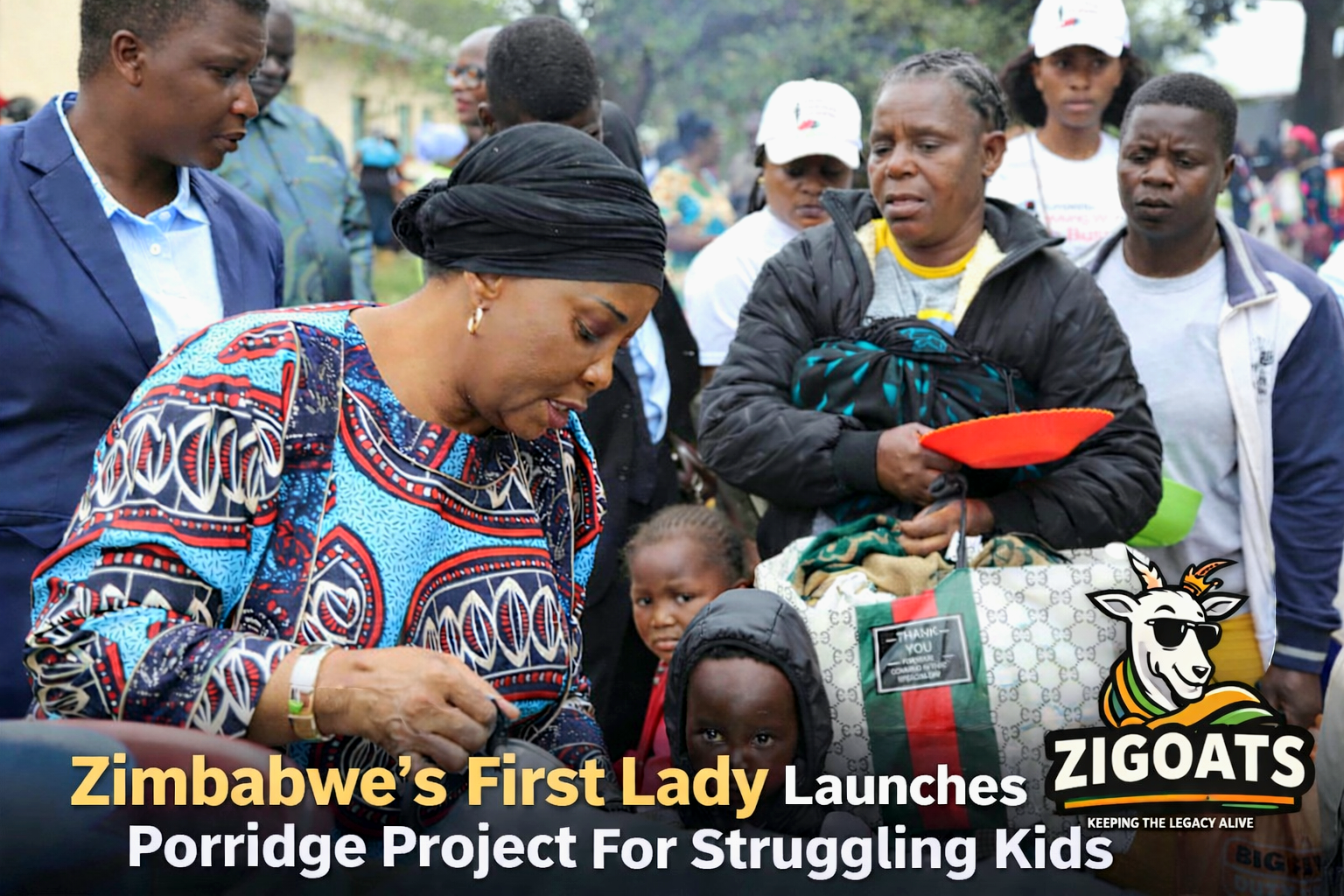
Zimbabwe’s First Lady, Dr Auxillia Mnangagwa, has unveiled the Toddlers Warm Bowl Project, a new porridge initiative aimed at feeding and nurturing struggling children and families. Speaking at the launch on Thursday, Amai Mnangagwa said the project is designed to provide nutritious, health-approved porridge at a critical stage in child development, easing the burden on parents and strengthening community health. She personally served porridge to mothers and toddlers, even teaching families how to prepare it at home. Alongside this, she distributed food hampers to further support food security within attenders’ households.
Speaking after the launch, the First Lady framed the initiative as both a nutrition and community-building intervention, saying:
“I am delighted to have launched a new initiative, the Toddlers Warm Bowl Project, designed to provide nutritious porridge to children at their critical stage of development. Multitudes of mothers, accompanying their toddlers, joined to receive nourishing, health-approved porridge… Every child matters, and this project eases the burden on families while strengthening our community.”
She added that beyond feeding children on the day, the goal was to transfer knowledge, noting that she personally prepared and served the porridge while teaching mothers how to make it at home, complemented by food hampers to promote household food security.
Porridge Project Not Isolated Initiative
The porridge project forms part of a broader humanitarian portfolio championed through her Angel of Hope Foundation, which focuses on health, education, youth and women’s empowerment across Zimbabwe’s most vulnerable communities. Past initiatives include free eyesight checks and distribution of spectacles and food hampers to the elderly, disabled, and persons with albinism, in partnership with the Chinese Embassy, highlighting inclusive outreach beyond food support. Amai’s foundation has also sponsored aviation scholarships for academically gifted but underprivileged students, a rare and ambitious investment in future leaders. The Angel of Hope Foundation runs mobile health clinics, school feeding programmes and women’s empowerment projects, such as sewing and meat production training, which aim to reduce idleness and build practical skills among youths and women.
The Angel of Hope Foundation was seeded with substantial financial pledges at its launch, where individuals, corporates, churches and partners committed nearly $1,000,000 alongside in-kind support. Since then, the foundation has continued to receive donations through fundraising events, charity drives and institutional partnerships, funding programmes in nutrition, health, education and social welfare across different communities.
Criticism of Zimbabwe First Lady Porridge Project
But this latest effort has sparked a sharp debate. Critics argue that porridge projects and hand-outs are short-term fixes in a nation grappling with deep structural challenges like unemployment, economic stagnation and weak infrastructure. “Zimbabweans don’t need charity, they need a conducive environment to grow their businesses, jobs, housing and roads, not grandstanding,” one commentator wrote online, reflecting a sentiment shared by many who see charity as a distraction from sustainable development and empowerment.
Moreover, the line between public service and political spectacle is drawing scrutiny. Dr Mnangagwa’s high-profile works, including lavish charity dinners where businessmen commission premium bids for fundraising, have raised questions about the role of state influence and patronage in philanthropic space. In one recent example, prominent businessman Wicknell Chivayo bid US$600,000 for President Mnangagwa’s scarf at an Angel of Hope gala, with proceeds going to the foundation, an act praised by supporters but viewed by some as blending political theatre with charity.
There are also emerging concerns tied to related programmes. The Angel of Hope Foundation’s drug and substance abuse rehabilitation centre in Mbare, launched in 2025 to serve up to 200 patients with counselling and skills training, has rapidly become overwhelmed, with hundreds on waiting lists. This points to a growing social crisis beyond childhood nutrition, underscoring how deeply entrenched some issues are in Zimbabwean society.
Still, many beneficiaries genuinely appreciate the First Lady’s hands-on approach. Community members have praised the porridge feeds, free health checks and empowerment initiatives, describing them as “acts of love” that bring dignity and relief to those often left on the margins.
What all this reveals is a humanitarian landscape shaped by goodwill, political optics and very real social need. In a country where many struggle with soaring living costs and limited opportunities, projects like the Warm Bowl can provide immediate relief, but critics warn they risk masking deeper governance and economic failures. Whether this latest drive will translate into lasting change, or remain a short-term stopgap in a long-term crisis, is a question Zimbabweans will be watching closely.
Leave a Reply