
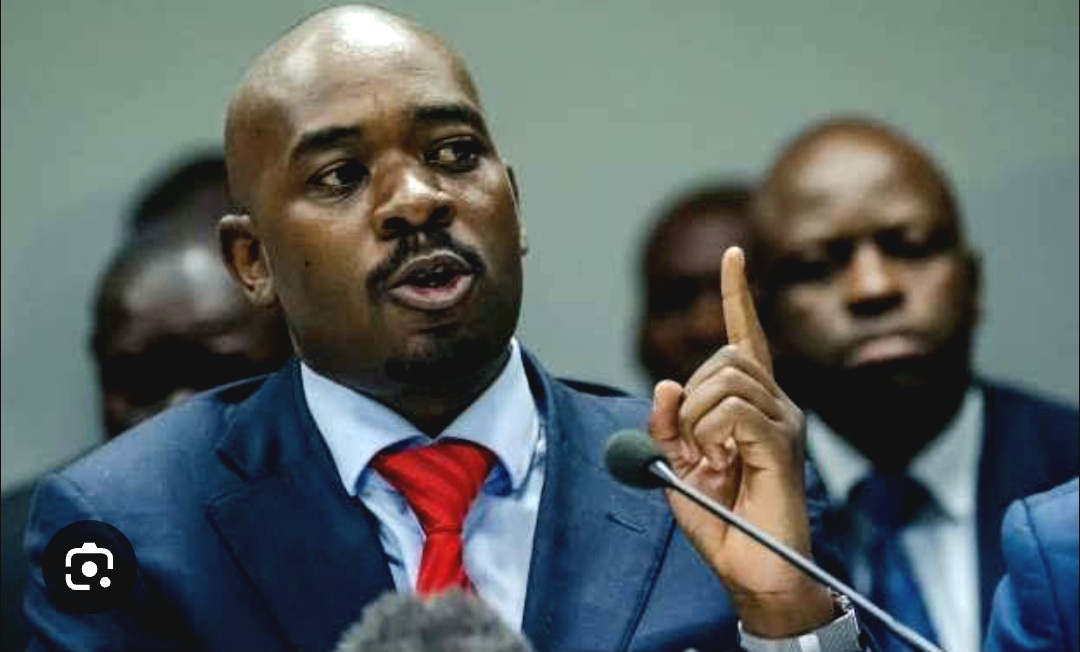
Former Citizens Coalition for Change (CCC) leader Nelson Chamisa has declared proposed constitutional amendments “unacceptable” and called for a national dialogue, a clear shift from his earlier assertion that Zimbabwe had “no constitution to defend.”
Posting on his social media platforms Tuesday, the former ICT Minister in the Government of National Unity (GNU) said the country was at a defining moment. He said:
“COMING TOGETHER..We are at a defining moment. Amending the Constitution , and worse, amending the will of the people ,is unacceptable. This is no time for luxury-time bickering . It is a time for crisis-time collaboration. We need a constitutional and political settlement that delivers real reforms and lasting prosperity for everyone . Only as one can we win the future. Zimbabwe is us. We, the citizens!
#AsOne #NationalConsensus #CitizensTogether”
The tone is markedly different from his previous messaging, where he framed Zimbabwe’s crisis primarily as one of legitimacy rather than law. At the time, he argued that debating constitutional amendments was secondary to addressing what he described as a leadership crisis, likening it to arguing over “changing the wheels” of a stolen car instead of reclaiming the vehicle itself.
With a Constitutional Amendment Bill now gazetted and awaiting tabling in Parliament, Chamisa appears to have repositioned himself as a defender of the 2013 Constitution.
What The Amendment Bill Seeks To Change
The proposed amendments are structural and far-reaching. Among the key provisions:
- Extending the presidential term from five to seven years
- Aligning the electoral calendar with the longer tenure
- Altering the method of electing the President
- Restructuring succession mechanisms
- Abolishing the Zimbabwe Gender Commission
- Abolishing the National Peace and Reconciliation Commission
One of the most contentious clauses would remove the direct popular vote for President and instead allow Members of Parliament to elect the Head of State.
Legal analysts argue this would fundamentally alter executive legitimacy and weaken the “one person, one vote” principle embedded in the current constitutional framework.
If passed together with transitional provisions, critics say the changes could potentially extend President Emmerson Mnangagwa’s tenure to 2030.
A Noticeable Shift In Tone
Chamisa’s latest statement marks a deliberate change in emphasis.
Previously, he suggested there was effectively no Constitution to defend, arguing that without credible leadership, constitutional debates were misplaced. That position drew criticism from some opposition figures, including Jealousy Mbizvo Mawarire, who accused him of abandoning constitutionalism as a rallying platform.
Now, by describing amendments as “amending the will of the people,” he is framing the Constitution itself as a democratic mandate under threat.
Supporters argue the shift reflects evolving political realities, that once amendments became concrete and imminent, resistance became unavoidable. Critics, however, view it as a recalibration aimed at reclaiming reformist ground.
Either way, the repositioning is unmistakable.
What Does He Mean By A “Constitutional And Political Settlement”?
Chamisa’s call for a “constitutional and political settlement” has sparked debate over whether he is proposing structured dialogue, or something deeper.
In Zimbabwe’s political history, a “political settlement” often refers to negotiated arrangements following disputed elections. The most notable example was the 2009 Government of National Unity involving Robert Mugabe, Morgan Tsvangirai, and Arthur Mutambara, which ultimately produced the 2013 Constitution.
Chamisa has not explicitly called for a new GNU. However, by invoking the language of “settlement,” he appears to be elevating the issue beyond a parliamentary vote.
The key question is whether he is advocating:
- A national indaba bringing together political parties, churches and civil society to agree on reforms;
- Electoral and institutional safeguards before the next general election;
- Or negotiations that could lead to a transitional or inclusive governance framework.
A constitutional settlement typically means agreement on the rules, elections, succession, checks and balances. A political settlement, however, can imply negotiated arrangements to stabilise a contested political environment.
By pairing the two, Chamisa who recently returned to active politics after a two-year sabbatical signals that, in his view, the crisis is both legal and political.
Parliament Or Negotiation?
The amendment process, if confined strictly to Parliament, will depend largely on numbers. The ruling ZANU PF party holds a commanding majority, meaning passage would hinge on party discipline rather than cross-party consensus.
But if the debate shifts into a broader national dialogue framework, it transforms from a legislative procedure into a political negotiation.
That distinction is critical.
By calling for collaboration and consensus, Chamisa appears to be testing whether constitutional reform can be addressed outside partisan arithmetic.
High Stakes For Zimbabwe
Zimbabwe’s 2013 Constitution was born out of compromise and national negotiation. It expanded rights, entrenched term limits and strengthened independent commissions.
Amending it, particularly on presidential tenure and mode of election, touches the core of executive legitimacy.
Chamisa’s latest intervention signals that he intends to engage directly in that battle. From previously downplaying constitutional defence, he is now placing it at the centre of his messaging while simultaneously calling for dialogue.
Whether this marks strategic maturation, political recalibration or renewed activism, one thing is clear: the constitutional amendment debate has become a defining political fault line.
And Chamisa has firmly chosen his side.
Leave a Reply